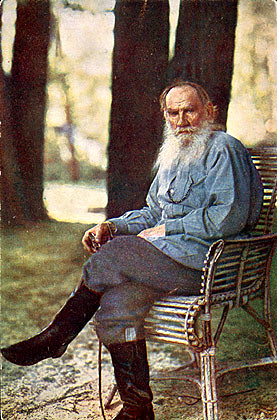
 When people found out I was reading War and Peace this summer the most common question posed was, “Is it worth it?” To which I generally shrugged, sighed and said, “Yes and no.” For those who love literature and are interested in the evolution and idea of the novel, then it probably should be read. But for most of us, with all the options of books, not to mention various entertainments and outdoor diversions available, the answer leans towards No, that it is not worth it and that life is too short to read War and Peace. You can lead a wonderful life without ever knowing the Rostovs or the Bolkonskys or even its pontificating author.
This is not to say that I feel War and Peace is a bad book per se. Tolstoy does some marvelous work dramatizing one of the most cataclysmic events in Russian history. (Who will dramatize the Russian Revolution? It seems incredible that no Russian novelist has tackled that event and transformed it into a literary epic.) Tolstoy demonstrates a thorough capacity for detail, describing the nuances of aristocratic manners and the gruff speech of common foot soldiers with persuasive savoir-faire. His characters are lively and unique and undergo profound changes, grappling with responsibilities of war and career, marriage, finances, births, and death-- in other words, life in all its glory and banality. As some critics have suggested, should the earth write a novel, it might sound like Tolstoy.
But the Earth is not perfect and neither is Tolstoy’s book for that matter. We can generally gauge the quality of a novel using three primary benchmarks: the story, the characters and the style. War and Peace suffers from many digressions into the lives of periphery characters but remains compelling due to its dramatic historical nature. The main characters, as I mentioned, are mostly sympathetic, their humanity drawn out beautifully. It’s difficult to discuss style since War and Peace is a translation (I had the Anthony Briggs edition) so while we cannot judge Tolstoy by his prose, we can nevertheless opine on his structuring of the novel and the general pool of language he has chosen to tell that story. It is here that Tolstoy astonishes me with his narrative miscalculations. The problem is the author inserting himself into the story to make declarative points that relate to his celebration of a divine force. The unfortunate consequence on the reader is having to bear the lecturing of a writer guilty of a god complex. Little is left for us to interpret on his or her own. Everything must be explained according to the way Tolstoy intended it. He violates the cardinal rule of storytelling: show, don’t tell.
In doing so, Tolstoy comes off as an insufferable dinner companion. He never hesitates to interrupt the narrative with long-winded discussions regarding the scientific basis for understanding history (an irritating device that has no place in a novel! None!) but literature, though an aesthetic branch of the arts, is understood by rules established between authors and their audience. Of course these rules are malleable (art being more lenient than science) but to disregard them is done at the writer’s peril.
As everyone knows, whether consciously or intrinsically, good storytelling makes for an irresistible yarn: the writer instills in the reader the need to know what happens. Napoleon’s invasion of Russia was an incredible event, changing the course of history. Historical narrative is drawn out in both micro and macro formats-- the lives of individual characters contrasted with the nation’s larger struggle. I found Tolstoy’s telling at the micro level engrossing. For example, on the eve of the French entering Moscow, during the collapse of public order Count Rostopchin’s justification for throwing a criminal (traitor) into the mad violence of a crowd is apropos of Tolstoy’s insight into human character, in this case, a politician’s:
“Since time began and men started killing each other, no man has ever committed such a crime against one of his fellows without comforting himself with the same idea. This idea is the ‘public good…’” (Vol. III, Part III, Ch. 25)
Could a historical novel involving George W. Bush’s faith in the Iraq War be written any different? In a thoughtful meditation on the wastefulness of armed conflict, Tolstoy, speaking through Andrei Bolkonsky in a midnight oil heart-to-heart with Pierre the night before the Battle of Borodino would destroy the young prince, suggests:
“If we didn’t have all this business of magnanimity in warfare, we would only ever go to war when there was something worth facing certain death for, as there is now.” (Vol. III, Part II, Ch. 25).
Here is Tolstoy at his very best, pensive and theoretical, but, importantly, expressing himself through his characters. His narrative problems come when he enters the scene, for example, carrying on about troop movements, particularly the fate of the French army making the catastrophic blunder of retreating on the Smolensk road, which had seen the land around it plundered and destroyed and so would not provide the needs for Napoleon’s massive army. Tolstoy wastes our time with endless dissections of this blunder, reveling in it, repeating it, and in the end, boring us with such eye-glazing assertions and unnecessary sarcasm:
“This was done by Napoleon, the man of genius. And yet to say that Napoleon destroyed his own army because he wanted to, or because he was a very stupid man, would be just as wrong as claiming that Napoleon got his troops to Moscow because he wanted to, and because he was a clever man and a great genius. In both cases his individual contribution, no stronger than the individual contribution of every common soldier, happened to coincide with the laws by which the event was being determined.” (Vol. IV, Part II, Ch. 8)
This paragraph propels two important theories of Tolstoy’s. First, that historians put too much weight on single individuals (personalities) guiding history-- in doing so, they fail to cite the billions of contingencies that determine world events (which are God’s doing). Secondly, it’s another opportunity for Tolstoy to criticize Napoleon. Sometimes it feels he wrote the book for the purpose of excoriating Napoleon to a general reading public. Throughout the novel but especially in the epilogue, Tolstoy goes out of his way to downplay his achievements, arguing that Napoleon was simply an egotistical, arrogant opportunist at the right place and the right time.
This is the book’s greatest failure: not his antipathy for Napoleon-- Tolstoy is entitled to his likes and dislikes-- but that his arguments overwhelm the storytelling in pompous cant. According to biographers, Tolstoy turned to literature as a young writer after being disenchanted with history. In his second epilogue, he spends more than 40 pages (in technical, colorless, dull language) disparaging the work of historians on the premise that they are unable to differentiate the actions on mankind, whether it be free will or motivations built from necessity. What he seems to suggest, dramatically in Napoleon’s retreat and the marriages of Pierre and Natasha and Nikolay and Marie is that they were predestined by a supernatural force. It was all meant to be:
“And just as the indefinable essence of the force that moves the heavenly bodies, the indefinable essence that drives heat, electricity, chemical affinity or the life force, forms the content of astronomy, physics, chemistry, botany, zoology and so on, the essence of the force of free will forms the subject matter of history.” (Epilogue, Part II, Ch. 10).
A decade before Tolstoy composed his thoughts on this subject, Charles Darwin had published his Origin of Species, whose arguments of evolution refute Biblical infallibility. Probably, its evidence threatened Tolstoy’s vision of the world. Obliquely referencing Darwin’s thesis, he argues that,
“in the frog, the rabbit and the monkey we can observe nothing but muscular and nervous activity, whereas in man we have muscular and nervous activity plus consciousness.” (Epilogue, Part II, Ch. 8)
But this confuses me. What is the importance of consciousness if everything is divinely predetermined? Is it so we can recognize and celebrate God? And why are we even getting into this? On abstract terms rather than through the prism of the characters’ actions or dreams? Imagine John Steinbeck ending The Grapes of Wrath not with that lovely and tragic scene of the Joads’ pregnant daughter sharing her breast milk with an emaciated stranger but the novelist spending thirty pages examining the causal effects of the Great Depression and the merits of the New Deal. I’d love to read Steinbeck’s views on politics, but preferably in a chapbook or a magazine interview format.
In the epilogue Tolstoy ignores the Rostovs and Bolkonskys, only bothering to mention Napoleon (for one last drubbing) in his final descent into didacticism. Beyond whether or not Tolstoy is persuasive in his argument is besides the point. The best storytelling weaves philosophy into its narrative without resorting to pedantic posturing. I found Tolstoy’s voice irritating, his arguments confusing, his language obfuscating. Not to mention hypocritical. After lambasting historians for telling us how to interpret events, he goes and instructs us himself. The nerve of great minds!


