In the 18th and 19th centuries, so little was known of the Nile and its source that one of the most trusted authorities continued to be Herodotus, the great Greek historian, whose writings on the subject were more than 2,300 years old. Maps of the African interior were topographically blank, leaving one to conjecture that the Dark Continent was one vast void where one descended into Hades, which it might as well have been, as leaving the coast one would have to contend with malarial fever, savage tribes, and wild beasts. Only the most ingenious and intrepid explorers could hope to survive such expeditions. A contemporary history of its survey, Alan Moorehead’s excellent The Blue Nile, is not so much about the travails of these curious eccentrics as it is about the engagement of major military expeditions into Egypt, the Sudan and Ethiopia, in which scientific learning was not always as valuable as the procurement of gold, ivory, and slaves.

Moorehead’s history begins with James Bruce, a Scottish aristocrat-turned-adventurer, who convinced that the Nile’s source was in Lake Tana in the Ethiopian Highlands, sets out to prove his claim. Bruce’s résumé was not atypical of the age’s explorer, for “he studied Arabic manuscripts in the Escorial in Spain, he sailed down the Rhine, he fought a duel in Brussels, he made drawings of ruins in Italy,” and eventually he was posted as a British consul in Algiers among the Barbary pirates. Having accumulated experience and confidence among ruffians and scoundrels, he attempts crossing into Ethiopia via the Red Sea Route with his secretary, Luigi Balugani, successfully entering the kingdom of Gondar, where with a great demonstration of élan, he makes courteous acquaintance with the royalty there. Disgusted by the behavior of the court, where raw meat was devoured and licentiousness carried out in the open (“…and if we may judge by sound, they seem to think it as great a shame to make love in silence as to eat.”), Bruce nevertheless managed to mark what he believed to be the source of the Nile at Ghish Mountain. Bruce’s ecstatic reaction deserves to be quoted in full:
“Faithful squire! Come and triumph with your Don Quixote, at that island of Barataria where we have most wisely and fortunately brought ourselves! Come, and triumph with me over all the kings of the earth, all their armies, all their philosophers, and all their heroes!”
Unfortunately for Bruce, he had not been the first European at this spot, some missionaries having passed this way before. Moreover, this was not even the true source of the Nile, which lay 1,000 miles away at Lake Victoria (coming down via Khartoum in the Sudan and witnessing the appearance of the White Nile where the two rivers join had to have been heartbreaking for the explorer). Bruce’s journey back to civilization took some years and when he finally published his findings, he was ridiculed on-end for his anthropological observations. So much so that a new edition of Baron Munchhausen was dedicated to James Bruce. In spite of the bad press, Bruce’s geographical findings were more or less accurate and would make an enormous contribution to the coming military campaigns, beginning with Napoleon in 1798.

Napoleon, only 28 at the time, and coming off a string of successes in Italy where he had made his name humbling the Hapsburg empire, believed that if he could cut a route through the Suez isthmus, he would give France immediate access to the Red Sea, thus creating a short cut to India, the crown jewel of the British colonies (the British at this time were committed to the Cape of Good Hope as passage). As a learned man, Napoleon’s interest was not restricted to conquest but to the arts and sciences as well, and could count on this military expedition a staff of engineers, geologists, mathematicians, chemists, zoologists, astronomers, geographers, mineralogists, archaeologists, arabists, poets, and painters.
Bonaparte, intent on winning the loyalty of the Egyptian fellaheen then under the autocratic thumb of the Mameluke caste (paying nominal tribute to the Ottoman Empire and who at this stage had succumbed to decadent decline), gave strict orders to his soldiers that mosques and Muslim priests were to be regarded as sacrosanct and that women and private property were to be respected.
Not dissimilar to the more famous janissaries of the Ottoman court, the Mamelukes were purchased children from the Caucuses who were taught Islam and the arts of war. They ruled Egypt with a fierce militaristic ethic, hoarding the resources and wealth so they could live in opulence. The indigenous Egyptians and various minorities endured their rule the best they could, via passive aggressive resistance, avoiding any civic commitment whatsoever. It was a comfortable arrangement, centuries in the making. Napoleon’s calls for equality, fraternity, and liberty would later prove baffling to a people more familiar with the strong arm.
Bonaparte managed to evade Admiral Nelson’s frigates in the Mediterranean, successfully landing near Alexandria and easily taking the city, commenced his divisions on the long march across the desert to Cairo. After three days they reached the Nile. Upon arrival, the soldiers suffering from the appalling summer heat in their blue serge uniforms threw themselves into the river without bothering to remove their clothes. On the far side of the bank waited the Mameluke army, led by a hothead named Murad, oblivious to the anachronisms of his military strategy.
A turning point in history, now, east meeting west upon a battlefield dormant for centuries. The Mamelukes were certainly brave horsemen, but in spite of the best efforts of their headlong cavalry charges, they were easily slaughtered by rifle-fire and cannonballs. Technology, rather than courage, had decided the outcome. More a massacre than an actual battle, the shootout was a harbinger of 19th century colonial warfare.

A Mameluke charge painted by Goya
From there it was easy progress for Napoleon and his forces to take Cairo and thus, Egypt. In the spirit of his enthusiasm, he pronounced that though he was a Catholic in France, he would be a Mohammedan in Egypt. Dressing like a robed pasha and eating with his fingers, he hosted dinner parties for the imams and those warriors acquiescing to French rule, the attendees of various banquets receiving both the Koran and Thomas Paine’s The Rights of Man translated into the vernacular Arabic.

The romance of oriental conquest for this latter-day Caesar did not last long. Nelson’s frigates sank the French fleet at Alexandria, stranding Napoleon and his forces in Egypt. If worrying over his annihilated navy wasn’t enough, the fellaheen rebellion against the French efficiency for collecting taxes consequenced in violent crackdowns. Equality? Fraternity? Liberty? So they said but what they had really created was a bureaucracy enforced by military law. Napoleon began having trouble with his own troops, grown fractious from the tedium of a conservative desert society and Napoleon’s request to the Directory in Paris for replenishments reads like a sumptuous bachelor’s party: “a company of comedians, a troupe of ballet dancers, a marionette show, a hundred prostitutes, two hundred thousand pints of brandy and a million of wine.”
Marooned as they were, Napoleon assigned his best lieutenant, General Desaix, to finish the last of the Mamelukes, now led by Murad and committed to a kind of guerilla warfare down the Nile River Valley. Accompanying this expedition was Vivant Denon, an all-around aesthete and archaeologist. Moorehead, always astute on gathering the more profound observations, artfully chooses to follow Denon on this journey even with regards to battle (the artiste described the skirmishes as a clash of “northern austerity with eastern pomp: iron seemed to be trying its strength with gold; the plain glittered, the spectacle was admirable.”)
Let’s pretend we are sailing the Nile towards Upper Egypt with Denon and the French forces. Suffering attacks from both the Mamelukes and Bedouin scavengers, it was hardly the idyllic trip it is today but then again it must have been stunning for a man of Denon’s learning to be visiting these ancient, revered, mythical monuments at Luxor, Philae, Karnak, and Dendera, awestruck among the first Westerns seeing these fantastic but crumbling temples, tombs, and obelisks for the first time in a thousand years. What might it have suggested to a Frenchman whose own nation and thus civilization was reaching its own apex? Denon was spellbound and much harried trying to record what he saw in drawings, often dodging spears and arrows, assailed by troglodytes squatting in the mausoleums (“this was a war with gnomes.”). General Desaix was able to pacify the region but the French lasted just three years in Egypt. Nevertheless, Egypt was no longer a forgotten land but a very strategic piece of real estate in geopolitical wrangling.
In the power vacuum of their hasty departure, emerged the original Muhammad Ali, a Turk from humble origins whose chief tools were cunning, sadism, and a force of cutthroat Albanian bodyguards. Unlike the Mamelukes, he desired to modernize Egypt as well as to utilize Western technology to mine whatever materials were available, particularly gold. The third section of The Blue Nile deals with his brutal reign and the various explorers, adventurers, and tourists now coming down to visit the ruins.
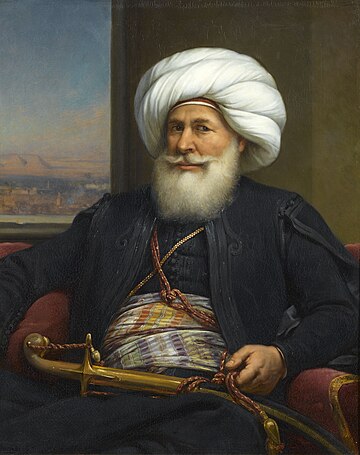
Muhammad Ali
What Ali wanted for his court was slaves and gold and sent a military expedition towards the Sudan to claim it. In 1820 when the invasion commenced, the Sudan was as backwater as any place on earth: “nothing was built, every activity was delayed, and the villages turned listlessly in upon themselves…” This was pagan Africa, a frontier between the Islamic desert of Egypt and Christian highlands of Ethiopia. If there was a power in the region it was the Shaiqiya, a Muslim cavalry caste of adroit warriors similar to the Mamelukes in both horsemanship and passé fighting tactics. The battle, though hopeless, deserves to be described for all its raucous pomp:
“A young girl mounted on a gorgeously caparisoned camel, gave the Shaiqiya the signal to attack—that warbling cry, lilli-lilli-loo— and a horde of unarmed peasants came running down on the Turks in a cloud of dust. They had been assured by a religious fanatic that bullets could not kill true believers…behind came the Shaiqiya cavalry, accompanied by a roll of drums and uttering their sardonic war-cry Salaam Aleikoum as they charged… the Turks took to their guns and pistols.”
After the battle, ears were collected from the living and the dead, as Ali had offered a small bounty for them.
As horrible as the campaign would prove to be it made the Nile safer and some Europeans decided to include the Nile experience in the Grand Tour. Those who visited published, and those who read were entertained to tales of temples, animals, savages, concubines, and treasure buried in the sand. That a “sophisticated past was overwhelmed by the primitive present” illuminated the adventure in a profound context. But great care had to be spent on the undertaking as this fascinating inventory of the big game hunter-turned-explorer Samuel Baker testifies: “a large umbrella with a double lining, a quart syringe for injecting brine into meat, sticks of Indian ink that can be ‘rubbed up in a few moments to write up the notebook during the march’, tinted writing paper, burning glasses and flint and steel, quicksilver and lead for making bullets.”
The final section of The Blue Nile deals with the mad Emperor Theodore of Ethiopia who puts several British envoys and missionaries in chains upon deciding that the Empire is conspiring against him. By now it is 1867 and John Speke has confirmed that Lake Victoria is the source of the Nile and in Egypt construction of the Suez Canal is underway. Rescuing several dozen Europeans was not a priority with England when it was very much involved in so many global affairs, but in order to save face, they sent a major expedition to rescue the hostages. The situation was indeed delicate as Theodore had a habit of having prisoners thrust off a precipice.
The arrival of the British in Africa was indeed the culmination of the taming of the Blue Nile. It marked the arrival of major technology in the region as the British employed a remarkable exercise in logistics (the commander, General Napier, had begun his career as an engineer). Napier had to move 32,000 men (only 13,000 of whom were soldiers, 9000 of them Hindus, Muslims, and Sikhs conscripted from India, Persia and Egypt) as well as 55,000 animals from the coast at Zuba to Magdala in the mountains, where the prisoners were being kept. To make it happen, a port with pier and tramway was constructed. A railway with locomotive came next and inevitably a native bazaar. In the march itself, engineers composed the vanguard, ensuring that the crossing would be safe for the forty-four trained elephants sent from India to carry the heavy guns. Even the banks in Vienna were solicited, as the only European currency accepted in the region was that of the Maria Theresa dollar, the one minted in 1780 showing a “profusion of bust.” Because the expedition was so religiously diverse, great sensitivity was taken in culinary matters so that 50,000 tons each of salt and pork were inventoried (as well as 30,000 gallons of rum). Discipline was strict regarding propriety: “No swarthy damsel was subjected to any rude gallantry on the part of the redcoats.” Such the 19th century globalization column appeared:
“The cavalry came first, the troopers dressed in crimson caps and green uniforms, and the officers with silver helmets on their heads. Among the infantry that followed on, many of the white men in the Irish regiment wore beards, their cheeks burned a deep brown by the Indian sun, and the native soldiers, the Beloochees, marched along in green tunics with red facings and with large green turbans wound round their fezzes.”

This is a story in logistics rather than in war and the battle was somewhat anticlimactic, if a little tragic as will happen when technology is so mismatched. Suffice it to say, the Battle at Magdala ended Ethiopia’s isolation forever and would be now engaged in contemporary politics and its characteristic swindling. The history of Africa is a brief one as far as written records go and reads like an awakening. It is rude, but it is also at times comic and poetic. That might be Moorehead's strength as a historian: he tells a good story, one so vivid and anecdotal, it inspires readers into engaging flights of fantasy that make Africa, in spite of all the detailed hardships, worth the while so that the reader not only commiserates with the British wayfarer wandering under an assumed name such as Sheikh Ibrahim ibn Abdullah (as the explorer, Burckhardt, does), he wants to be him too, warts and all, sailing up the Nile, notebook hidden within one's jellaba.
In spite of the inevitability of history detailed in this book, when technology competes with superstition, more often than not it fails. This is generally true in Africa at least. The efficiency of machines just cannot compete with the wonders of the mystical. Beyond Aswan and the cataracts that make journeying by boat difficult, life on the Nile has yet to be revolutionized by the digital byte or even a Big Mac bite. Part of it is politics and violence, part of it is the brutality of the climate and part of it is that some people hold fast in their ways. Thus traveling in some regions in the Sudan and Ethiopia remain nearly as exotic today as they were two hundred years ago. And anyone going there today is considered as much an adventurer as they were in Victorian times. The risk lingers. As does the sense of drama.


