Monday, October 26, 2009

Getting Along


In mid-summer, 1941, following the Nazi incursion into the Soviet Union, German soldiers entered the small Ukrainian town of Jedwabne. Instead of resistance, they were welcomed by the local Christian community. Once they met with town authorities, the Nazis had no trouble organizing local mobs to engage in a bloody pogrom slaughtering various people of Jewish descent: old men, young mothers, newborn babies, many of them incinerated in the barn of the town baker. What was most remarkable about this was not just that half the town’s male population was involved in the carnage but that until the chaos engendered by the Nazi invasion, the town had enjoyed peaceful religious heterodoxy.

This gruesome account is one of dozens of such episodes described (often referenced in detailed first person accounts) in Niall Ferguson’s The War of the World. It is an ambitious work that attempts to explain the violence of the 20th century, the cataclysms of which led to the decline of the West in military, economic, and moral terms. Regarding the causes of violence itself, he cites economic volatility, ethnic conflict, and the nationalism that spurred the decline of the great royal empires of the 19th century.


Ferguson finds it ironic that in a time of so much progress— not only scientific and technological but artistic and liberal as well— that the century, particularly the first half, should be defined by violence so wretched and thorough, it defies contemplation. Technology, of course, made genocide more systematic and quicker (the huge numbers of casualties listed repeatedly chillingly recall the words of a prominent mass murderer, Josef Stalin, “One death is a tragedy; one million is a statistic.”)

Throughout most of history, ethnic conflict was often a contest of land, food, wealth, and resources, vied for by peoples of unique language, culture and customs. But the beginning of the 20th century saw the popularization of eugenics adopted by megalomaniacs and fanatics, who would argue that not only color and physiognomy, but also intelligence, aptitude, character, and even morals were hereditary, rather than environmentally influenced. Thus miscegenation, or racial interbreeding, would dilute the genetic quality of superior races. It was this ability to create a hierarchy of “good” and “bad” that enabled normal, young, perhaps intelligent men to commit atrocities. If the “enemy” is so dehumanized, then it is no different than slaughtering swine or poultry, or as the Hutus called the Tutsi, “cockroaches.”

What fascinates Ferguson about the Nazis is that the war and genocide were carried out by highly educated people in the most industrialized state of Europe under the dictates of a government elected by primarily democratic means. The extermination of the Jews, in particular, utilized the genius of German science and logistics, and the examples Ferguson cites are psychopathic:

- A PhD thesis from Breslau University, titled, “On the Possibilities of Recycling Gold From the Mouths of the Dead.”

- Fares charged by German state railway for transporting Jews to extermination camps were half price for children and discounted for groups of 400 or more.

- Victims of gas chambers had their screams drowned out by songs mocking their execution, like, "Highlander, Have You No Regrets?

The man responsible for human experiments at Auschwitz, Josef Mengele, had doctorates in medicine and anthropology. How could highly educated men running this extraordinary killing machine not know better? Was it conviction in Hitler’s racial war, peer pressure, or were they simply “following orders” like Eichmann, the logistical mastermind of the Holocaust? This commitment of a professional, educated class to the wholesale destruction of a certain ethnic group is both astonishing and frightening. The Nazis were very modern in the engineering of their philosophy— the radicalization of these professional classes is one of the great enigmas of the Second World War.

Nazi Propaganda Poster Painting the U.S. as Some Strange Robot Monster

This hatred of the other was notably inorganic, specifically a product of state propaganda, yet accepted by majorities of the public as fact. This was true in Imperial Japan as well, which fought a war of aggression in Asia that was racially motivated and thus comparably violent. What is commendable in Ferguson’s approach as a historian is that as much as he finds the Nazis’ behavior reprehensible, he demonstrates that although the plans for a “final solution” were beyond contempt, their methods of constructing a monstrous, bestial enemy were not unique. The so-called victors of the war, the Americans and British, utilized caricature in order to demonize the enemy and mobilize popular support for a conflict in which the Allies adopted the practice of Total War.
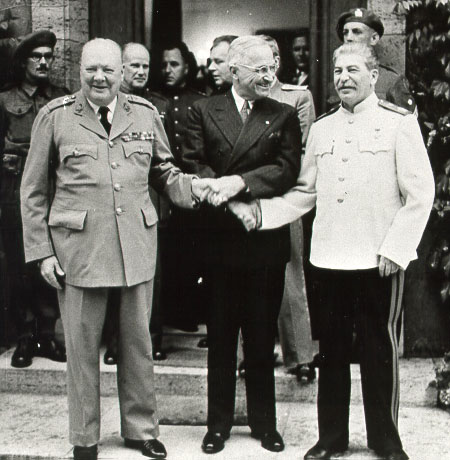
The Big 3 at Potsdam

Many historians (and pundits especially) call WWII a “good war,” (oxymoronic, anyone?) fought valiantly by the “greatest generation.” I suppose they see it as such because the Korean and Vietnam wars were fought on ideological grounds rather than against a demonstrably evil, dangerous, and threatening regime. There is no question that Hitler needed to be stopped. That is not debatable. But how much did we need the “means” in order to secure the “end?” Total War meant beating the Nazis at their own game, the slaughtering of civilians. In order to push through victory, cities like Hamburg, Dresden, and Tokyo could be justifiably firebombed and Hiroshima and Nagasaki could be rationally atomized. Ferguson does not suggest there was a moral equivalence between Auschwitz and Hiroshima as the former was meticulous slaughter as a goal of war while the latter, an indiscriminate mass killing in order to end the war. Some justified the bombing as payback. Others saw it as a demonstration of Machiavellian terror that would demoralize support for the regimes. Whatever it was, it resulted in the deaths of millions of civilians, people who had been dehumanized to the point where they were just meaningless statistics obliterated for the sake of victory guaranteed to the “good guys.”

Dresden, 1945

Ferguson makes an interesting contestation about who really won the Second World War, as the map of Europe was redrawn at the end of the conflict to one nation’s titanic advantage: the Soviet Union, who draped their infamous Iron Curtain over the Eastern Bloc from the Baltics to the Balkans, as well as instituting rigid control over East Germany, Poland, Hungary, Czechoslovakia, Romania, and Albania, the so-called Soviet satellites, thus replacing the totalitarianism of one government with another. But Britain refused to take a stand against Soviet imperialism, as it had gone to war to protect Poland from Germany, not Russia, so that its loss of sovereignty was regrettable but not in its best interests.

Did Churchill and his Allies thus regret their collaboration with the Soviets? It’s clear that this had been a Faustian bargain struck under conditions of extreme duress but a deal with the devil nonetheless. Without American supplies, i.e. rations, radios, tanks, and bullets and British intelligence, the Eastern Front would have seen a lot more attrition; had armies been bogged down there, perhaps the British and Americans might have liberated Eastern Europe. As it happened, with aid and logistical support, the Soviets prevailed and in their march through Germany into Berlin, looted, raped, and murdered civilians with unrelieved brutality. Once the German government capitulated, the British returned more than a million POWs to the Soviet Union, aware that these men would be either executed or sentenced to hard labor in Siberia.

The unconditional access to resources offered Stalin and the ingenuous faith that he would be accommodating in postwar development had not been the only flaw in Allied strategy. Much has been rightly criticized of Churchill for his idea of situational democracy. Believing that the Poles had the right for self-determination, but not Malays, Kenyans, or Indians is hypocritical, if not racist. The dismantling of English, French, and Portuguese empires and the kind of governments they would be allowed to have would mean a perpetuation of war, but in different theaters.

Ferguson’s primary research focuses on the great wars and the causes leading up to them. One of his principle arguments rails against the traditionally accepted length of the World Wars, arguing that the sloppy configuration of borders at Versailles meant that there had been no true peace so much as truce (and that in the dismemberment of empires, nationalism had taken an ethnic character leading to massive violence not just in the former Hapsburg empire but in the Ottoman disintegration as well). He also makes it clear that though the Cold War was ostensibly peaceful to the superpowers, the period of decolonization saw massive violence in the Third World, wars (famously Vietnam but all over) fought by proxy armies between the U.S. and U.S.S.R. And again the Americans are criticized for taking a morally ambivalent stand, proclaiming the language of peace and democracy, while suppressing democratically elected governments sympathetic to the Soviets or anti-capitalist in general. Thus their backing of infamous strongmen like Saddam, Suharto, and Marcos to protect American interests (“It doesn’t matter if he’s a sonofabitch, so long as he’s our sonofabitch.”).

And with the end of the Cold War what shall we look forward to in the new century? Ferguson’s critique on nations, ethnicity, and war ends with a caveat against Islamic fundamentalism. Curiously, Ferguson laments the declining birth rate of Europe, arguing that it will be impossible to support entitlement programs like health care and pensions without an influx of immigrants, and the likely source of this labor will come from North Africa, where the birth rate is significantly higher. Reminding us of the recent bombings in Madrid and London, Ferguson warns the contemporary citizen:

“A hundred years ago, globalization was celebrated in not dissimilar ways as goods, capital, and labor flowed freely from England to the ends of the earth. Yet mass migration in around 1900 was accompanied by increases in ethnic tension…with ultimately explosive consequences. In 1914 the first age of globalization ended with a spectacular bang because of an act of terror…”

Ferguson goes on to say that civilization, even the most well integrated ones sharing language, faith and even genes, can collapse, particularly during economic volatility. But in order to protect ourselves, what are we willing to give up? What moral values do we cede in order to be safe? How far do we rely on government and state sanctioned violence to protect us before we stop being the victim and start being the terrorist?

What the Jew, the Communist, the Nazi, the Islamist and the terrorist all seem to have in common is the specter of the Boogeyman. This is the default setting which governments and media utilize in order to rally patriotism, whether the system is democratic or totalitarian. What this regrettably leads to is simple: the dismantling of basic civil and human rights. In Germany, this meant the Holocaust. In George Bush’s America, this has meant Guantanamo Bay. Of course, what the Nazis did was much worse, but that’s not the point— the conception of the modern “terrorist” is male, Islamic, bearded. This association has already been deeply drawn by the wars and crises over the last decade so that the Muslim is shrouded in Boogeyman terror—just last week over a third of Americans polled favor a ground invasion of Iran. This is the self-destructive nature of our terror: that in our fear of the other, we debase the physical humanity of our enemy, impoverishing our own spiritual humanity.

There is no winning or losing a war, there is only loss.

Sunday, October 25, 2009

Moonlighting

A casual examination of this blog would quickly reveal a dereliction of duty, as nothing has been posted, explained, rhapsodized, loved, or praised since mid-June more than four months past. This suggests, I suppose, multiple conclusions, as it may indicate either slothfulness or vivaciousness-- I will take credit for both. No doubt there has often been something more important to do, just as there has been much acquiescence to the pleasures of reading, traveling, and social visits. I have spent a great many evenings with nothing much to be proud of, simply one day older and worrying about the unrealized life.

Anyways, maybe there have been some lost opportunities; I have read a great many books that are consumed, digested, and forgotten like some terrific meal, whose taste I will forget if I don’t jot down the distinguishing characteristics of its fine flavor. So I’d like to try to use this forum more often, perhaps to review or discuss literature and history, even cinema, if only to provoke questions that lead not necessarily to concrete answers, but to even more interesting questions. So great attempts will be made, but with life accelerating in all its pleasures and obligations, I am capable of no promises, only hope.

Tuesday, June 16, 2009

Chatting With Your Ferns About Love and Weather

There sleeps Titania sometime of the night,
Lull'd in these flowers with dances and delight.
(Shakespeare)


In the southern state of India's Tamil Nadu, an enormous banyan tree in a dry, dusty plain had been the original inspiration for the experimental city that has become Auroville. A large meditation center was built nearby and all roads in Auroville generally run to this tree, heart and soul of a utopian village populated by eco-conscious foreigners and likeminded Indians. A no-noise zone, the shade under the canopy is a pleasant place to gather, rest, and contemplate. It's not unusual to see the banyan's trunk embraced by visitors, literal 'tree huggers,' whose state of grace smiles seem to suggest they are being hugged back. And perhaps, as I later learned, they are.

I recently watched a 1970s documentary called, "Journey to the Secret Life of Plants," one of the weirdest psychedelic movies ever made, the apogee of the flower-power movement (pun intended). Its soundtrack was arranged by Stevie Wonder who appears briefly in the movie in an incandescent dreamcoat traipsing through a similarly effulgent landscape. Star power, sure, but the real interest here is the idea of plant life having a higher consciousness.

This idea is not at all novel. For centuries, Hindus have believed in the unity of life. Man can witness his spiritual flowering reflected in flora, understanding the elements of the human body as being one with the "infinite cycle of creation." This belief in the unity of existence is reaffirmed through chanting of Vedic hymns (at this point, those familiar with the inequities in India's social caste would likely reference Mark Twain's famous assessment, "In India, all life is sacred, except human life.")

One could convincingly argue that Christianity makes the same argument, as in funereal rites: "Dust thou art, and unto dust thou shalt return."

This complementary relationship between man and flowers was for centuries founded upon faith. In recent years however, we have learned that the cognizance of the green world is more alert than we could have ever guessed. In 1960s San Diego, California, an inquisitive member of law enforcement, Cleave Baxter, decided one night to investigate what would happen when he attached a polygraph's sensors to his house plant. His intention was to record the plant's nervousness if he were to approach it in the most threatening manner: with fire. A non-smoker, the administrator would have to retrieve some matches from his secretary's desk. However, the moment he consciously decided to burn the leaf, Baxter noticed the polygraph needle jerk violently. The plant, it seems, read his mind and reacted fearfully. Baxter, a no-nonsense all-American empiricist, was sold.

More experiments followed. For example, a timer drops a thimble of salt water into a plant's soil, leading to flustered needle marks on the polygraph paper. Analysis of numerous tests confirm his hypothesis. Explaining in his own words, the clean cut officer sounds not too different from a Hindu Brahmin: "even on the lower levels of life there's a profound consciousness that binds all things together."

Some progressive scientists have attempted to build on this discovery with fascinating results. In one such test, a man was connected with a plant to the same polygraph machine. He was shown a movie with various scenes designed to elicit strong emotions at selected intervals. The man became excited when viewing a sensuous breast and then despaired at archival footage of nuclear testing in the Nevada desert. The plant responded correspondingly.

(What does this say about those people who can't seem to take care of plants, for whom flora becomes wilting petals, browning leaves, crackling textures? Can we read into a man's state of emotions through the state of his succulents?)

A team of scientists and engineers was able to build an interactive greenhouse in which machinery translated the energy emanating from plants into sound; visitors to the greenhouse exploring the botanical garden affected the mood of the plants so that the "music" emanating from the speakers modulated according to the interaction between the two distinct species of life, a conversation, or a "live concert," if you will.

Similarly, engineers in Japan created a computer capable of transforming the electrical output of plants into modulated sounds. At a temple in Kyoto, the president of Fuji Electronics and his kimono-clad wife demonstrate to a group of journalists how the machine enables one to communicate with a cactus. The wife attempts to teach it the Japanese alphabet; it murmurs back to her an approximate sound (but does not titter in response to her own nervous giggling).

Even the scientists in 1970s Soviet Russia became involved in testing though their methods were a bit more torturous. For example, a scientist blows tobacco smoke on a plant to test its irritability (he seems to enjoy peeving the plant). The sentience of a cabbage plant is then tested. A scientist slices through a distinct cabbage causing the unharmed plant to register alarm. That fits accordingly with the tests from San Diego. But what is especially interesting is that when the same scientist wielding the sharp knife enters the laboratory room two hours later (sans knife), the cabbage plant becomes agitated once more.

Wow. So plants can not only read our thoughts but they may very well have memory as well... what are the philosophical implications of these conclusions, particularly for vegetarians whose diet is a protest against the cruelty of meat-eating? What might carrots, cauliflower, and zucchini feel about being boiled, steamed, sliced? The agony of the silent scream (and the end of the riddle of regarding a tree falling in the forest... if the surrounding trees are perceptive to its collapse then it certainly makes a sound, doesn't it?)

Roald Dahl, that visionary genius of fiction, has a story dated from 1953 called "The Sound Machine" in which an inventor has created a means in order to record low and high-pitched noises inaudible to the human ear. His next door neighbor, Mrs. Saunders, is creating a cacophony of howling agony with her gardening. Confronting her, he asks pointedly, "How do you know that a rose bush doesn't feel as much pain when someone cuts its stem in two as you would feel if someone cut your wrist off with a garden shears? How do you know that? It's alive, isn't it?"

The inventor takes the machine and its earphones to a tree and hacks at it with an ax: "a harsh, noteless, enormous noise, a growling, low-pitched, screaming sound... drawn out like a sob..." He feels terrible about the wound he's gashed and contemplates the horrors of agriculture: "He thought immediately of a field of wheat standing up straight and yellow and alive, with the mower going through it, cutting the stems... Oh, my God, what would that noise be like? Five hundred wheat plants screaming together... no, he thought, I do not want to go to a wheat field with my machine. I would never eat bread after that. But what about potatoes and cabbages and carrots and onions?" (The story ends with the inventor insisting that his doctor friend rub iodine on the tree's laceration.)

The idea of interconnectedness explicit in this film reminds me of the water crystal experiments of Masaru Emoto. Emoto believes that words not only give form to powerful feelings but have vibrations that affect our everyday invisible world as well. Projections of appreciation and anger are written on test tubes of water, left aside, frozen, and when the ice is melting, there is a two-minute window in which to photograph the consequences language has on the crystals. His findings, taken at face value, are fantastic.

For example, this crystal was formed from the word "happiness:"


And this one, conversely, from the word, "despair:"


Significantly different, right? Similarly, this crystal was viewed from "good job:"


And this one from, "You did it wrong!"


Emoto assumes that because humans are composed 70% of water, it's natural to conclude that our wavelengths, whether positive or negative, are projected and assimilated towards those around us. In a somewhat related experiment, Emoto photographed Tokyo tap water which looked distinctly unhealthy, contaminated as it was by chemicals. He then had five hundred people pray for its health. Following this consensus of hope, there had been a detectable change in the crystal makeup.

One can criticize Emoto for being selective about which crystals are photographed and that scientifically, his methods could be considered spurious. But if you want to examine the argument from dissenters closely, they seem to suggest that our thoughts, feelings, and ruminations have absolutely no effect on our environment.

Does this not seem as outlandish as the discoveries of Emoto and Baxter?

It's not just a crisis in imagination on their part, but an indifference to the metaphysical. You don't have to be a hippie to be excited by the vitality of the living world, its chatter and its music.

So do not forget to wish your flowers, "Good morning," when you are watering them. It might make a difference...


Tuesday, June 9, 2009

You Can Lead A Camel to Water, But...


"Can you teach a camel to dance?"  booms the hoity-toity voice of the English-speaking emcee on the crackling public address system. Instead of answering his question, he continues, digressively, "What you see will remain vivid in your late years." Drummers rattle bombastically and a camel gallops onto the main stage, its head swung back so that its neckline is exposed sunward, the animal staggering forwards and backwards not dancing so much as appearing to be in dire need of urination. "Bravo, what a clever beast," gapes the emcee, rhapsodic.

The city of Bikaner has always played second fiddle to its beautiful sister, Jaisalmer. Both cities are in Rajasthan, set squarely on the edge of the Thar Desert, the southern frontier between India and Pakistan, but Bikaner is never included in fly-by-night tourist itineraries: Jaisalmer is the chosen desert dream locale. Perhaps one could fault the city planning of Bikaner, which beyond the claustrophobic alleys of the Old City, is too spread out, too suburban, too dull while the fort in Jaisalmer is an inhabited relic; a few thousand people still live there, mostly Brahmin families, connecting a contemporary intimacy with a mythologized past, a sense of wonder that feels quite remote while dodging the busy buzz of Bikaner's traffic. But for three days a year, Bikaner is queen of the desert during its annual camel festival.

The city holds the first day of the festival at a stadium named for a famous local son, an Olympic clay pigeon marksman. The groundskeepers have set up three sections of plastic chairs, one for the Indians, one for the tourists and one for press. Unsurprisingly, organization spirals quickly out of control and within the first hour of the show, nearly everyone has wandered past the police line onto the field itself for a closer look.

"Look at the shine! Look at the raiment of the Pied Pipers!" When the emcee mentions Pied Pipers I immediately think of mice at the nearby Rat Temple at Deshnok but he wants to draw attention to a battery of musicians—horns, reeds, drums, bagpipes—leading the cavalcade. "Dressed in most gorgeous finery, propped lovingly to be incomparably beautiful, the camels will demonstrate a gorgeousness to silence their harshest critics." I've never met anyone critical of the aesthetic quality of camels—indifference is slightly more common. But indeed plenty of brouhaha has gone into bedecking these passive beasts—attired in garlands, tassels, confetti, bells, inlaid mirrors, plastic flowers, nose piercings, silk scarves, marigold necklaces, pink balloons, India national flags, Kohl eye shadow, even their enormous ungulate toes look pedicured— "stunning" as the emcee declares, as I like most others, bravo with our cameras. 


Gentlemen of the B.S.F. (Border Security Force) enter, riding the animals accoutered in corresponding vestments but of a martial couture: epaulets, gongs-and-pips, ironed-on patches, and immaculate uniform creases. Rainbow-turbaned and armed to the teeth they brandish spears, swords, crescent knives, and goofy smiles (watch yourself, Pakistan!). Most conspicuous though are their waxed mustaches, where in this particular detail, size matters. Protected by extraordinary facial hair, they chaperone a princess in a purple sari in need of a parasol.

Following India's finest are some camels lugging a cart loaded with Kashmiri rugs. Then a camel pulls a large cardboard house reading State Bank of Bikaner and Jaipur, the proud local sponsor getting its air time. And then, oddly, the show progresses into real life logistical examples of the humpback experience. Camels slog past its audience tugging the most quotidian loads: wagons overloaded with bundles of broken tree branches, another with carefully chopped firewood, the next with food in open air sacks, another crowded with poor farmers and so on "in recognition of their contribution in desert transportation." The obviousness of their usefulness bores the audience, who stir from the their descending torpor only when we move on to camel acrobatics.

The first camel in the contest genuflects to the audience, a salutation not especially acrobatic despite the emcee's euphemistic encouragement: "Not an easy thing to do. Certainly not!" The next act involves a man rising to a standing position on the animal's hump as it gallops before the grandstands. ("Great sense of balance!") The next man does a headstand on a strutting camel ("The duty of the camel is to take a man to his destination no matter how peculiar his riding preference."). The following camel runs past us with a man balanced like the Nike Swoosh ("Even yoga can be performed on a running camel. Camels are so important in our daily life.") After this stunning stretch is a comedy act featuring a joker doing the rodeo clown bit, rolling under the animal, connecting an air pump to its rear, administering air, and checking the pressure. His gag ends with him riding backwards ("His own particular way of riding camels.") I glance at some Kuwaiti sheiks in VIP chairs, expressionless behind their dark sunglasses.

The camel dancing seems redundant after the acrobatics exhibition. Led by bearded men in dhotis, pulled by the reins like marionette strings, camels move herkyjerky as if they are dodging Pakistani machinegun fire. More photogenic is the camel-shaving festival in which several camels are paraded before us with intricate geometric designs shaved into their flanks, reminding the viewer of henna, mandalas, and carpets. The camels are escorted by their barbers around a circle of spectators posing at specified positions for the cameras to encapsulate the ephemeral beauty. ("You know it's like the catwalk, a real fashion show. Bravo.")

Well, not like any I have ever been to but this is India. More germane to the spirit of a fashion show is the Mr. Bikaner contest. Representing the different cities of Rajasthan, the contestants' turbans are varieties of pattern and color: red, saffron, shades of purple and green--if you even notice the colors once you've gotten over the men's outstanding mustaches, the longer ones unrolled and curling out stretched to their fullest diameter. "Just look into their faces, ladies and gentlemen, and witness…the glory," the emcee intones with situational gravitas. But glory can be superficial and the true determining factor for Mr. Bikaner is personality. Taking turns addressing the audience, their handling of the mic would be decisive. Some, despite the swagger of their facial hair, are short but sweet. One bursts into song. A bearded Mr. Bikaner wannabe shouts a maelstrom at us, blowing his chance of victory, though to be honest if one of them has the chutzpah to unsheathe his sword and feint, he would have clinched my vote (the announced judges are army officers and doctors to a chair which leads me to presume military service and medical knowledge are essential qualifications for evaluating the ideal Mr. Bikaner). Bizarrely, in a flagrant push for cuteness, a small boy and girl dressed in the height of desert fashion are brought on stage. The tiny boy embraces the tiny girl and kisses her cheek and the crowd goes nuts for this saccharine outburst (organizers manage to pull the stunt off in spite of the risk of controversy, for Rajasthan is infamous for child brides being married off in group dowries and here could have been poster children).

Following Mr. Bikaner against the backdrop of a soft, magical light, begins the Miss Meridan contest, which is named after a woman involved in a folk tale that includes drought, seeds, floods, love, and camels. "This contest is about grace, style, poise, personality." Yes and it is just like a real fashion show because the girls have to utilize their feminine charms to woo our cheering. They work mostly from the same template as the camels:  henna, bangles, jewelry. Of course, they are wearing swirling, colorful saris but the garment, like the Japanese kimono, is justly famous for the intricacies in its folds and certainly requires a touch of finesse to make it work. In fashion you capitalize on your strengths, you work with what you have, and some of the women do well exploiting the flirty potential of a veil, conjuring an aura of mystery and romance. ("Sometimes sexy is not what you can see, but what you can't!")  Like the contest for Mr. Bikaner, personality goes a long way and the women finish their catwalk performance with an address to the audience. Some sing village songs, some are cheered by local factions, but most of the girls flop the personality bit, but for this they can hardly be faulted—they are not only shy but also bewildered to be standing before such an enormous (mostly male) audience. Traditionally accustomed to modesty rather than stage events, the women betray not only their girlhood but also a lifestyle that has not conditioned them towards spectacle.

I do not stick around to hear the winners announced, nor do I return to the stadium that night when another local hero is scheduled to perform (the winner from a TV talent show—the American Idol equivalent). I worry the celebrants might have dug into their moonshine in the interim and having been to several Indian weddings, I have had enough of moshpits and juiced-up, excitable Indians, their elbows in my teeth.

My reliability as a Bikaner Camel Fair witness deteriorates from the moment the Miss Meridan contest wraps up. I do not attend the last day of the festival due to outgoing travel arrangements and the day I do go to Ladera, a desert village within the Thar Desert, I don't have the patience to decipher the slipshod scheduling of the events. A certain fatigue plagues my notetaking and without the exclamations of the ironic emcee, my enthusiasm does not respond critically to the events. Or perhaps the novelty of camels has begun to wear off.

On the way to Ladera, civilization disappears when we leave the main highway and the claptrap bus takes to a potholed dirt path. We pass mud huts, thatched roofs, idle children and village elders surrounded by a landscape of desert scrub and top-heavy sand dunes. Bunting twined on some cables indicates the festival's presence as well as a Vodafone banner in some dusty, leafless tree.

By the time I alight from the bus, the first event has already begun, a variation of Greco-Roman wrestling. One prone to conjecture has to wonder whether the source of the sport is a residual consequence of Alexander the Great's incursion into the Punjabi region. That theory can not be guaranteed and neither can a view and I don't feel like using the tourist card to push myself through the crowded male audience. I wander the dunes slightly incoherent, taking in the landscape, emptying my shoes of sand, failing in conversation with a stoned sadhu, and waiting for the next event, a foot race up a dune. This, too, lacks camels but provides an outlet for hyperactive locales to exhaust themselves for no suitable reason.

Nothing like the Indian Air Force for a strong pick-me-up. Two fighter jets practice maneuvers over the event leaving sonic booms in their wake and stunned shoeless farmers gasping for their gods. Then higher, from an aircraft built for such purposes, skydivers leap into the void, floating down on bright parachutes and who, once they land, are mobbed by impressed children.


How are the camels supposed to follow James Brown at the Apollo? The camel jockeys whip their animals across a 200-meter field, wiping out for me at least the animal's cliché reputation for slowness. Tragedy is narrowly averted on the final race when halfway through one of the camels right-turn off the course and stampede in the audience's direction, his rider perhaps aiming for a creditor he has spotted in the sands.


With the sun thus setting I mill around the trail leading back to the village, Ladera, and beyond, my hotel in Bikaner. Wandering, I see a camel's cart being loaded with what must have been the entire female half of a local family clan. Squished together, they giggle at me as the camel's handler mutters his familiar orders to the animal, a genuine moment of truth within the staged artifice. I walk along the wagon, waving farewell to the blushing ladies.

Edited from an earlier draft dated 2008

Friday, May 29, 2009

Easy Does It: Slow Motions On the Way to Darjeeling

The following short story was written for the Japanese travel magazine, Transit. I spent one week in Darjeeling, which is more famous for its tea than its train but when you're in the hill station itself, the train seems to embody the town much more than the tea estates in the periphery. Being built on a hilltop, Darjeeling only has so much space to accommodate its growing population and thus has to deal with many of the problems associated with overcrowding in other Indian cities. Nevertheless, quietness abounds if you walk long enough and if you're lucky you can see the Great Himalayas, the "Roof of the World," on a clear day.
         As an American, it was interesting to write a short story intimately revealing the relationship between a Japanese father and son.
         Anyways...


As the train hungrily devoured large lumps of coal, fire blazed in its belly and great bursts of steam whistled forth from its chimney. It reminded the man of large, adorable animals with enormous appetites and slow gaits. And like the endangered species of black rhinoceros or the maritime manatee, the train was something to watch, as much as for its aesthetic shape as for its rarity. For there were not many places left in the world where you could still arrive by steam locomotive.

It was possible in Darjeeling. Before this trip to India, he had known vaguely that Darjeeling was famous for its tea, though being Japanese, he had decided it inferior to green tea; that was nothing personal, for he found all tea lacking the piquancy of his homeland’s brew. Like Japan, tea in India was very much a part of the culture. Also, like Japan, nearly everywhere in India was accessible by train. And it was for this very reason the man had come to Darjeeling with his son: to ride trains.

Their story begins with a Sunday night NHK documentary. A TV special on steam trains had mesmerized his son, seven years old, and a veritable otaku when it came to anything to do with railroads. The father, lacking an interest in things mechanical, felt his eyes glaze over as animated sequences and sepia-toned photographs explained the various functions of valve gears, fire-tube boilers, blast pipes, coupling rods, among other complicated tools and parts—material for him that was stronger than sleeping pills.

His son, however, was duly impressed. And because this documentary espoused the merits of the steam locomotive in Darjeeling, his son had become extremely enthusiastic regarding how their next vacation was to be spent. “You want to go to India?” the father had asked, flabbergasted. “I want to go to Darjeeling,” was his specific response.

And so they went. After all, he felt he owed it to his son. His wife had broken the family unit the year before, bored by a marriage that had begun as an inspiring love affair but had evolved into a sterile arrangement. He supposed that as a young man he had made promises to her that he wasn’t able to keep. Of course, his son had been upset by the subtraction within the family and it was an important occasion when his son revealed his rare joys. The man himself had never had much interest in India, a country he knew from newspaper headlines that suggested famine, war, and disease. It also had the world’s best locomotive. A week there wouldn’t kill them…well, probably not.

It was in April they left. Landing in Delhi, the two of them were both totally fatigued by the 40-degree temperatures. They observed a series of historic monuments there with a thought to the comforts of the air-conditioned bus from which they had arrived. “Some vacation!” the father harrumphed to himself, whenever he saw beggars or a blighted building, which was just about everywhere in Delhi.

He had wanted to fly to Siliguri in West Bengal, from where they would be able to take the train to Darjeeling but his son found this idea unimaginative, for they had come to India to ride its trains. And so they would take the twenty-hour overnight Rajdani Express from Delhi to Siliguri.


The father, used to the speed and efficiency of the shinkansen, was shocked when their train failed to depart in time. He was baffled later when the train would come to sudden halts in the middle of the countryside, stalling for ten, twenty, even thirty minutes. This would be inexcusable, even shameful, should it happen in Japan but none of the other passengers seemed distressed about it. He and his son joined the locals outside beside the tracks, smoking cigarettes and gazing out towards the horizon. One of the delays was caused because the tracks had to be realigned… manually!


The father had to admit that being on the train had been interesting. He’d had no idea how high-tech Japan was! He’d heard about the silicon revolution in India, in cities like Bangalore, but much of the countryside he saw looked like it had not changed much in three hundred years: mud and grass huts, ox-cart farming, and even the absence of electricity! “This isn’t just a train,” the man thought: “It’s a time machine!”

They arrived in Siliguri one hour late. “Can you believe how slow it was?” he asked his son, who seemed annoyed by his father’s question: “Dad, if I’d wanted to ride the bullet train, we would’ve gone to Hiroshima.” The boy was excited that he would be able to stretch out and sleep in a bed within the train. Japanese trains were much too fast for this particular indulgence.

In Siliguri, they learned that the first leg of the train trip north was by diesel engine and that they would have to change in the town of Kurseong in order to ride the so-called “toy train.” At this point, the father was not surprised to learn that the train was “slow” and that going by jeep to Kurseong would be more comfortable and quicker. “No way, Dad!” his son had exclaimed. “Don’t you think it’s stupid to take a jeep when a train is available?” The man realized that this sort of logic escaped him completely, as he always felt speed rules options in all spheres, whether it was transportation or communication. Getting it done and done fast was his way of doing things. His son had more particular ideas, especially, when the matter concerned trains.

Love at first ride: his son was an early trainspotter and from the age of three could name the various trains on the JR line by their colors. At six, the boy could correct his father regarding directions as to which series of trains was the most convenient from one destination to another. The boy knew all the stops for all the major shinkansen lines. As far as trains went, he was a passionate genius.

The train from Siliguri was slow indeed. The tracks ran alongside the road and on the way, many vehicles, passed them: scooters, jeeps, lorries. Sometimes the train was riding right alongside patches of flora: tree branches whipped at the windows and leaves got in the boy’s hair. It also passed storefronts and people’s homes at a quite intimate distance, within meters of a front yard or restaurant window.

The father and son, unable to book first class tickets, were crowded into general seating: it was standing room only, which was okay for the boy who was too excited to sit still anyway. The man was shocked by the way Indians could hop off the train as it was going. Like cats, they always landed on their feet.

He was also shocked by the Indians. They didn’t look like Indians anymore. They looked very nearly like Japanese, their faces being very Asiatic. Talking to them in broken English, he learned a few were from Bhutan, a few from Sikkim, but most were from Nepal. They called themselves “Gorkhas,” and they smiled when they said that.


In Kurseong, they changed to the steam train. Here, the boy really came alive. He watched spellbound as a team of railroad men worked together to ready the train. A man shoveled coals down the train’s gullet, while another tended the firebox. The driver was polishing and greasing and testing the various functions. When the train was ready, the driver tooted the whistle, blowing great belches of steam into the air.

The steam train was perhaps even more leisurely in its pace. Again, scooters, jeeps, and lorries passed them alongside and the locomotive was slow enough that commuters were able to hop off the train when it was in motion, shortcutting their route.

It was also a bit dirty. Coal ash from the steam blasts drifted through the open windows and into hair and pockets. Nevertheless, there was something exciting about the ride. It was not just his son’s contagious gaiety. He himself was getting caught up in the novelty of the ride. For as they chugged along, the train seemed to overwhelm the atmosphere wherever it went, whistle blowing its passage, calling forth townsfolk to witness. As it winded towards Darjeeling, work stopped, parents grinned, kids waved. Wherever the train went, so it was met with a hero’s welcome.

Arriving in Darjeeling, the boy looked up at the father disappointed, remarking, “The meaning really is in the journey, not the destination, right?” The man had heard that before but had never really thought too much about it.


Darjeeling turned into a good place for a father and son. There was a zoo with a Himalayan Bear and snow leopards. There was also a mountaineering institute, a beautiful Hindu temple, and many great restaurants. Darjeeling is a good lookout spot for the Great Himalayas to the north. It was misty for some of their time but one afternoon after the rain stopped, they were able to see the large, snow-capped mountains, some of them the highest in the world, including Kanchenjunga.


There was something very beautiful about being able to see these mountains and it reminded the father of a fond memory. Returning by plane from a stressful business trip in the afternoon, he had happened to glance out the window between fitful attempts at sleep. He saw Mt. Fuji rising from the earth, its white top peeking out from sparse clouds, telling him a secret, but one that he did not really understand.

On their last day in Darjeeling before the express back to Delhi, the son wanted to return to the train station. There was a tourist service in which passengers could take a trip to the town of Ghoom nine kilometers away, returning after a short break.

They arrived at the station an hour early so that they could watch the worker teams preparing the engine. The boy wanted to meet the driver. He stands in the front of the locomotive as it roars through the mountainside, signaling and directing the speed and stopping of the train. Through the station manager they were able to have a brief conversation. They learned being a driver was a family business. The man’s father had been a driver during the British era and he had hopes that his son would take over once he retired.

Sadly, this reminded the man of his own family. His father had run a ramen shop in Shinagawa. Growing up, he had no intention of taking over the family business. He did not like ramen, he hated the movie Tampopo, and wanted nothing more than to become a star pitcher for the Tokyo Giants. Baseball had been his great love, its simplicity, strategy, its love of statistics and averages.

When he was tooling around in a semi-professional league, his father had passed away. Instead of taking over the business, he sold it and the space eventually became a KFC franchise. His dreams of baseball stardom never materialized and he went to work as a salaryman at a typical, uninteresting corporation. Shortly into his career, he developed a whimsical taste for hot noodle soup that he had never known as a child.

In this resurgence of memory, the man recognized a connection between himself and his son that he had overlooked; that in the boy’s memorization of trains, their names, schedules, depots, and mechanical idiosyncrasies, he demonstrated a similar penchant for calculations that the father enjoyed for the laws of averages in baseball and its mess of statistics. Madness, he smiled proudly, was genetic.

They said goodbye to the driver and boarded the train. The train was slow, of course, but it hardly seemed to matter now. The train, in fact, was too small, too inconvenient, and with its gluttonous diet of coal, too polluting but it was all the more special because of that. When any and all of us looked upon the steam locomotive, we were moved because in its leisurely, pleasurable pace we recognized our child spirit reflected back at us.


The man and the boy were the only foreign tourists; the rest of the small compartment was a group visiting from Bombay. They were older and prone to singing Bollywood songs. They sang for a while and eventually turned to the man, requesting something from him. Having no karaoke habits, he was nervous at first, but after much prodding, attempted Happy End’s “Kaze O Atsumete.” It was an old song that he’d loved as a teenager but only now, older, did he realize why he liked it so much. He was off-key and a bit subdued but they appreciated his performance all the same. It did not matter that the Indians would not know the meaning of the Japanese lyrics, for they were applauding the sentiments of the man.

When he turned to look at the seat behind him where his son was sitting, he saw the chair empty. He found him at the back of the compartment, leaning out the door as the Indians were wont. He thought of admonishing him to be careful but his son was looking up at him, smiling, as the train whistles blasted into the misty mountain air.


Friday, April 10, 2009

Last Dance in Manila

The following short story was written following a trip to the Philippines in September/October of 2007. It was originally published in the Japanese travel magazine, Neutral. I am putting it on my blog since it is a story of a brother and sister, fictionalized, but there is a little truth in every story.


Last Dance in Manila

When Grandma died, I figured my brother, Max, was kidding when he recommended we visit the Philippines together. The last time we had vacationed was probably when he was sixteen and I was fourteen: the Grand Canyon, a hot, stuffy ride between vistas, Grandpa complaining about the crowds, Grandma about the heat. Behind their backs, Max repeatedly bombarded my teenage anxieties: ‘Olivia has an ostrich face.’ I hated my brother.

However the Philippines was not a completely random suggestion. When we lost our parents at a young age from a car accident, we were raised by our maternal grandparents. Grandpa had once been a military man who had fought in the Pacific, a hero of his time. When he helped the American army liberate Manila, he met my grandmother, “the most beautiful flower in all the archipelago,” Grandpa fondly boasted. Her name, in fact, was Rose, and though delicate and fragrant, she had thorns as well.

Around the time I finished graduate school, Grandma became sick. Max and I were her only relatives as she was ours. Both of our parents had been single children, as had been all our grandparents—we had no cousins, aunts, uncles—my brother, his wife, and that was it. But before Grandma died, she had become delirious. She spoke of the past, her childhood especially, of Manila, and of the coasts and mountains, of the sounds of birds and frogs at night, of the blues and greens of the swirling seas, of breaking curfew dancing with men of strong and sturdy posture. And then of a sister who she would “see in hell.” Here, my grandmother’s thorn.

While we were growing up my grandmother spoke little of her youth. We knew she was a ‘mestiza,’ because our great grandfather had gone there as an American entrepreneur to open some of the city’s first movie theaters, marrying a Filipina. But Grandma’s parents died right before the war. If Grandma had a sister it was the first time I had ever heard about it.

At the funeral I told Max about Grandma’s secret. A lot gentler since the days he called me ‘Ostrich Face,’ lately Max had been full of surprises. After university he had worked as a banker for some years but after getting married he suddenly quit to become a photographer. But he couldn’t seem to make much money out of it. He lived in San Diego, shooting weddings in Spanish chapels or barefoot brides on picturesque beaches. We knew very little of each other’s lives, mostly generalities. After a bitter childhood rivalry we never became friends.

“Let’s go to Manila and see if Grandma’s sister is still alive,” Max suggested. “Maybe we have a huge family there we know nothing about.”

I had only finished graduate school. Once I had wanted to be a writer but lately it looked like I would wind up a teacher. I wasn’t ready for a career or the future. I needed a vacation. And I was hoping we did have someone in Manila who I might love and who might help me in my loneliness.

With the money we inherited from Grandma’s estate, I decided to accompany Max to the Philippines, hoping he wouldn’t call me ‘Ostrich Face,’ and that we would somehow get along.

On the flight to Manila I learned Max had big plans for us: “I had no luck with the Internet. In fact, all I managed to find was the address of a private detective. I figure he can look for us while we travel around the Philippines.”

That was not what I had envisioned. He was copping out. I figured we would be the detectives but Max wanted to outsource our labor.

“Look, Olivia, it's a big city in a big country. Did you know that there are 7,107 islands in the Philippines? Even if she hasn’t left the city, there are over ten million people in Manila. Many speak English but the main language is Tagalog. I say we hire an expert so we are free to travel. Besides I need some pictures…”

Manila reminded me of Los Angeles, a city without a center, an urban sprawl that seemed endless and without exit. We wandered the crowded streets where I bought fresh mangos and Max ordered grilled chicken feet. I scanned the faces for a distant cousin, dreaming of the happy reunion. But the faces seemed contrary, not only from my own, but from each other. Filipino people—having mixed ancestry from occupying forces of Spanish, Americans, and Japanese, as well as having been settled by Chinese—reminded me of Americans and their complicated multicultural heritage. They had an easygoing laugh and talking to them reminded me of my grandmother, her dark olive complexion and warm smile.


We found a taxi easily enough so we could visit with the detective. His office was in the outskirts of Makati, Manila’s skyscraper district. Garcia was his name—a round, balding type who smelled of tobacco and who took our information down with an old typewriter. Our great grandfather’s name was Frank Fergueson. Our great grandmother’s maiden name was Monica Loutenco, a name that for me spotlighted an older, more elegant world. That was about all we knew.

“You’re not giving me very much,” Garcia shrugged, puffing his stogie.

“But can you do it?” Max asked. The question just kind of hung there for a moment, until finally repelled by the shrill traffic noise rushing below the window.

Garcia said anything was possible in Manila. But we didn’t stay and wait for his news. Max had booked us flights, for which we had to hurry to make. I asked him where he intended for us to go—Bohol, Mayon, Banaue—I had not done my research and the words sounded exotic, but like code, the secret language of pirates. “It’s easy:” coral reef, volcano, rice terraces was his explanation.

We flew to Bohol, an island in the southern range of the archipelago. Upon landing, we headed to a hotel on Panglao, a smaller island to the southwest connected to the larger island by bridge. Riding the taxi, I could see the jungle closing in on the road, shrouding the homes and schools, basketball hoops built from bamboo posts, plywood and recycled metal. In the front porches: karaoke machines, bottles of beer, scalped coconuts, and people singing.


Max insisted we go snorkeling. Throughout the Philippines, the coasts are famous for their reefs and aquatic life. As a boy, Max had been competitive—he liked to race as well as hold his breath—if we swam I expected him to dive down into the jumble of fish so that he could declare how strong he was. But when he propelled himself deep the first time, he squeezed my hand to follow and we kicked out, floating before the scattering fish like characters from dreams, until both of us ascended together, gasping for air.

While in Panglao, we hired a taxi to take us inland to the Chocolate Hills, a geographical wonder of gumdrop-shaped mountains, nearly identical in size and color, hundreds of them going to the horizon. Legend declared they were the teardrops of a heartbroken giant. Max set up his tripod and referred to his light meter. The sun was nearly gone and the sky was rippling into deeper and darker colors.

“Do you think they look more beautiful in a photograph?” I asked.

“It depends on the photographer,” he said.

“What do you see?”

“Light. Earth. Myself.”

“Is this why you became a photographer?”

The shutter clicked. He looked up at me. “I’m still becoming, Olivia.”

He made me jealous then. Unintentionally. Because he seemed to love photography as much as he once loved banking, which had one time been basketball. He was easy with his passion; it seemed to be his natural disposition.

The next day we took a connecting flight to Legaspi, in the vicinity of Mt. Mayon, a notorious volcano, which had erupted many times, as late as 1993. It never stopped smoldering—sulfurous smoke swirling from its cone like some exhalation of the earth’s bad breath—so very much alive, the earth seemed— tempestuous, sullen, magnificent. It was good enough for me when the tip poked out of some clouds but Max grumbled as he repositioned his camera along different viewpoints.

“This volcano reminds me of you,” he joked. “Coy, but full of fire, ready to blow up anytime, extremely dangerous.”

“Volcanoes don’t blow up without cause. Maybe they're jolted from dormancy by the acts of man.  Or maybe they just seem more frightening if you don't make an effort to understand them.”

"What are you getting at?"

"You started this whole subtext thing. You can figure it out."

“Was I a bad brother?”

“You don’t seem to know how hard it was. You even made we wish I was an only child.”

Max paused, unsure what there was to say, “The way we used to fight, you and I may as well have each been an only child; we were more bitter roommates than brother and sister.”

“I don’t hate you anymore,” I really believed this.

“Thank you.” He smiled at me, not as a brother but as a friend. “You know, when I decided to quit banking, I was scared for awhile. I want to start my own family but I can’t afford it yet. I often wonder if I would be better off as a talented amateur instead of a struggling professional. I thought it was too late to become a photographer. But times aren’t that hard, Olivia. And I like the work. Its never too late to do something if you try hard enough.”


We had just enough time to get to Banaue, in Northern Luzon, where we wanted to visit the famous “Stairway to Heaven,” rice terraces carefully carved into the Cordillera Mountains. They were cut into the earth 2,000 years ago by hand, a feat which made the spectacle all the more beautiful.  Unfortunately, many of the fields had fallen into disrepair, as many young people had left their villages to sell souvenirs or make fortunes in Manila, a neglect visible in some crumbling walls. 

Being the back end of the rainy season, we treaded on sodden paths made mysterious by mist languidly tickling the hills. Stepping lightly on these narrow grooves bordering flooded plots on either side, we followed Mario, a local guide, leading us through the wistful paths of twittering dragonflies, and as evening came, past frogs croaking amid the soiled fields. No matter how steep or muddy our way pointed, Mario’s singing pierced the relative quiet with his joy for melody. I wished I had his utter lack of self-consciousness.
 

I thought of my grandmother then and the way she used to hum when cooking dinner or driving us to school. She loved music, needed it. In her time she taught ballroom dancing, though I never seemed to pick the steps up.

“Do you think Grandma ever made it this far north?”

It made me sad that I did not know, that I had not asked this when I had the chance and that in all the time I had my grandmother I had never asked her the right questions, that there could exist a world she kept to herself, a part of me that had been lost but partially recovered.

In Manila again, the crowded, colorful jeepneys, the karaoke bars, and Spanish stone churches, paintings illustrating the trials of Jesus. At our hotel, a message from Garcia: an address he wanted to share with us.

“Good news, bad news,” he announced at his office. “Good news is your grandmother had a sister named Felicity. She’s alive. The bad news is she never married. She has no children and so when she dies you will have no more relatives here.”

I looked at my brother looking at me. Indeed we were all we had.

Felicity’s address was down a quiet alley in Binondo, the Chinese enclave in Manila.

We practiced opening greetings. Nothing sounded right. I wondered if maybe Grandma’s sister would even want to meet us. I wanted to turn back and go home but Max insisted we finish what we started.

The apartment was up a stairwell. We knocked. An old, dark woman appeared with graying hair. But I saw in her eyes the spark Grandma once had, something both resonant and intimidating. She looked us over, confused why two foreigners should be standing in her doorway.

“Felicity Fergueson? We have something important we need to share with you. Can we come in?” Max asked.

She led us into a small room furnished in an elegant colonial style. A karaoke machine was connected to the television. On a side table, an old phonograph and beside it, a shelf with hundreds of old records. I saw small paintings of landscapes, cats, and flowers, framed and hung, reminding me of Grandma’s other talent. Felicity served us Coca Colas. She must have been in her 80s but didn’t look frail. Her figure was slim and she moved gracefully for her age.

“My name is Max and this is my sister, Olivia. We are your kin,” Max explained. “Rose Fergueson, your sister, was our grandmother.”

The old woman staggered back, her face pale. “My God, you are!” She appeared horrified. “Is Rose with you?”

“Grandma died last month.”

“Oh.”

“Why did you and Grandma stop talking?”

“Ask your grandfather.”

“He’s dead too.”

The old woman sighed, falling back into a chair. She didn’t have to say anything more. Her history was past and personal. Perhaps mistakes had been made. Some slights could never be forgotten though perhaps forgiven.

She sat there in silence. Max had been fidgeting with his camera but decided to put it away. He moved to the phonograph. “You have quite the record collection.”

“Hm?” Felicity was looking away, looking back it seemed.

“Grandma used to give dance lessons.”

“Oh, she could dance well but she wasn’t patient enough to teach.”

“She’s right,” Max said to me. “I still don’t know how to dance.”

“It’s easy,” the old woman growled. She rose from the chair and moving to the phonograph, selected Benny Goodman’s “In a Sentimental Mood.” The prewar jazz strands of Goodman’s clarinet rasped as Felicity took my brother and moved to the music. “One, two,” she whispered, directing his feet and how he should turn her.

“But I’m too old,” she said. “You should try with her.”

Max stood over me, his hand outstretched, offering me a dance. I moved to embrace my brother who did not step on my toes.


Sunday, March 22, 2009

Treasures Dug, Things To Hold Onto For the Storms Ahead


I could tell you some days are all right and some days aren't but that's not really exact. It's more of an hour-to-hour thing... minute-to-minute. 

Thought-to-thought.

Whole blocks of time may go where I feel engaged, happy, and optimistic. But there has not been a day gone by when I have not had to think about loss. About never having one more lingering conversation, one more revelation, one more laugh. To know she's gone.

This is inevitable. I stumble upon articles on anthropology, lefty politics, child rearing, and start thinking: "What would Jennifer make of this?" I hear songs and I think of her and then all the books and films that I knew she enjoyed or would enjoy. There are so many things in this world, that only with her I could share, for we had our own language, with its own codes and symbols and jokes. As a friend wrote me of a memory from 2001 of witnessing the two of us after drinking way too much coffee:

the two Lotmans turned into a pair of flying, autistic monkeys, bouncing off walls, dodging, and running in and out of doors, little kids with their private language and unbounded energy. It was something to see, that is, from a middle-aged perspective. And that's when I knew that you and your sister were twinned, not by birth but by disposition and circumstance.

This cache of sibling ciphers now amputated, means so much more than it once did but has no more energy to run. It's gone.

So I go on, without her, but wonder how much will be lost when I "move on." Will "acceptance" entail putting it all in a tiny box, only to be taken out when crying is permitted, when sighing is the only sound I have in my heart? Will that box within eventually be misplaced so that what was once was my sister, Jennifer Lee Lotman, slips into abstract form? What then? 

The wise people remind me, Be thankful for what you've got. 30 years of Jennifer in my life is more than anyone else in the world save my parents. It's to be celebrated as much as mourned. 

There are things we can hold, thoughts we can cherish.

I want to share with everyone this video, which Jennifer discovered somewhere. It is a Brazilian anti-globalization video from the 1970s that she translated and then recorded in English for an anthropology class that she was teaching in Binghamton. I know how much she appreciated clarity of thought and in just under twelve minutes, these filmmakers reveal the tragedy of our economic system. It is wonderful for me, not only the content, but the chance to be able to hear her voice.

You would not believe how something like this affects the preciousness of everyday objects.

Scouring through computer files and old journals for traces of the past, I get lucky occasionally. For example, I found this video, where she sings to Miles:


Four years ago I went to visit her in St. Affrique, France, via an eight-month journey through the Middle East and Africa, where I had enjoyed many adventures and undergone difficult trials. I was feeling tough and brave and very much my own man.

But arriving in St. Affrique I discovered my sister had become a woman, a mother, a pastoral goddess. Miles was just five weeks old and very much in love with his mother. The French countryside, as lovely as you can imagine, was just a five-minute walk from their doorstep.

This is a diary entry I have from that time: 

It was mostly foggy with winter moving in but the one day we had a perfect sun we hiked through the forests to a Paleolithic tomb. Along the way we picked mushrooms. Jenni knew which berries were edible and which were poisonous, what was ripe and what was not worth picking. We plucked grapes and spat out the seeds.  She could spot a fig tree from a kwong (sp?) and praised fig leaves for their use as an alternative to toilet paper. She was in touch with the land in a very unique way, benefitting from its yields in a method I thought that many of the people I'd met in the Middle East and Africa--in their rush to modernize--were forgetting.

We had waked over six km and decided it would be sensible to hitch back. Because there were four of us Benoit walked ahead while Jenni and I remained behind at the T-junction. She'd done her masters thesis on hitchhiking and was teaching me the nuances. Full cars were obviously forgivable but single passenger vehicles could be condemned as it was Sunday and they likely knew that there was no public bus available to us. Drivers paused at the junction, looked us over, and drove right past! Four-wheel drivers, forget it: heartless, ungenerous personalities. There wasn't much traffic and the passing motorists couldn't be bothered to consider our circumstances. I grew despondent. I felt the human race was selfish, lacked empathy. Samaritan instincts had dried up and chivalry was an antiquated virtue. "Don't worry," my sister consoled. "Don't lose faith. I get depressed too and then one car will stop and pick you up. They take you where you want to go, expecting nothing in return except a little conversation, if that. One good person makes up for all the bad."

Within five minutes of her solace, we were picked up by a chef on his way to work. He took us home. Again, her faith in humanity had been redeemed.

More difficult for me to move through was this entry, which described our last night together before I was to board an early morning bus to Montpellier and the train onwards to Barcelona:

Back in the apartment Benoit picked up two Guienneses and a bottle of wine. He said they'd have failed as hosts if I didn't leave with a hangover. Jenni cooked stirfry tofu while I packed. We talked to Mom and Dad separately. We mulled over our fates. Benoit wanted to play dominoes but we talked about our past and the future if we could buy a house anywhere in the world and live together with our families. We looked at a map of the world for a long time and decided on Vermont, Chile, Morocco, and Thailand--somewhere stable politically but we were aware that nothing in the world was forever. But this house wouldn't even have to be a place to live; it could be a refuge. We talked well into the night--what would have become of us if one of us had never existed?

Sadly, the question has evolved into something else entirely. Another dream is farewelled for good and I can only wonder at the laughter and love lost in its passing. 

I look into her son and the stories and memories of her friends. 

There, she lives on.