Showing posts with label war on terror. Show all posts

Friday, March 5, 2010

Burning Billboards and Other Literary Matters


Edward Abbey’s The Monkey Wrench Gang begins with “the aftermath” of the novel itself, the detonation of a bridge in the Four Corners Region of the American Southwest. Like an inspiration born of yippies or Al-Qaeda, the bridge is a high-profile target, sabotaged during a media event with officials glad-handing, local TV news crews videotaping, and the public witnessing: the bigger the spectacle, the larger the message, which is more or less, neo-Luddist.

It is generally a risky move to make literature overtly political (as opposed to presenting your polemics with subtlety, which is the greater trend; done right, nuance can be just as powerful). Fictional agitprop generally does not sell well with the public nor does it charm the midlist critics. Notable exceptions would be Harriet Beecher Stowe’s Uncle Tom’s Cabin and Upton Sinclair’s The Jungle, both of which went on to affect the public conscience on such vigorous levels that their narratives entered the national debate over slavery and food safety, respectively.

Abbey’s The Monkey Wrench Gang was published in 1975, a fascinating period in liberal dissent, in which some radicals had more or less abandoned sit-ins and peace marches in favor of violence. Members of The Weather Report and the Symbionese Liberation Army really did believe that terrorist acts against institutions that promote or profit off the industry of war and oppression were fair targets and through their destruction would come significant change. Putting down the love beads and picking up the Molotov cocktail, they were fearless, if not misguided individuals operating in a social climate that was moving comfortably towards The Hustle and cocaine on pleather love seats.

Abbey’s Monkey Wrench Gang is not a clan of hippies indoctrinated by the burgeoning Earth Day celebrations but are men of the earth who have soil in their fingernails and the wherewithal to live by their philosophy, that is that technology and industry are incompatible with the pristine beauty of nature. As Seldom Seen Smith, the polygamous, blonde, lanky, good-humored Mormon whose living, livelihood and life is the marvelous Colorado River, says:

"The river, the canyon, the desert world was always changing, from moment to moment, from miracle to miracle, within the firm reality of mother earth. River, rock, sun, blood, hunger, wings, joy-- this is the real... all the rest is androgynous theosophy. All the rest is transcendental transvestite transactional scientology or whatever the fad of the day, the vogue of the week."

Philosophically, he is right on with Doc Sarvis, a middle-aged surgeon with a pathological antipathy regarding highway billboards, of which he indulges in his pyrotechnic habits. Doc Sarvis views man’s fate through fiery-tinted apocalyptic goggles, the Devil’s Advocate in any conversation related to man’s inherent goodness:

"The wilderness once offered men a plausible way of life. Now it functions as a psychiatric refuge. Soon there will be no wilderness... then the madness becomes universal. And the universe will go mad."

Over a campfire of rations, whiskey, and beer, they discuss possible targets, Doc Sarvis working himself into a rage as he lists nature’s worst transgressors due a mean reckoning:

"And don't forget the billboards. And the strip mines. And the pipelines. And the new railroad from Black Mesa to Page. And the coal-burning power plants. And the copper smelters. And the uranium mines. And the nuclear power plants. And the computer centers. And the land and cattle companies. And the wildlife poisoners. And the people who throw beer cans along the highways."

Doc Sarvis’s secretary and chauffeur-cum-lover, Ms. Bonnie Abbzug, is a Bronx Jewish beauty who is the Patty Hearst of the gang, a city gal politicized by charismatic company and the delight of detonating bulldozers. As the men get carried away with their visions of sabotage, she reminds them that prudence would be key to survival. She’s the voice of the 1960s, bright, lovely, idealistic, meditative, and yet she can see the more clearly than the others:

"But they have everything. They have the organization and the control and the communications and the army and the police and the secret police. They have the big machines. They have the law and drugs and jails and courts and judges and prisons. They are so huge. We are so small."

Her philosophical rival within the group is George Washington Hayduke, a hairy, squat, muscular, vulgar Vietnam Vet with itchy trigger fingers and an incapacity to resist any kind of sabotage, as much for the fun factor as for the environmental statement itself. Though told in the third person, it’s clear that Hayduke is the story’s protagonist, if not Abbey’s altar ego, as he is the most offended by the pathetic turn in materialist America. Hayduke is a kind of rampaging Greenpeace Rambo whose end-all pastoral vision of America is compromised by his ingrained pessimism:

"When the cities are gone and all the ruckus has died away, when sunflowers push up through the concrete and asphalt of the forgotten interstate freeways, when the Kremlin and the Pentagon are turned into nursing homes for the generals, presidents and other such shitheads, when the glass aluminum skyscraper tombs of Phoenix Arizona barely show above the sand dunes, why then, why then, why then by God maybe free men and wild women on horses, free women and wild men, can roam the sagebrush canyonlands in freedom--goddammit!--herding the feral cattle into box canyons, and gorge on bloody meat and bleeding fucking internal organs and dance all night to the music of fiddles! banjoes! steel guitars! by the light of a reborn moon!-- by God, yes! Until... the next age of ice and iron comes down and the engineers and the farms and the general motherfuckers come back again."

Take or leave the politics, this is passionate prose, and the story flows with energy and humor. Progress of the narrative is simple and inevitable: after forming the Monkey Wrench Gang (also called the Wooden Shoe Conspiracy as the word sabotage is derived from the French sabot or ‘wooden shoe,’ as in “from damage done to machinery by sabots (Webster’s)), they progress from simple to complicated operations that lead to evermore close calls with the law, including some extraordinary chase sequences that would make great cinema (though it’s very unlikely corporate Hollywood would spend the big bucks financing such a piece). Throughout the Four Corners region, they have supplies cached for regrouping, survival, and the next act of mayhem. In case you were wondering, the typical inventory was such:

“The stores consisted of (1) food: tinned goods, dried meats, fruits, beans, powdered milk, sealed drinking water; (2) field equipment: medical kits, tarps and ponchos, fire starters, topographical maps, moleskin and Rip-Stop, sleeping bags, canteens, hunting and fishing equipment, cooking gear, rope, tape, nylon cord and (3) the basic ingredients: monkey wrenches, wrecking bars, heavy-duty wirecutters, bolt cutters, trenching tools, siphon hoses, sugars and syrups, oil and petrol, steel wedges, blasting caps, detonating cord, safety fuse, cap crimpers, fuse lighters and adequate quantities of Du Pont Straight and Du Pont Red Cross Extra."

If Abbey is political, he is also poetic and oftentimes funny. The Gang’s enemy, the representatives of industry are the kinds of people that "can hear a dollar bill drop on a shag rug." No institution is safe with Abbey, even cartoon characters suffer embarrassing acts of vandalism:

"Bonnie unbuttoned Smokey's fly, pictorially speaking, and painted onto his crotch a limp pet-cock with hairy but shriveled balls. To Smokey's homily on fire prevention Hayduke attached an asterisk and footnote: "Smokey the Bear is full of shit."
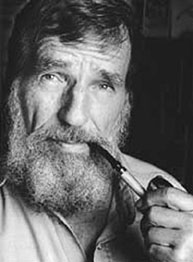
Mr. Abbey
Would you play with dynamite with this man?

In the copyrights page, Abbey declares that though the novel is “fictional in form,” it is “based strictly on historical fact.” Mischievously, he adds that “it all began just one year from today.” It seems then that his novel is a call to arms for all environmental warriors to take up wrenches against industry. As we all know, such a Neo-Luddite revolution never occurred but that is not to say it might happen yet with Abbey some smiling godfather angel poet.

Abbey, who had an FBI file going back to the 1940s, was a fringe thinker with a golden pen, but is not known to have engaged the system as his fictional characters had. But he was at the right place at the right time, as it’s hard to believe that he could get away with his politics in our contemporary and endless War on Terror. Finding an empathetic editor and courageous publishing house would have been extraordinarily tedious. When the character Hayduke speaks for Abbey, “Because freedom, not safety, is the highest good," he is contradicting the literature of our age, with its sanitized, whitewashed machinations. Had he lived long enough, maybe the author would have gone rogue in his eighties. Abbey was too aware of what was at stake to stand by idly. Best to let the bard enjoy the last word:

"That ultimate world... the final world of meat, blood, fire, water, rock, wood, sun, wind, sky, night, cold, dawn, warmth, life. Those short, blunt and irreducible words which stand for almost everything he thinks he has lost. Or never really had..."

Monday, October 26, 2009

Getting Along


In mid-summer, 1941, following the Nazi incursion into the Soviet Union, German soldiers entered the small Ukrainian town of Jedwabne. Instead of resistance, they were welcomed by the local Christian community. Once they met with town authorities, the Nazis had no trouble organizing local mobs to engage in a bloody pogrom slaughtering various people of Jewish descent: old men, young mothers, newborn babies, many of them incinerated in the barn of the town baker. What was most remarkable about this was not just that half the town’s male population was involved in the carnage but that until the chaos engendered by the Nazi invasion, the town had enjoyed peaceful religious heterodoxy.

This gruesome account is one of dozens of such episodes described (often referenced in detailed first person accounts) in Niall Ferguson’s The War of the World. It is an ambitious work that attempts to explain the violence of the 20th century, the cataclysms of which led to the decline of the West in military, economic, and moral terms. Regarding the causes of violence itself, he cites economic volatility, ethnic conflict, and the nationalism that spurred the decline of the great royal empires of the 19th century.


Ferguson finds it ironic that in a time of so much progress— not only scientific and technological but artistic and liberal as well— that the century, particularly the first half, should be defined by violence so wretched and thorough, it defies contemplation. Technology, of course, made genocide more systematic and quicker (the huge numbers of casualties listed repeatedly chillingly recall the words of a prominent mass murderer, Josef Stalin, “One death is a tragedy; one million is a statistic.”)

Throughout most of history, ethnic conflict was often a contest of land, food, wealth, and resources, vied for by peoples of unique language, culture and customs. But the beginning of the 20th century saw the popularization of eugenics adopted by megalomaniacs and fanatics, who would argue that not only color and physiognomy, but also intelligence, aptitude, character, and even morals were hereditary, rather than environmentally influenced. Thus miscegenation, or racial interbreeding, would dilute the genetic quality of superior races. It was this ability to create a hierarchy of “good” and “bad” that enabled normal, young, perhaps intelligent men to commit atrocities. If the “enemy” is so dehumanized, then it is no different than slaughtering swine or poultry, or as the Hutus called the Tutsi, “cockroaches.”

What fascinates Ferguson about the Nazis is that the war and genocide were carried out by highly educated people in the most industrialized state of Europe under the dictates of a government elected by primarily democratic means. The extermination of the Jews, in particular, utilized the genius of German science and logistics, and the examples Ferguson cites are psychopathic:

- A PhD thesis from Breslau University, titled, “On the Possibilities of Recycling Gold From the Mouths of the Dead.”

- Fares charged by German state railway for transporting Jews to extermination camps were half price for children and discounted for groups of 400 or more.

- Victims of gas chambers had their screams drowned out by songs mocking their execution, like, "Highlander, Have You No Regrets?

The man responsible for human experiments at Auschwitz, Josef Mengele, had doctorates in medicine and anthropology. How could highly educated men running this extraordinary killing machine not know better? Was it conviction in Hitler’s racial war, peer pressure, or were they simply “following orders” like Eichmann, the logistical mastermind of the Holocaust? This commitment of a professional, educated class to the wholesale destruction of a certain ethnic group is both astonishing and frightening. The Nazis were very modern in the engineering of their philosophy— the radicalization of these professional classes is one of the great enigmas of the Second World War.

Nazi Propaganda Poster Painting the U.S. as Some Strange Robot Monster

This hatred of the other was notably inorganic, specifically a product of state propaganda, yet accepted by majorities of the public as fact. This was true in Imperial Japan as well, which fought a war of aggression in Asia that was racially motivated and thus comparably violent. What is commendable in Ferguson’s approach as a historian is that as much as he finds the Nazis’ behavior reprehensible, he demonstrates that although the plans for a “final solution” were beyond contempt, their methods of constructing a monstrous, bestial enemy were not unique. The so-called victors of the war, the Americans and British, utilized caricature in order to demonize the enemy and mobilize popular support for a conflict in which the Allies adopted the practice of Total War.

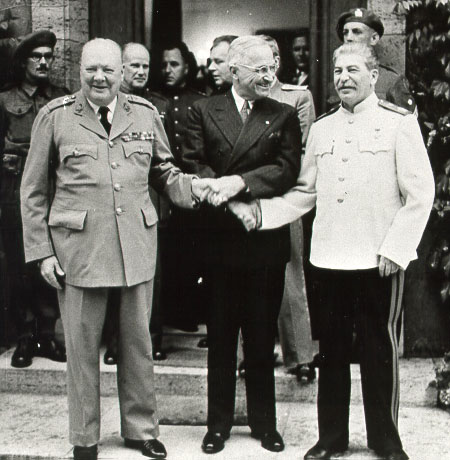
The Big 3 at Potsdam

Many historians (and pundits especially) call WWII a “good war,” (oxymoronic, anyone?) fought valiantly by the “greatest generation.” I suppose they see it as such because the Korean and Vietnam wars were fought on ideological grounds rather than against a demonstrably evil, dangerous, and threatening regime. There is no question that Hitler needed to be stopped. That is not debatable. But how much did we need the “means” in order to secure the “end?” Total War meant beating the Nazis at their own game, the slaughtering of civilians. In order to push through victory, cities like Hamburg, Dresden, and Tokyo could be justifiably firebombed and Hiroshima and Nagasaki could be rationally atomized. Ferguson does not suggest there was a moral equivalence between Auschwitz and Hiroshima as the former was meticulous slaughter as a goal of war while the latter, an indiscriminate mass killing in order to end the war. Some justified the bombing as payback. Others saw it as a demonstration of Machiavellian terror that would demoralize support for the regimes. Whatever it was, it resulted in the deaths of millions of civilians, people who had been dehumanized to the point where they were just meaningless statistics obliterated for the sake of victory guaranteed to the “good guys.”

Dresden, 1945

Ferguson makes an interesting contestation about who really won the Second World War, as the map of Europe was redrawn at the end of the conflict to one nation’s titanic advantage: the Soviet Union, who draped their infamous Iron Curtain over the Eastern Bloc from the Baltics to the Balkans, as well as instituting rigid control over East Germany, Poland, Hungary, Czechoslovakia, Romania, and Albania, the so-called Soviet satellites, thus replacing the totalitarianism of one government with another. But Britain refused to take a stand against Soviet imperialism, as it had gone to war to protect Poland from Germany, not Russia, so that its loss of sovereignty was regrettable but not in its best interests.

Did Churchill and his Allies thus regret their collaboration with the Soviets? It’s clear that this had been a Faustian bargain struck under conditions of extreme duress but a deal with the devil nonetheless. Without American supplies, i.e. rations, radios, tanks, and bullets and British intelligence, the Eastern Front would have seen a lot more attrition; had armies been bogged down there, perhaps the British and Americans might have liberated Eastern Europe. As it happened, with aid and logistical support, the Soviets prevailed and in their march through Germany into Berlin, looted, raped, and murdered civilians with unrelieved brutality. Once the German government capitulated, the British returned more than a million POWs to the Soviet Union, aware that these men would be either executed or sentenced to hard labor in Siberia.

The unconditional access to resources offered Stalin and the ingenuous faith that he would be accommodating in postwar development had not been the only flaw in Allied strategy. Much has been rightly criticized of Churchill for his idea of situational democracy. Believing that the Poles had the right for self-determination, but not Malays, Kenyans, or Indians is hypocritical, if not racist. The dismantling of English, French, and Portuguese empires and the kind of governments they would be allowed to have would mean a perpetuation of war, but in different theaters.

Ferguson’s primary research focuses on the great wars and the causes leading up to them. One of his principle arguments rails against the traditionally accepted length of the World Wars, arguing that the sloppy configuration of borders at Versailles meant that there had been no true peace so much as truce (and that in the dismemberment of empires, nationalism had taken an ethnic character leading to massive violence not just in the former Hapsburg empire but in the Ottoman disintegration as well). He also makes it clear that though the Cold War was ostensibly peaceful to the superpowers, the period of decolonization saw massive violence in the Third World, wars (famously Vietnam but all over) fought by proxy armies between the U.S. and U.S.S.R. And again the Americans are criticized for taking a morally ambivalent stand, proclaiming the language of peace and democracy, while suppressing democratically elected governments sympathetic to the Soviets or anti-capitalist in general. Thus their backing of infamous strongmen like Saddam, Suharto, and Marcos to protect American interests (“It doesn’t matter if he’s a sonofabitch, so long as he’s our sonofabitch.”).

And with the end of the Cold War what shall we look forward to in the new century? Ferguson’s critique on nations, ethnicity, and war ends with a caveat against Islamic fundamentalism. Curiously, Ferguson laments the declining birth rate of Europe, arguing that it will be impossible to support entitlement programs like health care and pensions without an influx of immigrants, and the likely source of this labor will come from North Africa, where the birth rate is significantly higher. Reminding us of the recent bombings in Madrid and London, Ferguson warns the contemporary citizen:

“A hundred years ago, globalization was celebrated in not dissimilar ways as goods, capital, and labor flowed freely from England to the ends of the earth. Yet mass migration in around 1900 was accompanied by increases in ethnic tension…with ultimately explosive consequences. In 1914 the first age of globalization ended with a spectacular bang because of an act of terror…”

Ferguson goes on to say that civilization, even the most well integrated ones sharing language, faith and even genes, can collapse, particularly during economic volatility. But in order to protect ourselves, what are we willing to give up? What moral values do we cede in order to be safe? How far do we rely on government and state sanctioned violence to protect us before we stop being the victim and start being the terrorist?

What the Jew, the Communist, the Nazi, the Islamist and the terrorist all seem to have in common is the specter of the Boogeyman. This is the default setting which governments and media utilize in order to rally patriotism, whether the system is democratic or totalitarian. What this regrettably leads to is simple: the dismantling of basic civil and human rights. In Germany, this meant the Holocaust. In George Bush’s America, this has meant Guantanamo Bay. Of course, what the Nazis did was much worse, but that’s not the point— the conception of the modern “terrorist” is male, Islamic, bearded. This association has already been deeply drawn by the wars and crises over the last decade so that the Muslim is shrouded in Boogeyman terror—just last week over a third of Americans polled favor a ground invasion of Iran. This is the self-destructive nature of our terror: that in our fear of the other, we debase the physical humanity of our enemy, impoverishing our own spiritual humanity.

There is no winning or losing a war, there is only loss.