
Edward Abbey’s The Monkey Wrench Gang begins with “the aftermath” of the novel itself, the detonation of a bridge in the Four Corners Region of the American Southwest. Like an inspiration born of yippies or Al-Qaeda, the bridge is a high-profile target, sabotaged during a media event with officials glad-handing, local TV news crews videotaping, and the public witnessing: the bigger the spectacle, the larger the message, which is more or less, neo-Luddist.
Abbey’s The Monkey Wrench Gang was published in 1975, a fascinating period in liberal dissent, in which some radicals had more or less abandoned sit-ins and peace marches in favor of violence. Members of The Weather Report and the Symbionese Liberation Army really did believe that terrorist acts against institutions that promote or profit off the industry of war and oppression were fair targets and through their destruction would come significant change. Putting down the love beads and picking up the Molotov cocktail, they were fearless, if not misguided individuals operating in a social climate that was moving comfortably towards The Hustle and cocaine on pleather love seats.
Abbey’s Monkey Wrench Gang is not a clan of hippies indoctrinated by the burgeoning Earth Day celebrations but are men of the earth who have soil in their fingernails and the wherewithal to live by their philosophy, that is that technology and industry are incompatible with the pristine beauty of nature. As Seldom Seen Smith, the polygamous, blonde, lanky, good-humored Mormon whose living, livelihood and life is the marvelous Colorado River, says:
"The river, the canyon, the desert world was always changing, from moment to moment, from miracle to miracle, within the firm reality of mother earth. River, rock, sun, blood, hunger, wings, joy-- this is the real... all the rest is androgynous theosophy. All the rest is transcendental transvestite transactional scientology or whatever the fad of the day, the vogue of the week."
Philosophically, he is right on with Doc Sarvis, a middle-aged surgeon with a pathological antipathy regarding highway billboards, of which he indulges in his pyrotechnic habits. Doc Sarvis views man’s fate through fiery-tinted apocalyptic goggles, the Devil’s Advocate in any conversation related to man’s inherent goodness:
"The wilderness once offered men a plausible way of life. Now it functions as a psychiatric refuge. Soon there will be no wilderness... then the madness becomes universal. And the universe will go mad."
Over a campfire of rations, whiskey, and beer, they discuss possible targets, Doc Sarvis working himself into a rage as he lists nature’s worst transgressors due a mean reckoning:
"And don't forget the billboards. And the strip mines. And the pipelines. And the new railroad from Black Mesa to Page. And the coal-burning power plants. And the copper smelters. And the uranium mines. And the nuclear power plants. And the computer centers. And the land and cattle companies. And the wildlife poisoners. And the people who throw beer cans along the highways."
Doc Sarvis’s secretary and chauffeur-cum-lover, Ms. Bonnie Abbzug, is a Bronx Jewish beauty who is the Patty Hearst of the gang, a city gal politicized by charismatic company and the delight of detonating bulldozers. As the men get carried away with their visions of sabotage, she reminds them that prudence would be key to survival. She’s the voice of the 1960s, bright, lovely, idealistic, meditative, and yet she can see the more clearly than the others:
"But they have everything. They have the organization and the control and the communications and the army and the police and the secret police. They have the big machines. They have the law and drugs and jails and courts and judges and prisons. They are so huge. We are so small."
Her philosophical rival within the group is George Washington Hayduke, a hairy, squat, muscular, vulgar Vietnam Vet with itchy trigger fingers and an incapacity to resist any kind of sabotage, as much for the fun factor as for the environmental statement itself. Though told in the third person, it’s clear that Hayduke is the story’s protagonist, if not Abbey’s altar ego, as he is the most offended by the pathetic turn in materialist America. Hayduke is a kind of rampaging Greenpeace Rambo whose end-all pastoral vision of America is compromised by his ingrained pessimism:
"When the cities are gone and all the ruckus has died away, when sunflowers push up through the concrete and asphalt of the forgotten interstate freeways, when the Kremlin and the Pentagon are turned into nursing homes for the generals, presidents and other such shitheads, when the glass aluminum skyscraper tombs of Phoenix Arizona barely show above the sand dunes, why then, why then, why then by God maybe free men and wild women on horses, free women and wild men, can roam the sagebrush canyonlands in freedom--goddammit!--herding the feral cattle into box canyons, and gorge on bloody meat and bleeding fucking internal organs and dance all night to the music of fiddles! banjoes! steel guitars! by the light of a reborn moon!-- by God, yes! Until... the next age of ice and iron comes down and the engineers and the farms and the general motherfuckers come back again."
Take or leave the politics, this is passionate prose, and the story flows with energy and humor. Progress of the narrative is simple and inevitable: after forming the Monkey Wrench Gang (also called the Wooden Shoe Conspiracy as the word sabotage is derived from the French sabot or ‘wooden shoe,’ as in “from damage done to machinery by sabots (Webster’s)), they progress from simple to complicated operations that lead to evermore close calls with the law, including some extraordinary chase sequences that would make great cinema (though it’s very unlikely corporate Hollywood would spend the big bucks financing such a piece). Throughout the Four Corners region, they have supplies cached for regrouping, survival, and the next act of mayhem. In case you were wondering, the typical inventory was such:
“The stores consisted of (1) food: tinned goods, dried meats, fruits, beans, powdered milk, sealed drinking water; (2) field equipment: medical kits, tarps and ponchos, fire starters, topographical maps, moleskin and Rip-Stop, sleeping bags, canteens, hunting and fishing equipment, cooking gear, rope, tape, nylon cord and (3) the basic ingredients: monkey wrenches, wrecking bars, heavy-duty wirecutters, bolt cutters, trenching tools, siphon hoses, sugars and syrups, oil and petrol, steel wedges, blasting caps, detonating cord, safety fuse, cap crimpers, fuse lighters and adequate quantities of Du Pont Straight and Du Pont Red Cross Extra."
If Abbey is political, he is also poetic and oftentimes funny. The Gang’s enemy, the representatives of industry are the kinds of people that "can hear a dollar bill drop on a shag rug." No institution is safe with Abbey, even cartoon characters suffer embarrassing acts of vandalism:
"Bonnie unbuttoned Smokey's fly, pictorially speaking, and painted onto his crotch a limp pet-cock with hairy but shriveled balls. To Smokey's homily on fire prevention Hayduke attached an asterisk and footnote: "Smokey the Bear is full of shit."
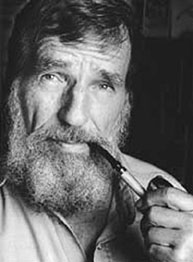
In the copyrights page, Abbey declares that though the novel is “fictional in form,” it is “based strictly on historical fact.” Mischievously, he adds that “it all began just one year from today.” It seems then that his novel is a call to arms for all environmental warriors to take up wrenches against industry. As we all know, such a Neo-Luddite revolution never occurred but that is not to say it might happen yet with Abbey some smiling godfather angel poet.
Abbey, who had an FBI file going back to the 1940s, was a fringe thinker with a golden pen, but is not known to have engaged the system as his fictional characters had. But he was at the right place at the right time, as it’s hard to believe that he could get away with his politics in our contemporary and endless War on Terror. Finding an empathetic editor and courageous publishing house would have been extraordinarily tedious. When the character Hayduke speaks for Abbey, “Because freedom, not safety, is the highest good," he is contradicting the literature of our age, with its sanitized, whitewashed machinations. Had he lived long enough, maybe the author would have gone rogue in his eighties. Abbey was too aware of what was at stake to stand by idly. Best to let the bard enjoy the last word:
"That ultimate world... the final world of meat, blood, fire, water, rock, wood, sun, wind, sky, night, cold, dawn, warmth, life. Those short, blunt and irreducible words which stand for almost everything he thinks he has lost. Or never really had..."


