"The less she bore man’s imprint, the more room she offered for the expansion of his heart.”
Marcel Proust on Nature
Sunrise in the desert is a true delight. With the stars slowly fading out, a purple haze becomes the western horizon. Light diffuses across your vision in rainbow patches, a hue of Venetian wild yonder gathered wishfully from Bradbury stories. And to be alone on the sands is to give in to imagination, to the magic of fairy tales and serialized adventure musings. It is desolate and cold yet romantic and rejuvenating. In central Morocco, I was wandering the Sahara dunes, alone, just after the sun had risen and a sky being blued. From the distance there was a lone figure coming towards me. My hotel, where I was the only guest, was on the outskirts of the village of Merzouga, a good six kilometers away from any dwellings or fashionable
auberges. The person seemed to arrive with the dawn, a man born of the light. As he approached, I discerned his navy tunic and matching turquoise turban-- ‘
le hommes bleu’ the tourist literature calls the Bedouin of the Western Sahara. Amid the wide expanse of sand, he approached my vantage point, called out a '
Bonjour,' and kneeled before me. From a satchel, he unrolled some newspaper and produced specimens of fossilized rock. "Good price," he said in English once he had successfully discriminated my American accent.
The first nick in the relevance of the Western Sahara caravan route came in the 16th century when the Portuguese opened the Atlantic coast with coastal shipping. Nevertheless, men, camels, and goods continued to cross the Sahara for hundreds of years, from Marrakech to Timbuktu, trading in salt, spices, ivory, slaves. In the 20th century the French established a Protectorate. Under their colonial supervision a modern highway infrastructure was constructed. Later than that, airplanes made transport quicker and more efficient. Thus, the legendary caravan routes have largely disappeared and very few hardy men still make this difficult journey. Still the desert grows, it effuses, beckons, and challenges. In this era of mass tourism and virtual experience, it is this market that is the only lucrative one left in this arid, foreboding land.
All along my travels I’d been warned against the hustlers of Merzouga, a small village on the edge of Erg Cherebi, where the largest sand dunes in the country were accessible via a good, paved road. Supposedly busloads of tourists made the stop, posed with camels for five minutes and took off on the long trip back to Ourezazate or even Marrakech, a good six hours drive away in grueling heat. This stretch of the desert has also become something of a Land Rover’s amusement grounds with manic cavalcades of sports utility monsters roaring through the gentle ambience, bellowing berserk macho energy. The camel tracks were covered by their 4x4 ruts and the quietude compromised beyond pity.
I was on the local long-distance bus from Tinehir to Erfoud, where I would have to change buses to get to Rissani. There, a taxi would take me to Merzouga. It was a convoluted route and I expected some trouble. Still almost a hundred kilometers from my destination two slick young cads took two seats across from me. Our conversation was typical of two hustlers making the peripatetic strike. They praised my coming to Morocco, for taking local buses, for meeting real Moroccans; these people on the tour buses, they said, missed out on the whole experience. "You are like Berber,” they announced, intending it as a compliment, a comparison to the indigenous population, the original Moroccans.
Following the obligatory round of sickly, sweet praise they turned their talk to camel treks. “I’m a musician,” the thin, peppy one informed me. “I will perform a party tonight. You must come.” I told them that I hardly had a party in mind for the desert and that I actually wanted someplace very quiet, remote, soundless… I told them I had chosen my hotel, the Nomad Palace, precisely because it was far away from all the other hotels in the area.
Ah, but the dunes weren’t as high, they said. Undeterred by my steadfastness, they remarked the place was dangerous, too close to the Algerian border and that sometimes Americans were kidnapped or even shot by snipers. I politely smiled, acknowledging their desperate spinning with a skeptical eyebrow furrow. The younger one, the musician, slipped into a pouting silence. His friend persisted, lamely, recommending a compromise: if I went on their desert excursion, they would be happy to drop me off at the Nomad Hotel in the morning. Nope. A series of unrelated personal questions followed--to save face or win me over I could not decide but answered them succinctly. When it was discovered that I lived in Japan, the melancholy musician sprang to life in simple, but perfectly pronounced Japanese: "Honto ni? O-genki desu ka? Sabaku ni ikitai?" Really? How are you, my good man? So you want to go to the desert?
The bus had reached Erfoud and was nearing its terminus. They reminded me that they were my ‘friends,’ and that I would be hounded by “faux” guides as soon as I stepped off the bus.
“Those people outside, they’re going to make couscous in your head.”
“Yeah,” I asked. “Then what are you making?”
“An egg.”
“Oh, so you’re frying an egg in my head?”
“Yes. With a Moroccan salad.”
“Abunai,” he said in Japanese, cocking his head to the faces outside the parked bus. Dangerous.
They weren't lying about that. I was hounded as soon as I disembarked. At a teleboutique, I called up the Nomad Palace: Ali, the proprietor, was in Erfoud picking up fresh produce from the weekly souk. A lucky break. He would be over in a few minutes to pick me up. I waited on the curb while some woebegone tout, stubbornly hovered over me, promising a once-in-a-lifetime experience.
I had visited various African deserts and witnessed their commercialization. I knew it by the sound of a flipped silver coin hitting the plastic table. But I couldn’t help myself: I clung to my expectations, I had visions of romance, adventure, and mysticism, but so tenuously held on.
Perhaps the desert loses its enchantment when it's turned into a postcard. Can a tourist really claim he’s been to the desert and the ascetic hardships the journey implies? Or has he merely seen it? If you walk far enough there’s the silence and the wind envelops, the sand gets in your eyes and mouth and scratches your skin. But the danger of its indifference to life, of its potential ruthlessness has been sanitized. The French Foreign Legion outposts have been replaced with ‘auberge avec piscine.’ Men who may have once raised camels mop the floors of honeymoon suites. The old ways are gone or put on as ‘authentic’ cultural experiences. It's not enough that the ways of the infidels had to contaminate the national governments, the cities, the youth... even in the desert, archetype of the middle-of-nowhere, the infidels had it right: money makes the world go round.
Perhaps I'm naive. You can’t blame the local 'men in blue' for wanting to make a little bit of profit out of us. For those who were born and will die there, the desert will always be a rough place, real rather than romantic. It's my fault, rather, for wanting to believe in Mickey Mouse although he’s just a cartoon character.
One can interpret a child’s innocence as having no real illusions. Fantasy and reality can be one thing: whole. At Disneyland there are no costumes. It is not a fabrication; there is no man sweating underneath cursing his lot in life, craving a cold beer. To adults, fairy tales imply whimsical make-believe, but for a child it is the way the world works. When the wizard of Oz turns out to be just a man behind a curtain, you know Paradise has been irrevocably lost.
I arrived in the desert as the reluctant cynic: I had my vision of the Sahara, its tranquil beauty, its dangerous history, and its savage light, and I expected disappointment. The only way I could come out unscathed was to adapt a special attitude, that of a fabulist, or a young child, an innocent. Perhaps channeling Don Quixote was the only worthwhile solution. All or nothing.
My cameleer, Abdul, didn’t speak English, mumbling his French incoherently, as if he had been to the dentist and injected with large doses of Novocain. Ah, but he had no tongue; it had been chopped off as punishment for a lascivious comment regarding the Sultan’s harem.
The camel, single-humped and technically a dromedary, was named Bob Marley. The resemblance to the Rastafarian legend was a stretch though the beast did have a friendly smile. The animal would be my carriage into the great sand sea.

And who was I but a Man Without a Past. Why had I come to the desert? Why was I intent on being here? Abdul inquired with his mangled tongue the origins of my history and my quest but I accepted the questions in silence, letting his enquiries echo into the void.
Leaving the village of Merzouga behind we entered the dunes. There on a small ridge of sand: a woman of Latin heritage in a tight white suit chaperoned by a heavyset man riding down the dunes on a piece of board. Surely, with her dark, agile beauty she was a foreign princess sold to the chief of a local tribe and he a carpenter and inventor showing off an ingenious device of transport. But where was her palanquin and her porters?
Along and over the dunes we trudged. Abdul faithfully inquired after my state of being: I was absorbed by the light playing upon the dunes, how it made ever so delicate shapes, shadows slipping away like a receding tide or its creeping arrival delivering coolness, all motions at the mercy of solar angles. Contentment did not describe my feelings. I was dazzled.
I thought I would have the dunes to myself but a group of eight camels came trawling from the opposite direction—their riders looked droopy and ill-begotten— perhaps they had made the 1000-mile journey from Timbuktu? Their gaudy social attire was terribly inappropriate for the desert… Did they run out of water and have to barter their raiments? I wanted to ask them about the oasis, as the desert was vast and harsh and what if we were to be lost should we fall under the spell of landscapes? But chagrined jowls set forward—I was out of their peripheral vision. I did not exist.
Going my way were a young couple from Switzerland. Abdul was friendly with the other cameleer and he tied my reins to the rear dromedary. I took them to be speculative merchants. They didn’t talk about their purpose here. They spoke of home. The desert has that effect.
The sun set. And the sky was cast with a mulberry glow, like a plum ripening through four seasons. The moon was nearly full, just a sliver bit off and the way was lit by lunar shine. We continued, our small camel train, cresting a high sand dune where we looked down upon an oasis, small, verdant, a cluster of palms, spilled figs, small shacks of wood covered in tarp, a well containing spring water, a fire and a cooking pot.
Abdul spoke to my dromedary and the beast collapsed onto itself in a sitting position. I dismounted and entered the camp. There was food and music and in the songs a local lore which seemed culturally impenetrable, yet exquisitely beautiful. The hand drums were spanked, an oriental flute was blown, lyrics lapping the night in a harmony barked as well as sung. I lay back, looking towards distant crowns and let the sound envelop me. The tumescent moon subdued the incandescence of the constellation but no matter. I could see the bushy bedhead outline of the palm grove poised before the great sand dune and the miracle of the oasis came to me— how water, the source of life, could be discovered in the most unlikely of places and because of these marvelous springs the desert could be crossed on foot or by beast. It has been crossed and will be crossed again. For a brief, ecstatic moment I fancied I could be one of those men, if only I wanted to. And then a shooting star defied the lunar light. It sparkled in the sky in a moment’s burst, just long enough to pause for wishes and dreams.
Edited from an earlier draft dated 2005


 Asilah, a small Atlantic seaside town just south of Tangier, annually commissions international artists to create large, painted murals. Some are representational while others are abstract: visible are elements of cave paintings, cubism, and Cy Twombly. Like most inner-city medinas in Morocco, Asilah's central layout is a complex maze of plazas, streets, and alleys that takes some time to orient oneself. Throughout the medina these huge murals can be found, though the best ones are located by the main elementary school, which hopefully, is an inspiration to the passing children.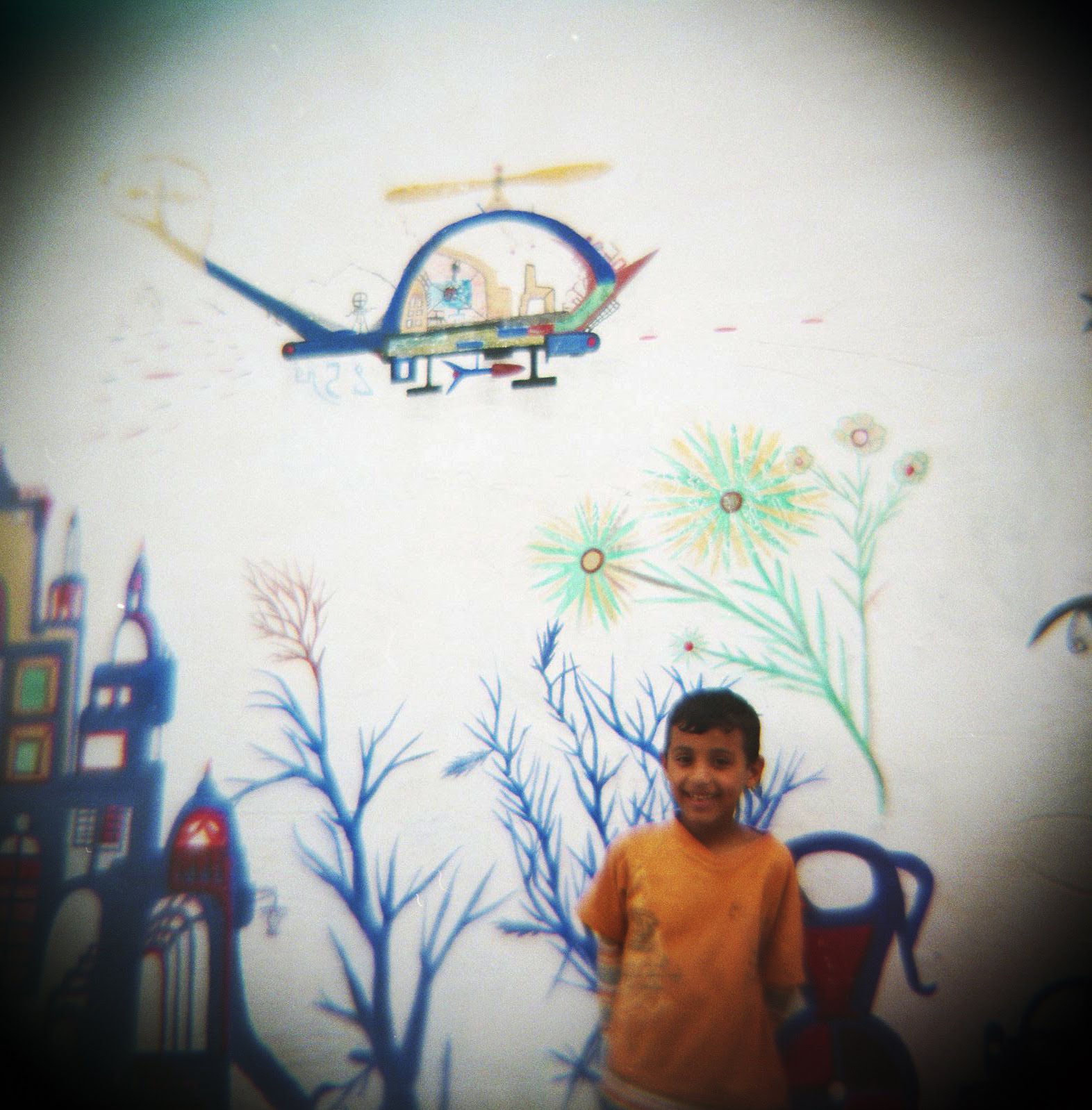
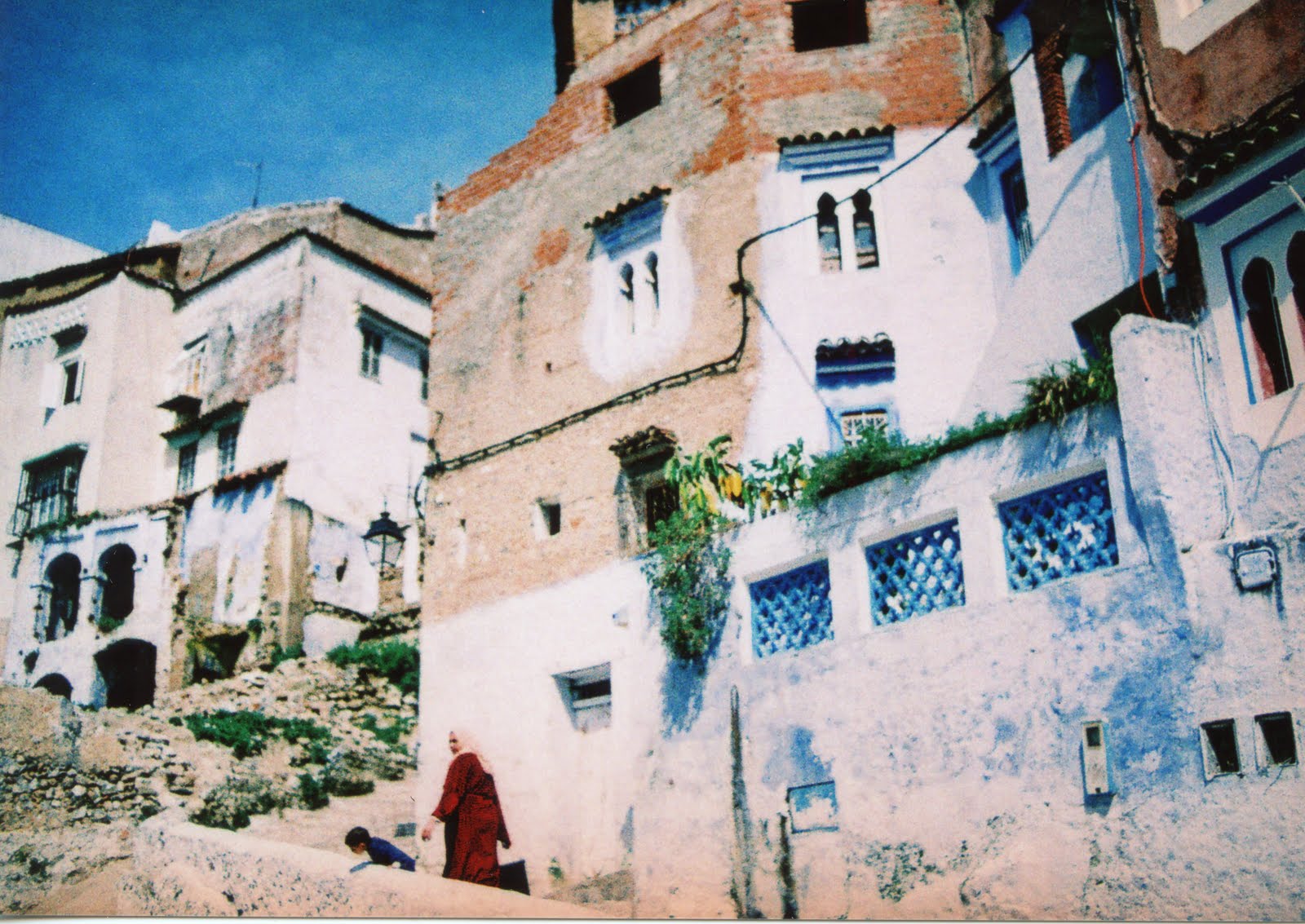
 Chefchaouen is another city remarkable for its color. Most of the town center has been painted a rich knockout blue and has been since the 15th century. This bold use of a uniform color has a tremendous effect. It gives the city a visible personality. Moreover, it welcomes the visitor into its space effortlessly, so that old men in djellaba cloaks, children playing with water guns, cats lazy from the sun and you, yourself, have all become characters within this rich and beautiful canvas.