Showing posts with label artists. Show all posts

Sunday, June 20, 2010

Why the Disenchanted Enchant

“Fame, romance, success—these things were so precious that no one could be entrusted with their possession for more than a moment.”

-- Budd Schulberg via Manley Halliday

If we are to employ the old standby, “There are two kinds of people in the world…” to Americans, we would say there are winners and losers, but it is not a black & white world of course and there are permutations to the categorization— what about losers who come to win and more spectacularly, winners who come to lose? What is it about déclassé failure that makes us feel better about ourselves? Are Mike Tyson, Richard Nixon, Michael Jackson, and Mark McGwire, to name but a few great legends that received their comeuppance, more famous today for their declines than their greatness? Are they not interchangeable? For example, can you talk about Nixon without mentioning Watergate or McGwire without steroids? It’s fascinating that the term for taking pleasure in others’ pain, schadenfreude, is a loanword borrowed from the Germans, since, with all the pleasure we take in our heroes’ downfalls, you would have thought by now we could have come up with our own Americanism for the blissful joys reaped from the public disgrace of others.

One of the greatest novels ever written on the subject is Budd Schulberg’s The Disenchanted (1950), which is a dramatization of Schulberg’s experience teaming with the legendary F. Scott Fitzgerald, who by the time he was hired out to work on an inane studio script was more legendary for his boozing than The Great Gatsby. Fitzgerald died before he could finish his comeback novel (from whose notes for The Last Tycoon include the famous, clairvoyant line, “There are no second acts in American lives.”) But Schulberg, most celebrated for his screenwriting credit for On the Waterfront, made the most of this opportunity, developing a story that not only indicts Hollywood, but the Jazz Age itself, the generation that spawned Fitzgerald and the excesses that would create the Great Depression.

Budd Schulberg

In The Disenchanted, art imitates life: it is the winter of 1939, the world is heading towards another war (“how calmly they floated towards the falls”) and Shep Stearns, a lit-grad and idealist leaning towards Marxism, has taken a low-level screenwriting job because he believes movies are “the great new folk art.” Shep is youthful, enthusiastic, and can talk the talk, even though he knows Hollywood-speak is “a world fenced in with exclamation points… a world where hyperbole is the mother tongue.” But he’s accommodating since he desires to marry his sweetheart and avoid a regular job, i.e. inheriting his father’s studio car rental business. So Shep’s written a stinker of a college romance called “Love On Ice,” which he knows bears no relation to realities or art but “is the most convenient of apologetics: the means to an end.”

The studio head, Victor Milgrim, a rags-to-riches nouveaux riches aristocrat emblematic of the early studio founders, sees potential in Shep’s script but wants to polish it so he’s hired Manley Halliday to work on the script. Halliday is a legendary but mostly forgotten Jazz Age novelist. He is also a recovering alcoholic trying to glue himself back together long enough to finish his final literary masterpiece. Milgrim wants them to travel cross-country together to Shep’s alma mater, the fictional Webster College in New Hampshire, to shoot background scenes at the Mardi Gras festival. He believes the adventure will inspire their writing endeavors (though Halliday is sure that Milgrim, an intellectually insecure millionaire, is pushing for an honorary degree and wielding Halliday as bait for the prize). Manley, dependent on his live-in girlfriend, Ann, agrees to go in spite of grave misgivings regarding what might befall him on the journey. His fears are perfectly ground. The great novelist soon falls off the wagon and the consequences are disastrous.

The problem is that screenwriting is all wrong for Halliday, an idiot savant, prolific with the most exquisite prose but incapable of correctly folding his suits. Screenwriting “wasn’t writing; it was diplomacy” and as a younger man, powerful, free and a bit of the snob, “he’d been able to indulge in a lofty contempt for movies.” But Halliday needs quickie cash and lots of it— he’s paying down the debts racked up from the wild living: back taxes, back alimony, back rent, his ex-wife’s analysis, his son’s prep school education. As in the case of Shep, the lure of Hollywood money is more powerful than pride or convictions.

But the young screenwriter turns out to be a tonic to the old artist: Shep has not only read all of Halliday’s books, he quotes liberally from them and whose generation he inexplicably, guiltily, envies and admires. On the flight to New York, Shep shares with Halliday a few bottles of champagne, which is the first burst of the floodgates. The taste of booze is the flavor of memory and once they arrive in New York, Manley operates in a twilight consciousness revolving around a glorious past, a catastrophic decline, and an inebriated, less than elegant present. And rather than writing, Shep is compelled to live up to his name, shepherding Manley safely through numerous crises, mostly of the self-inflicted variety.

Like Fitzgerald suffering his beautiful Zelda, Halliday’s bête noir was a flapper named Jere. Much of the novel’s thick middle is close third person stream of consciousness covering the couple’s witty banter, bad behavior, terrific parties, and wholesale crack-ups not dissimilar to the Fitzgerads’ very own. It’s a life of gay yachting parties on the Riviera and grim sanitariums in Upstate New York. And though we veer from the plot (will Manley get it together and solve the damn cipher of this silly movie?) the digressions provide some of the most exquisite prose in the novel. After falling in love in Paris, Armistice Night, 1918, Jere “made his young manhood a time of bewitchment, when springtime was the only season and the days revolved on a lovers’ spectrum of sunlight, twilight, candlelight and dawn.” As long as Halliday had the Golden Touch they thrived vivaciously: “we weren’t a-Freud of anything.” But neither Manley nor Jere could transition to the austere 1930s, as “the trouble with both of them… was that they thought youth was a career instead of a preparation.”

The Good Old Days:
Two Flappers and a Gentleman

Failure has embittered Halliday, who can’t help but loathe the new generation. Jealous of the youthful love between Shep and his girl, he comforts himself with the knowledge that “the happiest of people were machines running down.” Pressured by Milgrim and Shep to produce something usable pronto, Halliday fortifies his incapacity to create with his condescending view of writers that churn out material by demand: “Writing comes easy… when you’re a natural hack an’ haven’t got any self to express.”

Nevertheless, Halliday sees himself as a professional. When it’s sink or swim, Manley can riff on the plot, adding poetry and dimension to the staid college romance formula. Shep’s impressed, but dubious, for “it was much too good for what they needed. But for what they needed, not good enough.” Unfortunately for them (but felicity for the schadenfreude-happy reader) when they finally reach Webster, Halliday is “too stupefied to tell day from night, gin from vodka, love from hate.” When the great writer humiliates himself at a college mixer to the delight of colleagues and students, Shep is furious: “Manley was drunk and he was a spectacle. But they seemed glad this had happened to him. That is what galled.” It’s that damn devil, envy, working itself into a fit again, expressed in shits and giggles. Halliday knows the source of their spiteful laughter all too well, as from a time when he nearly conquered his own demons through self-reflection:

“Ruthlessly he made a list of all his faults and found them all to be the same fault, an over-supply of vanity, an over-developed concern to hear his name at the end of the cheers. The wish to be publicly admired. To be a Success. Like the others he had sneered at the Babbitts with their ordinary business success, their abysmal bourgeois ignorance that passed for ‘being a smart operator’ and yet inadvertently he had allowed himself to be caught in the great American net.” 

Thus written is the central dilemma of living in a consumerist society: this is the mother of our disenchantment and our insatiable appetite for the new and the next. It may even be defined by that vague catchall word, “cool.” We have an unfortunate tendency to compare our fortunes to those of others, whether it be money, knowledge, gadgets, or style. When we fall short, for we inevitably do because there is always someone better, faster, cooler, loathing is the default emotional reaction. There is only one great truth to salve such insecure feelings, true then, now, and forever and for a moment, Halliday nearly grasped it:

“Men as far apart as the Bible poets, the Elizabethans and the French symbolists all seemed to agree that if there was a single wisdom it was simply To thine own self be true… All he had to do now was decide what was his own self.”

Manley Halliday only seemed to really understand Manley Halliday in the process of writing, in great confessional prose that excoriated his blunders and romanticized the things that were worth making beautiful. In a difficult culture where morals are compromised and pride despised, art is the single greatest outlet afforded the honest man. In Halliday’s own intoxicated language, “No good work of art I mean there’s no good work worthwhile work of art without the artist exposing himself.”

The Great F. Scott, circa 1938

In the end, Halliday has exposed too much in real life and it destroys him. When he is dying in a hospital at the end of the story, Shep, in spite of the promise of his hero’s unfinished manuscript, believes that only in death will his friend reach immortality: “Let him be lowered into his grave so that disciples may begin to worship, so that readers may savor the pleasure of rediscovery. Let us bury the remains. Let the Halliday revival begin.”

Sometimes life follows the inspirations of art. F. Scott Fitzgerald died at the young age of forty-four. Posthumously, he has become a larger-than-life success, The Great Gatsby being quite possibly the most beloved book of our culture, the so-called Great American Novel. Death, it seems, can save a reputation. Schadenfreude has only so much emotional reach before sentimentality overwhelms it and we Americans are more famous for being maudlin anyway.

Unfortunately, forgiveness comes too late but at least it does arrive in time for posterity.

Sunday, April 18, 2010

The Writing’s On the Wall

"I’m an artist. When you tell people that they usually say, what's your medium? I always say, 'Extra large.'"

-Jean Michel Basquiat

Nobody as far as I know has written about the cultural significance of walls and that may be too bad, for though their subject may be pedestrian at first glance, their prominence within history and art is undeniable. Jerusalem has a Wailing Wall where wishes are wedged into the stone by faithful worshippers. Israel has another wall built recently, used as a border to filter Palestinian people through security checkpoints in and out of Gaza and the West Bank. Berlin once had a wall utilized for similar reasons and Pink Floyd has a depressing album about one. China’s wall you can see from the moon and Jean-Paul Sartre’s most readable short story is called The Wall.

Walls have been with us ever since man has sought shelter from his environment. They have various necessary and symbolic functions, the most obvious of which is providing structural support for homes and business. While accommodating privacy they also separate us, shutting people away from each other. Walls are boundaries; they suggest limits, establishing private property, telling us where we can and cannot go. They can be white, padded, and locked if one is deemed insane. Should they be covered with squiggly marks done in aerosol paint, they jeopardize real estate values. Walls are intended to protect us yet too often in these terrifying times they are adorned with barbed wire, their symbolism taking a ghastly, violent poise. We forget this but walls are also potential canvases. Huge, inspiring, storytelling space.

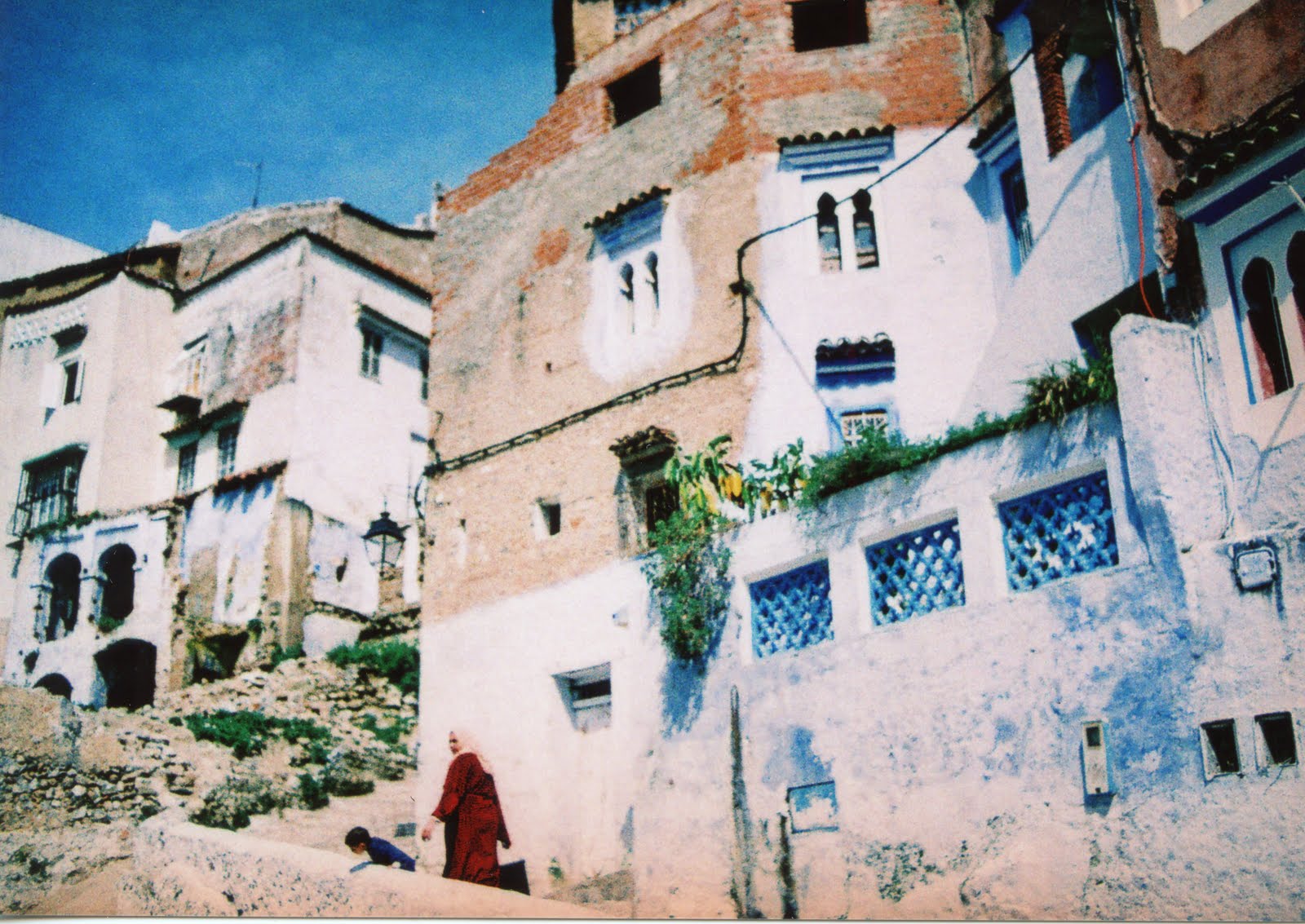
While the kingdom of Morocco may be famous for its deserts, bazaars, and couscous, it may be the vividness of color that strikes the visitor on a level that might be described as ecstatic. Psychologists have long pointed out the connection between mood and color and that melancholy can be a consequence of grayness. Throughout the large cities and small towns of Morocco, windows, gates, and doors are gilded with reds, pinks, and orange. Although it can feel slapdash and improvised, if not whimsical, the effect of urban color on the spirit is deliberate and powerful.

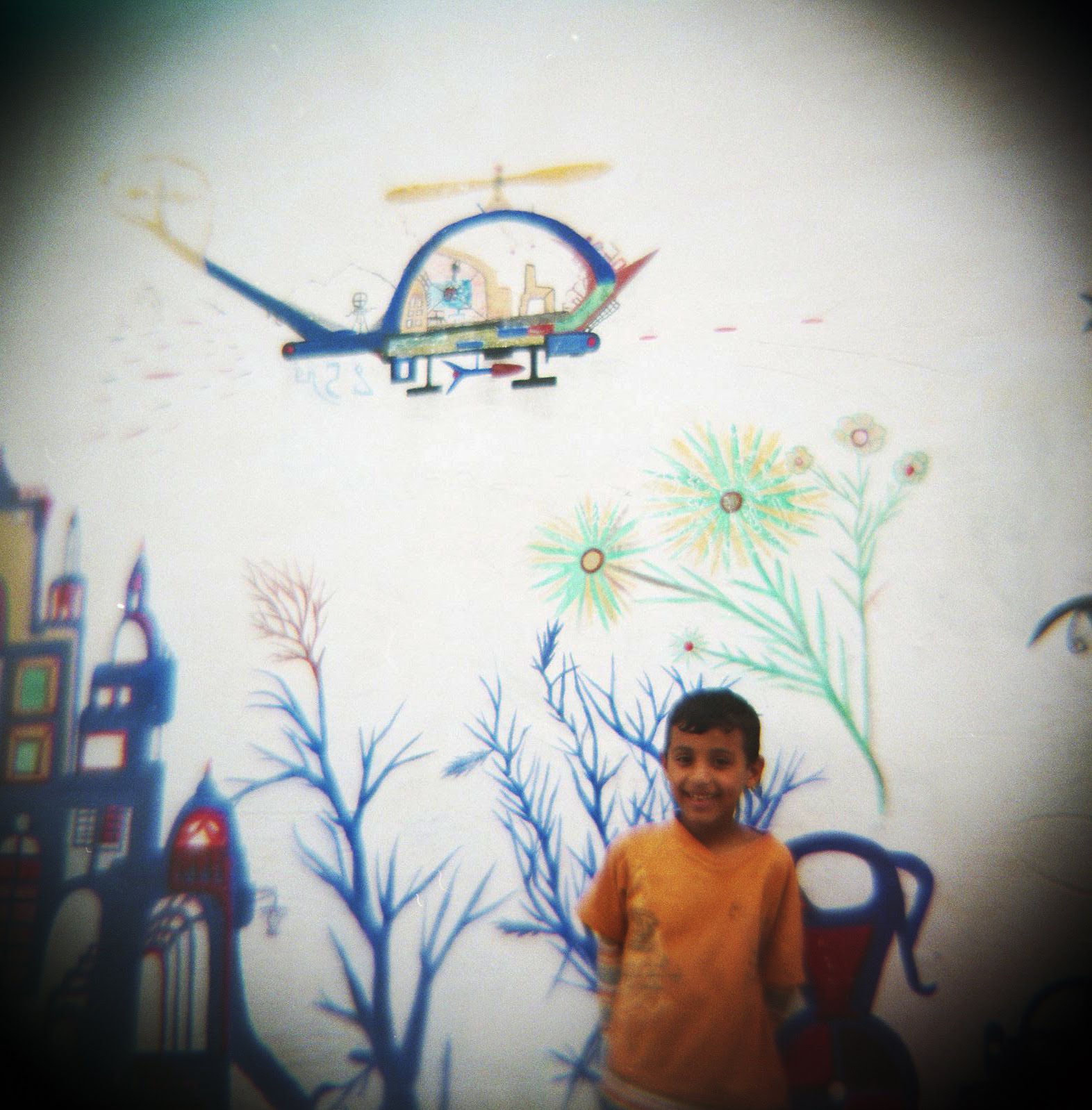
Asilah, a small Atlantic seaside town just south of Tangier, annually commissions international artists to create large, painted murals. Some are representational while others are abstract: visible are elements of cave paintings, cubism, and Cy Twombly. Like most inner-city medinas in Morocco, Asilah's central layout is a complex maze of plazas, streets, and alleys that takes some time to orient oneself. Throughout the medina these huge murals can be found, though the best ones are located by the main elementary school, which hopefully, is an inspiration to the passing children.

This is a wonderful thing. To keep art in museums-- as opposed to the streets-- is to suggest that art is 'historical,' and thus has little relevance to contemporary culture. Worse, secluding its appreciation to privileged circles within the museum complex, society withholds art's everyday effect from the ordinary citizen. To do this in Morocco, a country with double-digit unemployment would be spiteful and absurd. The streets of Moroccan towns are never silent. In cafes men smoke and talk. Women converge to gossip on doorways and park benches. Home for many is a cramped, dark place so it makes sense the street would be a viable contrast in brightness.

Chefchaouen is another city remarkable for its color. Most of the town center has been painted a rich knockout blue and has been since the 15th century. This bold use of a uniform color has a tremendous effect. It gives the city a visible personality. Moreover, it welcomes the visitor into its space effortlessly, so that old men in djellaba cloaks, children playing with water guns, cats lazy from the sun and you, yourself, have all become characters within this rich and beautiful canvas.

If one walks long enough (and in such surroundings one is inclined to walk all day), a person will eventually witness cracks in the walls, exposed brick and wood, childishly scrawled graffiti. Rather than imperfections, these marks seem to define character and age: not all dilapidation is bad just as not all shiny surfaces are beautiful. In fact, the flaws insinuate the aura of collaboration between time, nature and human creativity as on evidence is the work of the stonemason, the carpenter, the journeyman laborer, and the eleven-year-old boy.

As the world moves closer in globalized sameness it becomes imperative that we adopt a flair for color so appreciable within the towns of Asilah and Chefchaouen. Doing so would bring people out of their techno-cocoons and into the street for games, talk, and friendship. There is no excuse. After all, we have plenty of wall space to fill.

Saturday, November 7, 2009

Darger and the Artist's Ego


If it is important for an artist and his work to demonstrate the unknowable to us, what are the lessons we can learn from the life of Henry Darger?

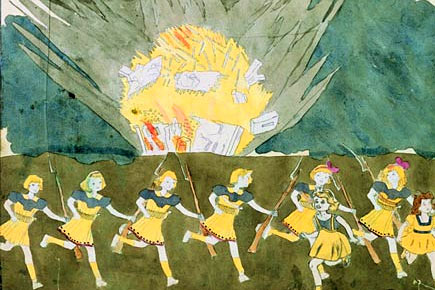
For those unfamiliar with Darger, he lived most of his eighty-plus years in Chicago, a friendless, anonymous man who did custodial work for a Catholic hospital. In his spare time, he created a complex parallel universe consumed by an epic conflict known to him as the Glandeco-Angelinian War, in which child slaves known as the Vivian Girls rebelled against their masters, fierce soldiers resembling Dixie grey coats in uniform and run by John Manley, a school bully Darger once had to contend with as a boy, now infamously immortalized for his tyranny. The story, a magnum opus if there ever was such a contender for the term, runs over fifteen volumes, totaling 15,145 pages, alternately typed and drawn, traced, painted, or collaged together, creating a dreamlike effect aesthetically unique: the vivian girls are androgynous creatures marked by lovely girlishness and small penises. They are violently tortured by their captors in explicit detail, often utilizing christian symbology, especially tragic martyrdom.


The work is beautiful, bizarre, and incredibly idiosyncratic, yet there are many such works of art that convey the wondrous details of the imagination not quite so universally celebrated. Darger may be the greatest embodiment of art brut--a movement describing artists who work outside institutions such as museums and galleries and have learned their craft independent of any apprentice work or university system-- but today he is anything but an outsider. Very few modern artists have bigger household name value.

Is it simply the beauty of the work itself that makes Darger so beloved? Or rather is it the purity of his intentions, his championing of innocence and childhood? Or perhaps it's the single-mindedness of his vision, that a whole life should be committed to a single project? Or is it possibly that Henry Darger, lonely and emotionally isolated, composed his epic narrative because he had to-- out of love, passion, or catharsis-- and its acceptance by the general public had nothing to do with it?

Darger did nothing in his lifetime to publicize his creations nor to advocate himself as an artist, a quality of indifference very unique among creative people. Most need to show their work and be congratulated for it. Because of the internet, today's artists are not so dependent on the fickleness of gallery owners in order to get their work out. In spite of its intangibility and inherent limitations, the internet means "space" can exist anywhere, in any room in the world and can exist there indefinitely. Nevertheless, with the creation of counters for plays or views, our egos are more than ever intertwined with being seen, heard, noticed. Most of us are all too human and attach self-worth to the attention, accolades or value our work receives. The unknown artist can only google his or her name with extreme caution. This is because for most of us, our work cannot exist on its own merits. Satisfaction is contingent on recognition from an audience. Is this a very human quality, the need to be appreciated? It's a matter of love, isn't it? We need it and the fact that Darger could be so creative for so many years while keeping such a marvelous work to himself must seem incomprehensible to the Myspace generation. In this sense, he was operating like an immortal, beyond the realms of the real, someone whose superhuman discipline, patience, dedication, fanatical detail, talent, and self-assurance is something worth our admiration.

Although his childhood was particularly Dickensian, his methodic channeling of sadness and the themes he explored therein were particularly American. Poverty-stricken and orphaned at a young age, he never quite got over his unhappy childhood and was perhaps trying to resolve that dilemma with this mammoth effort, drawing from ideas of war, christianity, and most especially the battle between good and evil. Though childless and too destitute to qualify as a candidate with adoption agencies, Darger followed the travails of children in his imagination, the only place in his life where he had absolute control. Many of us Americans suffer various maladies of Peter Pan syndrome in our own childish ways-- we don't want responsibilities, we want to look, feel, stay young-- yet if only more of us could so selflessly express these anxieties in art and be happy for the effort, we might be so much better off.

When Henry Darger died in a hospice in 1973, his life's work was discovered by his landlords, Nathan Lerner and his wife, Kiyoko. Lerner, an accomplished photojournalist, recognized immediately the value of Darger's vision and took careful measures to ensure it was preserved and shared with the world. Likely, there are many landlords who would have tossed out the entire shebang and thus today we wouldn't have the amazing paintings composing In the Realms of the Unreal.

If you want to go back further, if Darger had had a happy childhood, maybe he wouldn't have been inspired to create what he had.

Everything, it seems, then, exists as a trick of fate and we should be thankful for what we've got. What we've lost--through the failure to acknowledge or preserve the work of artists who had no name or reputation to speak of-- is something that we will never quite comprehend.