Wednesday, July 28, 2010

Touchdown for the Man

"But it's all part of being alive, man. The pleasure and the pain. You can't have one without the other."
-- Quarterback Seth Maxwell


What is it about football that is peculiarly American? Is it the intricacy of its strategies? The use of padding offering the illusion of controlled violence? The peculiar use of slang coloring the insiders' lexicon (fumblerooski, slobber-knocker, pooch punts)? The utilitarianism of every player on the field to some designated responsibility? The celebration of heroes and roasting of scapegoats? A harmonious association with High School memories? That it is best pleasured with mass quantities of beer?

Of the three great sports the U.S. has produced, only football has failed to create an international following-- it seems it will never qualify as an Olympic competition. If a character in a film once said, "Football is a game of inches," giving the sport a sense of delicacy and precision, a real-life coach also said, "Winning isn't everything; it's the only thing." The latter quote more accurately explains the game's ferociousness and the human capacity to brutally subjugate common sense and physical pain to the more immediate attainment of victory. When one considers the sacrifices your average American makes in compliance with his country's values-- substandard health care, comparatively little vacation time, the costs of extraordinary consumption, and most importantly, a fetishism of work and income as the definition of a man's worth-- then it seems we would expect our athletes on the gridiron should rally to that ideal as well.

In the early 1970s, a second-string flanker for the Dallas Cowboys named Peter Gent retired from the game and wrote what is perhaps the best novel ever written about the sport, North Dallas Forty (produced in 1979 into a mediocre comedy with Nick Nolte, all the nuances of Gent's themes stripped in favor of dumb jock jokes). The novel takes place over the course of eight days in the life of a wide receiver named Phil Elliot. Elliot is the team's joker but also a thinking person, who does not go for Vince Lombardi's philosophy on the merits of winning, hoping only to perform with enough aplomb as to guarantee himself more playing time and better pay. His logic, to wit: "Reading a contract is vastly more important than reading a blitz. A great negotiator makes much more money than a great running back." Of course, if money was what it was all about Elliot would be much more careful about toeing the company line but as he is, he cannot abide by any regulation or philosophy that marginalizes the individual. Through confrontations with management, players, and the society that celebrates the group effort of winning, Gent dramatizes this theme of the individual vs. the collective.

Winning means a number of adjustments on the players' parts. In fact, it seems that the only way the team can come together on Game Day is through liberal use of a psychoactive and pharmacological cornucopia. Injured players (particularly Elliot) pop Codeine like candy to combat the pain and linebackers swallow handfuls of Dexamyl (a once popular methamphetamine "upper") in order to reach the proper psychological level where body and mind can be properly tuned to a level of violence required to destroy opponents. Elliot self-medicates with "grass" on his down time and team parties are rowdy and debaucherous. The human body has limits but the devastating toll is tomorrow's problem: "The body wears out quickly but with training and chemicals the mind is conditioned not to notice." In this sense trainers and physical therapists are as essential to a team's well-being as a solid coaching staff. Without the ingenuity of team doctors, careers would be cut short and playing levels suffer. In the end, it's the player's responsibility to bear the pain as his body is not of his own but is contracted out to the sports franchise: "Don't worry about health; after all the body belongs to the club. Deal in pain thresholds and analgesics, amphetamines and anesthesia. Short circuit that bothersome equipment that communicates pain, numb it, bind it, but get the property back to work."

This idea of belonging to the club not as a person but as a thing is a vision unique to Elliot. The patriotism that affects Americans worshiping the flag is the same fever infusing team loyalty. In spite of claims as to being part of a "family," the team is a corporation and a person is a commodity whose value is conditional to his usefulness:

"We're just the fucking equipment to be listed along with the shoulder pads and headgear and jockstraps. This is first and foremost a business, with antitrust exemptions, tax breaks, and depreciations. And all the first and tens, all the last-second touchdowns, and ninety-five-yard passes, are just items on a ledger to be weighed along with the cost of precooked steak and green eggs..."

Coach Tom Landry: Gent's coach in Dallas

Of course, this fulmination against systems is not unique to football and the rules of the market apply just as boldly to the American worker, many of whom desperately cling to their jobs for mortgages, health insurance and overall livlihood. In the the event of downsizing or a family illness, the catastrophic loss of home, health, and savings is of no concern for a company concerned with its own financial welfare. As Elliot puts it so bluntly, "The past was worthless, the present anxious, and the future impossible." The player as a metaphor for the worker, this is American life, love it or leave it.

Although Elliot can clearly see the faults in the system, in no way does he desire to leave it. It may be a job but it does have its intangible benefits, particularly glory, fame and associated perks. "I'm a contemporary folk hero," is how he explains his profession to a group of stoned college feminists (who assume from his banter that he's a musician rather than an athlete). Men want to shake his hand and women want to bed him. He really is a contemporary folk hero, the kind whose efforts you can watch on television or read about in newspapers and the pleasure of being so well-regarded by friends and envied by enemies is intoxicating, even for someone as level-headed as Elliot.

But the team is not propelled forward by success, by wine and women nor by bold print and statistical averages, motivated instead by a more primal urge: "Fear, man. It's fear and hatred that supply us with our energy. They're what keep us up." Fear is in the newspaper headlines and the radio bulletins: this is Dallas, Texas in the early 1970s, a city suddenly wealthy on petrol profits, yet still mired in racist ideology that prefers apartheid to progressivism. The Vietnam War is ratcheting up the body count numbers and there are always typical, localized catastrophes: "A young housewife was found dead with her throat slashed." This is a society negotiating the delicate route between violence and fear. When these become our only alternatives, the consequences are terrifying. As Elliot puts it, "I am a man who has learned that survival is the reason of life and that fear and hatred are the emotions. What you cannot overcome by hatred you must fear. And every day it is getting harder to hate and easier to fear." Worded in even starker terms is an invective posted on the locker room's bulletin board by Thomas Richardson, a black fullback benched for his political views:

"MODERN MAN NO LONGER FEELS, HE MERELY REACTS.
CREATIVITY HAS BEEN REPLACED BY CONFORMITY.
LIFE HAS LOST ITS SPONTANEITY:
WE ARE BEING MANIUPLATED BY OUR MACHINES.
THE INVIDIDUAL IS DEAD."

Elliot's closest companion on the team is Seth Maxwell, the team's star quarterback (who enjoys possibly one of the best hagiographic introductions in literature: "There wasn't a pass he couldn't throw, a team he couldn't beat, a pain he couldn't endure, or a woman he couldn't fuck, given the right time and combination of pieces. That was how he lived. Time took care of itself; he collected the pieces.") Elliot's conversations with Maxwell on the conflicting values of individual vs. team success are the framework of the novel. In the end, Elliot has the last word on what it means for the individual once the game ends and the party's over:

"There is a basic reality where it is just me and the job to be done, the game and all its skills. And the reward wasn't what other people thought or how much they paid me but how I felt at the moment I was exhibiting my special skill. How I felt about me. That's what's true. That's what I loved. All the rest is just a matter of opinions."

Not everything: the only thing!

These provocative ideas are woven into a novel with a very grounded and well-tested framework: the team has a big game in New York and Elliot hopes to perform well. The author, Gent, is clever in his mingling of politics within the narrative. North Dallas Forty is never preachy though it is tragic. The determination of Elliot's fate has nothing to do with his talent, his marijuana, or the fact he is caught sleeping with the team president's woman but everything to do with the following mindset, a logic that should figure Phillip Elliot as a major (however under-appreciated) character in modern American literature: "There is no team, no loyalty, no camaraderie; there is only him, alone."

Monday, July 5, 2010

The Walking Contradiction

“Dreaming was as easy as believing it was never gonna end.”

--Kris Kristofferson from the song, “Leaving Her Was Easier.”

The music scene in the 1960s saw a lot of stars break out and just as many break down. The lucky ones were the one-hit wonders that just faded away, slipping into nostalgia and collecting royalties, as the next inevitable big thing came along. Many more were casualties of alcoholism, drugs, madness, guns, and the law. The 1972 drama, Cisco Pike, starring Kris Kristofferson as the eponymous Cisco, explores the idea of a once upon a time rock star living through the aftermath, dreaming only of a comeback.

You see, Cisco’s been busted twice for dealing and now that he’s set up in a small apartment in Venice Beach with his yogi girlfriend, Sue (the ubiquitous rock and roll cinema muse Karen Black), he just wants someone in the record business to appreciate his new recordings. Right away, we know Cisco is hard up— when we meet him, he’s walking into a music store intent on pawning an acoustic guitar autographed by Dylan, Cash, and other legends. The storeowner (poet Roscoe Lee Browne) is more interested in some “coke from Cuzco” than the guitar.

Gene Hackman’s Officer Leo Holland, a weird and wired-up policeman with a jogging penchant, has busted Cisco twice. Officer Holland has lately uncovered a Mexican pot ring, scoring a mother lode of marijuana and rather than report it to his precinct, desires Cisco’s help in unloading it for him. Cisco is naturally suspicious that this might be some kind of set-up but his nemesis seems “honestly crooked.” Holland needs ten grand pretty bad— bad enough that he’s promised Cisco he can keep whatever superfluous profits remain. Only problem, he needs the money by Monday, less than 72 hours away, or it’s big trouble.


Let's Make a Deal

Much of the film is Cisco journeying through Los Angeles in this hourglass timeframe, hooking up with characters in back streets and bars, recording studios and venues, in an altogether eccentric cityscape like something out of a lost world: dealers named Buffalo in pimp fashions eating at a local diner, Hare Krishnas dancing in front of the Troubadour, and Beverly Hills millionaires buying ten kilos of grass in their tennis wardrobes. Though these characters are holding on to the good times blazed by the sixties comet-- hip with the fashions and the lingo-- they're not nineteen anymore and the fast life is beating them down.

Kristofferson, Viva and Hare Krishnas outside The Troubadour, '72

This is no more apparent than when Cisco’s old bandmate shows up unexpectedly. Jesse (Harry Dean Stanton) hasn’t slept in three days— he’s a meth addict, completely oblivious to the tension between Cisco and Sue (caused by the former’s return to dealing). Once he’s got his high going, Jesse babbles manically about getting the band back together: “Hey, listen, this time we save our money, man. No more color TVs or Hollywood sports cars. We take our time, get it tight and then slip it in there slick as shit, man!” It’s a junkie’s ramble, a dream of second chances, a receding future put off by one more hit. Cisco’s no dummy: he knows that as things stand, it will never be like it was.

‘Who’s to say you’ve thrown it away for a song?’ sings Kristofferson over the enveloping personal disasters. The song, “The Pilgrim- Chapter 33,” is more famous for Cybil Shepherd’s Betsy describing to Robert De Niro’s Travis Bickle his strange personality in Taxi Driver: “He’s a prophet, he’s a pusher… partly truth and partly fiction… a walking contradiction.” But the language ably fits Kristofferson’s character. Who is Cisco Pike? Is he a musician who deals or a dealer who plays music? Cisco carries his product in his guitar case, further confusing the identity issue. When he meets Merna (Warhol superstar Viva) and she pins him as a dealer, he sighs, “I used to be a teenage idol.” Cisco may sign to a new label but he’ll never be a teen idol again. “You wouldn’t believe it, Lynn,” Merna tells her young groupie friend. “Things were insane then.” It’s only 1972, but already the 1960s are a long time ago, as happens when a personal narrative veers terribly off track.

Hackman’s corrupt policeman, explaining his problems, says, “You do things and then you wonder why you’re doing things:” a conundrum transcending humanity, from the dealer to the cop. How you handle yourself once you’ve figured this out determines whether you are a fatalist or not. But change is not easy, even for the beautiful and the brave. In some films you have to go through hell to get there.

Wednesday, June 30, 2010

What Sort of Sun Is Rising?

“Serious sport is war minus the shooting.”

--G. B. Shaw

As a person who believes geographical allegiances should be local rather than national and who has only the dilettante’s interest in competitive sports, I find the fanatical devotion characterizing the World Cup as amusing as the tournament itself. The World Cup produces intense feelings, which manifest themselves in a variety of aspects including facial paint, lucky charms, bizarre costumes, wild inebriation and customized cheering. For most followers of the competition, the World Cup is an opportunity to feel a uniquely communal agony or levity, dependent on the outcome of a match to which the fan has had no part in but who undergoes the winning or losing as if it were one’s own experience.

In Japan, this loyalty involved some ungodly match times due the time difference East Asia enjoys in relation to South Africa. When Japan advanced to the Round of 16 after defeating Denmark, 3 – 1, thousands of fans erupted into the streets to celebrate the victory. It was just after 5:00 AM on a muggy Friday morning and Hachiko Crossing, the busiest pedestrian intersection in the world, had erupted in such pandemonium that the casual non-fan might have been forgiven for believing that Japan had defeated Brazil to win the tournament itself rather than just the first of five rounds, a feat accomplished by fifteen other teams. Were such celebrations a spontaneous outburst born from low expectations? Was it a fit of pride, anomalous good news for a nation suffering through two decades of slow growth that has seen their economic cachet dwindling against China and other emerging East Asian markets? Or was it simply inevitable that thousands of young fans staying up all night drinking beer would want to get down and party when their team won?

To say the least, witnessing such an outburst in Japan is highly unusual for a culture famed for its social reticence. The Japanese may open themselves to others but rarely do they thrust their joys so deliriously upon strangers. The peculiarly Japanese cartoon types— exuberant in blue superhero suits, Yukio Hatoyama gag masks, and bright blue afro wigs (blue being the team color)— worked the fans like deft cheerleaders, gathering crowds and stirring them into a frenzy. Thousands of people streaming from Shibuya’s teeming bars towards the central train station threw off their exhaustion to improvise a jig with strangers, actions they would view with bewilderment in more sober circumstances.

The atmosphere had that rare whiff of danger, as one might expect in an environment compounded by sleeplessness, alcohol, and a sports victory. Yet this danger did not seem so much physical as it did psychological. You could hear it being screamed and sung in wild cacophonous eruptions, “Nippon! Nippon! Nippon!”— a cry as aggressive as any outburst of “USA! USA! USA!” to those not given to national self-mythologizing. They say one man’s meat is another man’s poison; thus the peril, which sometimes requires the competitive energy of a sporting event to make evident, is nationalism.

Like nearly all countries, Japan has its share of right-wingers, nativists, and xenophobes. Though they are ostensibly a minority, their soapboxes and bullhorns, ubiquitous at train stations and embassies, mean they are politically loud. However, they seem to be a dying bunch, grumpy old men with long memories of losing a great war.

I was thus surprised then to witness Japan’s Imperial Flag brandished by a heap of twentysomething soccer fanatics. There it was billowing in the morning wind with all the suggestiveness of history dyed in the bright red rays emanating from a rising sun. You might call it beautiful if you didn’t know better but for those who do, it symbolizes Japan’s catastrophic attempt at empire: colonies in Manchuria and Korea, gory battles in Iwo Jima and Okinawa and of course, the apocalypses of Hiroshima and Nagasaki— the fluttering cloth becoming an object of collective pride for hundreds of young, intoxicated, impressionable young men.

But soccer teams, like governments, do not always succeed in what they set out to do. Promises cannot always be kept. Despite a plucky performance the Japanese team was eliminated from the tournament in a tense, hard-fought finish against Paraguay. Those fans screaming the loudest will have to process the humility in losing with their convictions of national pride. This synthesis can only bring them into the greater fold of humanity, which may be the point of the World Cup after all.

Sunday, June 20, 2010

Why the Disenchanted Enchant

“Fame, romance, success—these things were so precious that no one could be entrusted with their possession for more than a moment.”

-- Budd Schulberg via Manley Halliday

If we are to employ the old standby, “There are two kinds of people in the world…” to Americans, we would say there are winners and losers, but it is not a black & white world of course and there are permutations to the categorization— what about losers who come to win and more spectacularly, winners who come to lose? What is it about déclassé failure that makes us feel better about ourselves? Are Mike Tyson, Richard Nixon, Michael Jackson, and Mark McGwire, to name but a few great legends that received their comeuppance, more famous today for their declines than their greatness? Are they not interchangeable? For example, can you talk about Nixon without mentioning Watergate or McGwire without steroids? It’s fascinating that the term for taking pleasure in others’ pain, schadenfreude, is a loanword borrowed from the Germans, since, with all the pleasure we take in our heroes’ downfalls, you would have thought by now we could have come up with our own Americanism for the blissful joys reaped from the public disgrace of others.

One of the greatest novels ever written on the subject is Budd Schulberg’s The Disenchanted (1950), which is a dramatization of Schulberg’s experience teaming with the legendary F. Scott Fitzgerald, who by the time he was hired out to work on an inane studio script was more legendary for his boozing than The Great Gatsby. Fitzgerald died before he could finish his comeback novel (from whose notes for The Last Tycoon include the famous, clairvoyant line, “There are no second acts in American lives.”) But Schulberg, most celebrated for his screenwriting credit for On the Waterfront, made the most of this opportunity, developing a story that not only indicts Hollywood, but the Jazz Age itself, the generation that spawned Fitzgerald and the excesses that would create the Great Depression.

Budd Schulberg

In The Disenchanted, art imitates life: it is the winter of 1939, the world is heading towards another war (“how calmly they floated towards the falls”) and Shep Stearns, a lit-grad and idealist leaning towards Marxism, has taken a low-level screenwriting job because he believes movies are “the great new folk art.” Shep is youthful, enthusiastic, and can talk the talk, even though he knows Hollywood-speak is “a world fenced in with exclamation points… a world where hyperbole is the mother tongue.” But he’s accommodating since he desires to marry his sweetheart and avoid a regular job, i.e. inheriting his father’s studio car rental business. So Shep’s written a stinker of a college romance called “Love On Ice,” which he knows bears no relation to realities or art but “is the most convenient of apologetics: the means to an end.”

The studio head, Victor Milgrim, a rags-to-riches nouveaux riches aristocrat emblematic of the early studio founders, sees potential in Shep’s script but wants to polish it so he’s hired Manley Halliday to work on the script. Halliday is a legendary but mostly forgotten Jazz Age novelist. He is also a recovering alcoholic trying to glue himself back together long enough to finish his final literary masterpiece. Milgrim wants them to travel cross-country together to Shep’s alma mater, the fictional Webster College in New Hampshire, to shoot background scenes at the Mardi Gras festival. He believes the adventure will inspire their writing endeavors (though Halliday is sure that Milgrim, an intellectually insecure millionaire, is pushing for an honorary degree and wielding Halliday as bait for the prize). Manley, dependent on his live-in girlfriend, Ann, agrees to go in spite of grave misgivings regarding what might befall him on the journey. His fears are perfectly ground. The great novelist soon falls off the wagon and the consequences are disastrous.

The problem is that screenwriting is all wrong for Halliday, an idiot savant, prolific with the most exquisite prose but incapable of correctly folding his suits. Screenwriting “wasn’t writing; it was diplomacy” and as a younger man, powerful, free and a bit of the snob, “he’d been able to indulge in a lofty contempt for movies.” But Halliday needs quickie cash and lots of it— he’s paying down the debts racked up from the wild living: back taxes, back alimony, back rent, his ex-wife’s analysis, his son’s prep school education. As in the case of Shep, the lure of Hollywood money is more powerful than pride or convictions.

But the young screenwriter turns out to be a tonic to the old artist: Shep has not only read all of Halliday’s books, he quotes liberally from them and whose generation he inexplicably, guiltily, envies and admires. On the flight to New York, Shep shares with Halliday a few bottles of champagne, which is the first burst of the floodgates. The taste of booze is the flavor of memory and once they arrive in New York, Manley operates in a twilight consciousness revolving around a glorious past, a catastrophic decline, and an inebriated, less than elegant present. And rather than writing, Shep is compelled to live up to his name, shepherding Manley safely through numerous crises, mostly of the self-inflicted variety.

Like Fitzgerald suffering his beautiful Zelda, Halliday’s bête noir was a flapper named Jere. Much of the novel’s thick middle is close third person stream of consciousness covering the couple’s witty banter, bad behavior, terrific parties, and wholesale crack-ups not dissimilar to the Fitzgerads’ very own. It’s a life of gay yachting parties on the Riviera and grim sanitariums in Upstate New York. And though we veer from the plot (will Manley get it together and solve the damn cipher of this silly movie?) the digressions provide some of the most exquisite prose in the novel. After falling in love in Paris, Armistice Night, 1918, Jere “made his young manhood a time of bewitchment, when springtime was the only season and the days revolved on a lovers’ spectrum of sunlight, twilight, candlelight and dawn.” As long as Halliday had the Golden Touch they thrived vivaciously: “we weren’t a-Freud of anything.” But neither Manley nor Jere could transition to the austere 1930s, as “the trouble with both of them… was that they thought youth was a career instead of a preparation.”

The Good Old Days:
Two Flappers and a Gentleman

Failure has embittered Halliday, who can’t help but loathe the new generation. Jealous of the youthful love between Shep and his girl, he comforts himself with the knowledge that “the happiest of people were machines running down.” Pressured by Milgrim and Shep to produce something usable pronto, Halliday fortifies his incapacity to create with his condescending view of writers that churn out material by demand: “Writing comes easy… when you’re a natural hack an’ haven’t got any self to express.”

Nevertheless, Halliday sees himself as a professional. When it’s sink or swim, Manley can riff on the plot, adding poetry and dimension to the staid college romance formula. Shep’s impressed, but dubious, for “it was much too good for what they needed. But for what they needed, not good enough.” Unfortunately for them (but felicity for the schadenfreude-happy reader) when they finally reach Webster, Halliday is “too stupefied to tell day from night, gin from vodka, love from hate.” When the great writer humiliates himself at a college mixer to the delight of colleagues and students, Shep is furious: “Manley was drunk and he was a spectacle. But they seemed glad this had happened to him. That is what galled.” It’s that damn devil, envy, working itself into a fit again, expressed in shits and giggles. Halliday knows the source of their spiteful laughter all too well, as from a time when he nearly conquered his own demons through self-reflection:

“Ruthlessly he made a list of all his faults and found them all to be the same fault, an over-supply of vanity, an over-developed concern to hear his name at the end of the cheers. The wish to be publicly admired. To be a Success. Like the others he had sneered at the Babbitts with their ordinary business success, their abysmal bourgeois ignorance that passed for ‘being a smart operator’ and yet inadvertently he had allowed himself to be caught in the great American net.” 

Thus written is the central dilemma of living in a consumerist society: this is the mother of our disenchantment and our insatiable appetite for the new and the next. It may even be defined by that vague catchall word, “cool.” We have an unfortunate tendency to compare our fortunes to those of others, whether it be money, knowledge, gadgets, or style. When we fall short, for we inevitably do because there is always someone better, faster, cooler, loathing is the default emotional reaction. There is only one great truth to salve such insecure feelings, true then, now, and forever and for a moment, Halliday nearly grasped it:

“Men as far apart as the Bible poets, the Elizabethans and the French symbolists all seemed to agree that if there was a single wisdom it was simply To thine own self be true… All he had to do now was decide what was his own self.”

Manley Halliday only seemed to really understand Manley Halliday in the process of writing, in great confessional prose that excoriated his blunders and romanticized the things that were worth making beautiful. In a difficult culture where morals are compromised and pride despised, art is the single greatest outlet afforded the honest man. In Halliday’s own intoxicated language, “No good work of art I mean there’s no good work worthwhile work of art without the artist exposing himself.”

The Great F. Scott, circa 1938

In the end, Halliday has exposed too much in real life and it destroys him. When he is dying in a hospital at the end of the story, Shep, in spite of the promise of his hero’s unfinished manuscript, believes that only in death will his friend reach immortality: “Let him be lowered into his grave so that disciples may begin to worship, so that readers may savor the pleasure of rediscovery. Let us bury the remains. Let the Halliday revival begin.”

Sometimes life follows the inspirations of art. F. Scott Fitzgerald died at the young age of forty-four. Posthumously, he has become a larger-than-life success, The Great Gatsby being quite possibly the most beloved book of our culture, the so-called Great American Novel. Death, it seems, can save a reputation. Schadenfreude has only so much emotional reach before sentimentality overwhelms it and we Americans are more famous for being maudlin anyway.

Unfortunately, forgiveness comes too late but at least it does arrive in time for posterity.

Monday, June 14, 2010

It’s Showtime!

“To be on the wire is life; the rest is waiting.”
Bob Fosse as Roy Scheider as Joe Gideon


In Bob Fosse’s All That Jazz, the director’s altar ego, Joe Gideon (Roy Scheider), part-time choreographer, part-time director, full-time bon vivant, may improvise his experiences as they happen, but his mornings necessitate a certain consistency in ingredients and routine: plenty of cigarettes, a hot shower, a pair of Alka Seltzers dissolving in a cup of water, a handful of Dexedrines, Visine squirts in both eyes, Vivaldi’s gloriously optimistic Concert in G on the tapedeck and finally, properly fueled, the best “It’s Showtime, folks!” Gideon can muster to his middle-aged, goateed reflection. Unfailingly, it is this ritual that keeps him sane and steady through an unpredictable and eventful daily life.

Being a film about show business, there is of course, a show and the film opens with a mass audition of aspiring stars, young men and women in their Hellenistic primes pirouetting, swaying, and diving to the sounds of George Benson singing a funked-up version of The Drifters’ hard-luck wannabe-famous anthem, “On Broadway.” (“They say I won’t last too long on Broadway/ I’ll catch a Greyhound bus for home, they all say/ But they’re dead wrong I know they are/ Because I can play this here guitar/ and I won’t quit ‘til I’m a star/ on Broadway”). Within five minutes of watching Gideon at work, we learn what kind of man he is— a perfectionist, a chainsmoker, a flirt, that he has a weakness for dancers’ good legs, and that he is his own man, casting his choices for the production and disregarding the advice of his financial backers. His will is formidable, with the charisma to back it up.

Not many make Joe Gideon's cut

All That Jazz
is the story of how this busy choreographer juggles his career obligations with his personal life against the pull of a failing physical health. An unconventional artist, Gideon struggles to put together a dance routine for a showtune inspired by commercial flying and his vision finally results in a very bawdy sketch with the makings of a mile-high orgy, leaving the big brass producers flabbergasted. (“I think we just lost the family audience,” one groans to another.) The dance numbers are great as you’d expect from an old master like Fosse, but what is most intriguing is the meta-mixing of reality and cinema Fosse indulges in so that frontiers between fiction and autobiography are no longer discernable and the audience becomes confused by the razzle-dazzle confessionary storytelling— is Fosse the ventriloquist, Gideon the dummy, and we the audience, the priest? Expected if not to forgive, then to understand?

"Now Sinatra will never record it."

Comparisons to Fellini’s 8 ½ abound since it too was made by a philandering director with autobiographical pretensions (Fosse had even used one of Fellini’s cinematographers, Giusepe Rotunno). Both Fellini and Fosse developed their sensibilities in yesteryear entertainment mediums; Fellini fascinated by clowns and the circus, Fosse grinding it out in vaudeville. One can credit Fellini with inspiration but then a line should be drawn: Fellini has no copyright on a great artist’s storied decline. All human lives, especially those weaned on show business, have their own tragic follies and brilliant failures and Fosse deserves credit for making a brave film.

There are both professional and personal connections between Joe Gideon and his creator. Like Fosse, whose last film was a dramatization of the comic Lenny Bruce, Gideon works late hours in the editing room, cutting a film about a philosophical funny man (whose routine about the five stages of death: anger, denial, bargaining, depression, acceptance, haunts Gideon in his physical and mental dissipation). Fosse’s real-life live-in girlfriend (Anne Reinking) plays Gideon’s best girl, Katy (for there are others…many others). When Gideon and Katy have a serious talk about love and fidelity, Gideon defending his capacity to give, Katy agrees but elaborates, “I just wish you weren’t so generous with your cock.” The effect on Gideon is not one of shame for his running around, but appreciation for the turn-of-phrase: “That’s good! Maybe I can use that sometime.”

Joe employs a delightful sense of humor when dealing with the accusations of the women closest to him, including his ex-wife, Audrey. In the same argument with Katy, in a clever twist of logic, Gideon assures her she is the most important person in his life because, “I go out with any girl in town… I stay in with you!” In another scene, when Audrey challenges him to name “the blonde with the television show from Philadelphia,” a worked-up Gideon blusters, “I remember her name because she meant something to me. The blonde with the television show… her name was ‘Sweetheart!’”

The difference between Joe and his women are that they are keeping score and he is not. He’s not even playing the game to win, but for the fun. Gideon doesn’t know any different and never will and the women tolerate his adulteries because they perhaps intuitively understand his present-moment living. As the cigarettes, the pharmaceuticals, and the situational amorous whims attest, he has a go-go appetite, insatiable for pleasure and passion even after he is admitted to the hospital, disobeying doctors' orders.

“Never bullshit a bullshitter,” Gideon jests. On the usefulness of saying ‘I love you,’ he declares in self-deprecatory fashion, “Sometimes I don’t know when the bullshit ends and the truth begins.” He may sneak around but when the moment comes to telling the truth, Gideon never wavers as when he needs to pep talk Victoria, a long-legged beauty with faltering self-confidence: “I can’t make you a great dancer. I don’t know if I can make you a good dancer but if you keep trying and don’t quit I know I can make you a better dancer.”

You Don't Need an Appointment in Samarra to Meet Her

Gideon is absolutely straight with Angelique (Jessica Lange), the Angel of Death, whom he carries a running conversation with in some fantastic dream-like state (more reminiscent here of Bergman than Fellini). She is alluring, delicate, and gentle, but her kiss, as enticing as it may be, has symbolic repercussions. The Angel of Death is calling because finally the tobacco, the speed, the booze and the pursuit of carnal knowledge were withdrawals to be paid back with interest. When his time comes his mental space becomes a great theatrical stage where Joe Gideon is introduced by an emcee (Ben Vereen) for his final performance in a hip language of extended epitaph so rich in its damning, it deserves to be quoted in full here and now:

“Folks, what can I tell you about my next guest? This cat allowed himself to be adored but not loved and his success in show business was met by his failure in his personal relationship bag. Now that’s where he really bombed. And he came to believe that work, show business, love, his whole life, even himself and all that jazz was bullshit. He became a numero uno gameplayer to the point where he didn’t know where the games ended and the reality began. Like for this cat, the only reality is death, man.”

"Bye-bye Life."

Far and away, this is the greatest-ever musical meditation on mortality. Fosse, who came up with the idea for the story after suffering a heart attack himself, has created a film touching on what nearly every person who ever lived has ruminated: the meaning of his or her death, and thus inevitably an examination of the meaning of one’s life. Gideon goes out with a showstopping bang, ad-libbing the Everly Brothers’ hit “Bye-bye Love” to “Bye-bye Life” and “I think I’m gonna cry,” to “I think I’m gonna die.” Everyone who ever mattered is in attendance: producers, rivals, dancers, doctors, the wife, the women, his daughter, Michelle. It is the greatest sayonara party ever imagined.

So ends Joe Gideon and his mornings in front of the mirror. His signature mantra, “It’s Showtime!” is not about a real show per se, since as we the audience know him, his life revolves around auditions, rehearsals, story conferences, trysts and dinners with his daughter. Rather, the ecstasy of Showtime represents his existence in its entirety, from beginning to end a masterpiece lived rather than created. Any dramatization, no matter how well choreographed or acted, will only be an echo of the real thing.

To quote a line from the director’s more famous film, “Life is a cabaret, old chum!”

For Bob Fosse as Joe Gideon, it certainly was.


Friday, May 28, 2010

Harold Fine Is Just Fine, Thank You

"Kiss my ankh."
-Peter Sellers as Harold Fine


As hilarious as Inspector Clouseau, Clare Quilty, Chance the Gardener and Dr. Strangelove are to the pop culture conversation, there must be a little bit of room for Peter Sellers’ Harold Fine. In the mostly forgotten 1960s film, I Love You Alice B. Toklas, he plays a very straight Los Angeles lawyer whose life changes one night after accidentally gorging himself on pot brownies. Giving up the suit and tie he grows his hair long and moves in to a swanky bohemian pad with Nancy (Leigh Taylor-Young), his gorgeous hippie paramour.

As far as I know, I Love You, Alice B. Toklas is the first great caricature of the 1960s counterculture, satirizing the movement’s embracing of Native American dress, Mao fetishism, Warholian weirdness, astrological infatuations, colorfully painted automobiles, and most especially, its language. (“Groovy… yeah, very, very groovy scene,” Harold says to his brother, Herbie, with the enthusiasm of a man greeting his dentist: it seems that already in 1968, the exclamatory power of ‘groovy,’ had slipped out of fashion.) Consider Harold’s conversation with a guru regarding his path of knowingness:

Guru: “How can you know a flower if you don't know who you are? Who are you? Do you know who you are?”

Harold: “I’m trying, Guru, I’m really trying.”

Guru: “When you stop trying, you’ll know who you really are.”

Harold: “I’m trying to stop trying.”


With the Guru

How many well-intentioned truth-seekers have been ripped off by such ambiguities substituting for life advice? Coming from a rational background—the law— in which arguments must be substantiated with some degree of proof, the semantics of Hippie colloquialism have begun to wear thin for Harold, especially when their general meanings really do seem to indicate general emotions.

This dearth of substance hits Harold when he discovers his lovely Nancy painting flowers on some handsome stud’s back. She is doing this because she “likes him,” but reassures Harold she likes him too. Enraged, Harold yells, “Is there anybody you don’t like?” This acting out of possessiveness betrays hippie etiquette and when she confronts him on his desires to be free, Harold cries aloud, “You bet I want to be free, but I want to be free with you alone.” It appears, thus, Harold would like to eat his pot brownie and have it too. Bourgeois love dies hard, especially when the girl you love is as gorgeous as Nancy.

The film climaxes at a party with Harold suffering a bad trip, but this being a Peter Sellers film, it is more ridiculous than frightening. I Love You Alice B. Toklas is a vision of the 1960s that can only exist within Hollywood, a place where hitchhikers don’t get molested and junkies don’t OD in the bathtub. As much as it has its fun at the movement’s expense, the film embraces the counterculture as well— marijuana certainly makes Harold Fine a better person. He may use the word “love” as casually as any bell-bottomed babe but there’s an awareness of his feelings and the needs of others that didn’t exist when he was a straight attorney. And having experienced the best and worst of both worlds, Harold remains committed to his revelations, abandoning his fiancé, Joyce, at the altar a second time so that he can find himself. Strutting down a busy Downtown street in an tuxedo, a stranger asks where he’s going, to which Harold cries, “I don’t know and I don’t care but there’s gotta be something beautiful out there, I just know it.” Harold’s choice is the filmmakers’ of course, and more than just an ending, it suggests that for all the silliness and naivety involved in finding oneself, it’s worth it.


Who needs a house when you have a girl like Nancy?

One last interesting parallel: I Love You Alice B. Toklas premiered in October, 1968. Though it wouldn’t be released until July, 1969, Easy Rider had already finished principal photography and was undergoing a lengthy editing process. It had a very different take on the counterculture. Like Harold Fine, Captain America and Billy the Kid want to be themselves, living apart from conventional social constructs. They take to their bikes to see America, a paranoid and dangerous journey in which they are martyred for their choice of freedom. Easy Rider thus feels like a cautionary tale, while I Love You Alice B. Toklas endorses the skewing of conventions wholeheartedly. One can't help but dissect the irony in this just a little: was it accidental, this bewildering of their intended audiences or were the mixed messages intentional? No wonder nobody says, ‘groovy,’ anymore…

Wednesday, May 12, 2010

The Long Egyptian Night Coming


In his novel, The Yacoubian Building, author Alaa Al Aswany employs a clever literary technique: a single, crumbling edifice and its population within serves as a metaphor for the decline of Egypt. Literature works well with restrictions and better with the ghosts of nostalgia and this trick could be well disposed for use among other residential landmarks with storied pasts (the Beverly Hills and Chelsea Hotels with its long-term guests come to mind, as does the Chateau Marmont Hotel on the Sunset Strip, a setting that could strip rock and roll to its essence, and perhaps, its popular decline). Decline is a popular theme in literature and for the fictional residents of the Yacoubian Building old enough to remember, change is not usually a good thing. Present circumstances, at least (the novel’s setting is the winter of 1991 during the onset of the first Gulf War), prove intermittently corrupting, debilitating, and horrible—those of a delicate cast, it seems, do not fare very well in modern Cairo.

Built by an Armenian businessman in 1937, the real life eponymously named Art Deco structure once housed Cairo’s elite but Third World capitals have their own kind of ‘white flight’ not dissimilar to ours (the rich gravitate towards greater space for their golf courses, swimming pools, manicured lawns— not so different from their Long Island or Montecito counterparts— it is a flat world, after all) and the inhabitants within Al Aswany’s novel represent various paradigms of contemporary society: political wannabes, Francophile dipsomaniacs, gay journalists, scheming tailors, and Islamic terrorists. Okay, perhaps not exactly. Rather than being an honest survey of urban Cairo this description of characters might appear handpicked at prima facie but Al Aswany has written a great book, one to my mind, is very nearly to his Cairo as Salmon Rushdie’s Midnight’s Children is to Bombay, The Master and Margarita is to Mikhail Bulgakov’s Moscow and What Makes Sammy Run is to Budd Schullberg’s Hollywood— a novel that is so evocative of time and place it defines a society as well as its culture’s plight, better (and certainly more poetically) than any history is capable of. And like these other great novels, there’s a lot of anger there. Its stand against a social system, with which it finds fault, is a brave one.

There is no central plot in The Yacoubian Building— Al Aswany weaves between characters, whose stories do not always intersect: Zaki Bel el Dessoui is a wealthy, aging, alcoholic womanizer reminiscing over the glorious pre-revolutionary past; Taha el Shazili is the doorman’s son who fails at his policeman’s test and is politicized enough to become a suicidal terrorist; Malak is a shirtmaker conspiring to hustle himself into a better apartment; Hatim Rasheed is a gay journalist who’s in love with a married soldier from the country, whom he bribes with gifts to woo his affection; Hagg Muhammad Azzam is a self-made millionaire opportunist aspiring into politics, an individual whom betrays his religious averring when he drugs his concubine mistress in order to force an abortion against her will.

But to my mind, the hero of the story is Busayna el Sayed, a young, beautiful woman who has to work to support her family, which involves indulging the sick petting of her boss for a mere ten Egyptian pounds reward (about two dollars worth). Like another character in the building, Abashkharon, a factotum to the philandering fleshpot el Dessouki wielding a prosthetic leg as “moral blackmail,” Busayna is compelled to use her body for whatever tiny, if not shameful, gains available to her. Inspired by her fetching figure, the charming lecher, el Dessouki, hires her as his assistant but eventually falls in love with her integrity. With his fond memories of an elegant, pre-revolution Cairo, El Dessouki might despise the impoverished, insular, religiously fundamentalist nation Egypt has become (Al Aswany’s prose describes drinking alcohol in Cairo as very nearly a speakeasy affair) but the old gentleman flinches when Busayna mocks his nationalism in the most important speech of the novel:

“You don’t understand because you’re well off. When you’ve stood for two hours at the bus stop or taken three different buses and had to go through hell every day just to get home, when your house has collapsed and the government has left you sitting with your children in a tent on the street, when the police officer has insulted you and beaten you just because you’re on a minibus at night, when you’ve spent the whole day going around the shops looking for work and there isn’t any, when you’re a fine sturdy young man with an education and all you have in your pockets is a pound, or sometimes nothing at all, and then you’ll know why we hate Egypt.”

Busayna is speaking of her own hardships, but she may as well be reporting for all the world’s fellaheen, whether they are Indians, Africans, or even Americans. The language resonates, particularly in its locale and environs: The Yacoubian Building was the decade’s biggest selling Arabic novel. It’s remarkable that such a book could be published and popularized in a country notorious for its censorship (it’s even been adapted into a film and TV series though in sanitized forms). As a work of art that challenges the status quo, the novel spits in society’s face: the government is portrayed as corrupt, barbarous, nepotistic, irreligious, and despotic— torture is described vividly. Malice, perversity, and cravenness pervade the motivations of much of the remaining characters. Egyptian society, here at least, seems to be tearing itself apart.

But how does one of the country’s annual seven million tourists perceive this? Well, he or she doesn’t. Although the Egyptian government fails to provide for the poor, an infrastructure catering to the needs of tourists is very well established. And why not considering the profits? High admission prices, luxury hotels, comprehensive tour programs are big, big business. In the popular press, Egypt is safe enough to visit but dangerous enough that individuals are advised against doing so on their own, a happy medium for a government quite enthusiastic to exploit a rich heritage they had absolutely no part in creating. This concern for travelers’ safety is a fallacy predicated on Egypt being a Muslim, and therefore dangerous, nation. Handholding becomes de rigueur so that in their ten-day ‘adventure,’ the average tourist’s interaction with Egyptians is limited to souvenir peddlers, waiters, concierges, bellboys, drivers, and the ubiquitous tour guide, an air-conditioned experience filtering the traveler’s participation to a culturally predetermined test formula.


Another way of looking at the Cairo skyline

It’s often the case that in the interests of tourism a country’s glorious history will overshadow present-day realities. In perhaps no other country is the disconnect between myth and reality so vast as it is in Egypt. Moreover, the historical gap between the marketed fantasy and the onerous reality is equally prodigious. Between the New Kingdom and modern Egyptian state, the fellaheen have suffered incompetent and taxing governments under Persians, Greeks, Romans, Circassians, Turks, and the British. Even religion has a long and varied history so that between Aman Ra and Allah, believers might have prayed to Zeus, Jupiter, and Jesus Christ— you can witness this textured history in ancient temples where stone-cut reliefs of Horus have been plastered over with painted Last Supper scenes, the facial features chiseled out by Muslim iconoclasts.

In most countries, it’s common to see as many locals as tourists at famous monuments, but not in Egypt. In fact, in the interest of state-sponsored tourism (and thus tourists) whole neighborhoods are being razed in order to recreate the glory of ancient Egypt, as in the Nile Valley region where the Sphinx road between the Luxor and Karnak Temples is being restored, displacing entire neighborhoods and thousands of people who are not being adequately compensated for the loss of their homes. For the casual tourist or amateur Egyptologist, the government’s initiative may seem a matter of course. After all, when the scales are weighed between the visual recreation of a glorious dynasty and the miseries of a few thousand peasants, which side do you think the majority of Nefertiti fetishists will find purchase?

Tourism: an inexhaustible machine

Egypt’s President Mubarak came to power in 1981 after the spectacular assassination of Anwar Sadat. Egyptian society has been in a “state of emergency” ever since. What this means is the suspension of habeas corpus, civil rights, and an impartial justice system. Dissidents, radicals, journalists, religious fundamentalists, and free thinkers are routinely jailed and tortured. Yet, Egypt is often held up as a model of the region’s potential for democracy. These tone-deaf proclamations as well as financial support (Egypt is the second highest recipient of U.S. aid— two thirds of which goes to military spending and police espionage used to oppress its citizenry) reveal the utter depths of American hypocrisy. Mubarak is eighty-four years old and expected to die soon. One of his sons, his rapacious reputation preceding him, is being groomed as the heir apparent. This is not a happy prospect for the impoverished Egyptian and in the cafés, many Egyptians, even those in middle-class positions who have benefited from the regime’s policies but whose moral instincts are disgusted by its behavior, are open to a people’s revolution. The land, so fertile with history, may burst into the international spotlight yet again.

As for fate of the characters in The Yacoubian Building, most end tragically, but the final scene finishes the novel on a happy note, one of love redeemed and survived in spite of the brutal reasons it shouldn’t. It may seem maudlin to some after so much tragedy, tagged on by a publisher’s recommendation, softening the political hammer but in its own way it works. Because readers, and by that extension human beings, need a reason to hope.

Sunday, May 2, 2010

That's the Way the Tortilla Crumbles

Although globalization has sped the process that colonialism began, integrating and importing different cultures and people into foreign lands, America remains foremost among the world as a nation of immigrants. The indigenous excepted of course, all Americans come from somewhere else. The ancestors that founded our American lines thus once upon a time endured a very brave journey to be here. There is no shortage of mythologizing these romantic origins and my family is no different. Collecting and adding up various stories of apocrypha, my great grandfather and progenitor of the American Lotmans was born in the Ukraine port city of Odessa. An army captain stationed in the Black Sea during the First World War, when the Russian empire collapsed into revolution, civil war and a pogrom against Jews, Captain Lotman went AWOL, gathering his wife and his brother’s family and fleeing the violence. It took nearly three years for them to walk across Europe—a Europe at the time devastated by war, revolution and the Spanish influenza— three years sleeping in barns and stealing chickens before they made it to the South of France where there was a little money and a ship to take them to New York and beyond, to Chicago, where lived a cousin with a tailor shop. Was this really how my American line was born or was it much more ordinary, bureaucratic, sanitized? I prefer to celebrate my great grandfather’s adventure regardless of disputations. As the famous line from the John Ford western advocates, “When the legend becomes fact, print the legend.”

Even the most hard-line, bigoted nativist waxes starry-eyed fables about the time his or her ancestors came over, glossing over the fact they were once aliens, maybe illegal, probably culturally and linguistically confused and likely despised for their efforts in trying to make a better life. The hatred reserved for Mexicans, Guatemalans, Salvadorians and the bulk of our South-of-the-border neighbors was once reserved for Wops, Micks, and Pollocks. Immigration is one of those issues that will never go away. Just last month, the Arizona state government passed Arizona SB1070, legislation also known as Support Our Law Enforcement and Safe Neighborhoods Act, which proposes police activism in interrogating suspected aliens regarding their papers and facilitating punitive measures for those in violation. Boosters of the bill deny any kind of racial profiling involved but it’s hard to imagine a white guy driving a Lexus being asked to provide proof of citizenship. Elsewhere this week an Alabama gubernatorial candidate in his TV ad proclaimed sanctimoniously that if elected he’ll make sure that Driver's Ed. tests are administered only in English and in California, a Republican congressman wants to deport U.S. born children of illegal immigrants, defying the Constitution.

Even those sympathetic to our melting pot heritage have precarious loyalties in moments of national crisis. Just look at attitudes towards Germans during the First World War, the Japanese at Manzanar, and Middle Easterners and South Asians after the terrorist attacks on September 11th. In normal times as well fear has been the catalyzing agent for the proclamation of draconian measures. While it may be true that immigrants commit crimes, you could argue just as exhaustively that it is poverty, more than culture, that is the inspiration. What is nearly always missing from the talking heads in the bully pulpits is some compassion and desire to understand the roots of the problem. It does not require tremendous common sense to realize that a human being will seek out his best opportunities for food, shelter, and work. What’s a thinking man with a strong body to do when his country suffers forty percent unemployment and his country’s biggest source of revenue is work remittances from the United States? It’s a problem, all right, and always it seems the solution is the reflexive ‘kick ‘em out, build a wall,’ answer. Never mind that California and the whole Southwest was once Mexican territory until an imperialistic war of the 1840s saw it ceded to the U.S. for a paltry sum. Never mind that we’ve damned the Colorado River and built so many aqueducts that by the time the river reaches Mexico, it’s so small and insignificant farmers are going bankrupt by the thousands. Never mind that without illegals picking lettuce out in San Bernardino farms for three dollars an hour, we couldn’t enjoy the very cheap produce we love drenching our low-fat Ranch dressing over. Never mind all that. It’s their fault, not ours, that people are scared, starving and killing each other.

It is not the artist’s responsibility to put the issue in perspective, but he or she can dramatize it in such a way that creates a sense of powerful empathy. T.C. Boyle does this admirably in his novel, The Tortilla Curtain. Published fifteen years ago, it feels as contemporary, relevant and urgent today as it did then. Compared favorably with John Steinbeck’s The Grapes of Wrath, a similar story of migrants, prejudice and their tragic trajectory, Boyle quotes Steinbeck’s character in the lead-in to his novel, “They ain’t human. A human being wouldn’t live like they do. A human being couldn’t stand it to be so dirty and miserable.”

Dehumanization is omnipresent in Boyle’s story, beginning when Delaney, a liberal white naturalist, runs over Cándido, an illegal alien crossing Los Angeles’s Topanga Canyon road at an inauspicious moment. Delaney doesn’t speak Spanish, the injured Cándido knows no English, and the unfortunate action is resolved by Delaney’s handing over twenty dollars to the battered Cándido. Explaining the resolution to his incredulous wife, Kyra, later, Delaney says, “I told you, he was Mexican,” as if that reduces the transaction into its simplest terms.

Nevertheless, their lives are herein interwoven and Boyle adroitly switches chapters between his characters without ever losing momentum. Delaney and Kyra represent the wealthy liberal’s contradictions. They live in a gorgeous, secluded enclave named Arroyo Blanco. The neighborhood, which owes its name and architectural style (Spanish Mission) to the culture of the undesirables it aspires to keep out, decides to put up a security checkpoint and when that doesn’t seem far-reaching enough, a steep wall is erected to enclose the community to the exclusion of others— Arroyo Blanco works as a fair enough metaphor for America itself and the futility of preventing the outside world from coming in. Kyra, a hotshot realtor, is particularly sensitive to the clustering of Mexican day laborers in certain convenience store parking lots and its inverse relation to property values. Although, she must have awareness such an action will have dire repercussions for those doing what they can to eke a living, she makes a phone call to immigration to “clean up” the streets. She doesn’t even feel guilty about this nor does she appreciate the choice of language. For Delaney, whose sympathies are always with the natural world he writes about, it doesn’t take much— a stolen car, a piece of graffiti, a low rider with tinted windows and rumbling bass speakers ominously encountered— before his feelings towards illegals are destabilized so that a personal vendetta develops in his mind between himself and the man he hit to a degree that violence becomes a rational solution.

As interesting as his psychological descent may be, what makes Tortilla Curtain so powerful is Boyle’s compassionate portrayal of Cándido and his young, pregnant wife, América. Cándido has been coming to El Norte for years to do backbreaking work, from Idaho’s potato fields to West Hills landscaping, never managing to secure that elusive tarjeta verde. América has come with him on the premise of a better life, which in her estimation is as little as a small apartment and three meals a day, not the stuff of Horatio Alger riches, but then Cándido, though clever, industrious, and diligent, is working in a cruel, violent world, which is one in which an individual, no matter how much his efforts, good intentions or small contributions to the local economy, runs the risk of deportation and the loss of everything accumulated and saved.


The Tortilla Curtain

Cándido is a victim of bad luck and the capacity of human beings for greed, thoughtlessness, and self-absorption. Promising América a better life, he is ripped off in Tijuana, humiliated at the border, reduced to squatting homeless in a creek bed, hit by a car, robbed in Canoga Park, and when things are finally beginning to improve for him and his pregnant wife, Cándido unwittingly sets off a catastrophe that not only ruins everything he’s worked for but nearly kills him. It is not for a lack of effort that prevents Cándido from getting ahead but a complex social structure that despises him for his efforts:

“Cándido was a sinner like any other man, sure, but no worse. And here he was, half-starved and crippled by their infernal machines, bounced from one to another of them like a pinball, first the big jerk with the Elvis hair and then the pelirrojo who’d run him down in the road, the very one, and his gangling tall awkward pendejo of a son who’d hiked all the way down into the canyon to violate a poor man’s few pitiful possessions. It was too much. He needed to go to confession, do penance, shrive himself somehow. Even Job would have broken down under an assault like this.”

Of course, there is some symbolism suggested in the choosing of a character’s name such as Cándido; a point is being made, an apologue being wrought and an interesting one at that. His namesake, a character created by a secularist in pre-Revolution France, leaves his native village behind in order to discover if it is true as his mentor Dr. Pangloss teaches, that this is the best of all possible words. Like Job, like Cándido, he discovers it to be a violent, soul-stricken place. In the end, the Candide of the French imagination returns home reassured that though the world may be horrible one can run a clean, lovely garden— your joys and ambitions will not fail you if they remain small scale. The big difference between the Candide of French literature and the Cándido in America is that our Cándido doesn’t need philosophy or its gratuitous hypotheses—his goals have always been a small home, food, maybe some house plants, and a woman and children to love. Of course these humble dreams are not uniquely Cándido’s own but remain a universal value to nearly every brave, hardscrabble immigrant who has ever strode boldly into the unknown world.

Friday, April 23, 2010

The Bottom of the Bowl

“Nothing in the world was more terrible than an empty bottle! Unless it was an empty glass.”

One of the worst transformations undergone in the publishing industry over the last generation has been the elevation of the personal memoir. Self-centered celebrity tell-all books notwithstanding, it is the testimony of former addicts, alcoholics, sinners and the apologetic like whose personal anecdotes of shame and redemption that tend to be very popular with an inquisitive public. These stories of decadence share a typical trope: wanton excesses are laid out for our prurient (and natural) curiosities, which are then incontrovertibly condemned by a puritanical (and programmed) morality. Other than refuting Blake, Huxley and Jim Morrison’s cause-and-effect advocacy regarding excess and wisdom, these books do not reveal the reason why some of us are destroyed by substance abuse while for others drugs and alcohol remain an indulgence, if not an occasional delight.

If you’ve read one 12-steps recovery tale of self-aggrandisement, you’ve read them all and, yet, you’re still no closer to understanding what was the point of all this embarrassing solipsism. Generally, it is understood that addiction is a terribly personal affair, a lonely misadventure so desolate that for the addict lost in lostness, “sunlight could not share his burden of conscience of sourceless sorrow.”


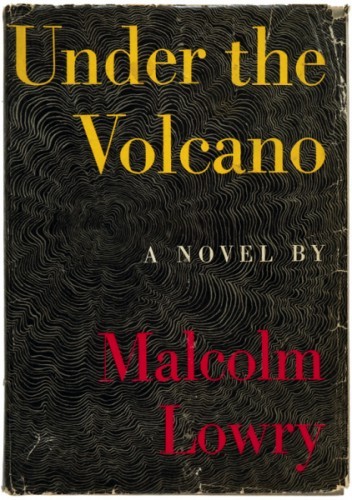
You will never find the above quote— so exacting in its prognosis of alienation—in any contemporary memoir. It belongs to literature, specifically Malcolm Lowry’s Under the Volcano, published in 1947, during a time when alcoholic and drug fiends—if they wanted to be published— transubstantiated their brutal experience into an exquisite poetry that demanded from the reader a severe attention if he or she decided to go along for the ride. For Lowry, an alcoholic who never beat his demons but exorcised them in this literary masterpiece, the devil doubled as the muse.

Under the Volcano is the story of Geoffrey Fermin, an ex-British consul drinking himself into oblivion in Quauhnahuac, Mexico. The story, like Joyce’s Ulysseus, comprises a single, eventful day, the Dia de Las Muertes, November 1st, 1938, a day that begins with his estranged wife, Yvonne, an American B-actress past her sell-by date, returning from California after a year’s estrangement. Along with the Consul’s half-brother, Hugh, they decide to travel to the nearby town of Parain. En route, they witness a crime that has later tragic repercussions.

The setting and time are important, related as they are to the major global event at the time, the Spanish Civil War, which, ideologically, had been a contest between anarchy and communism against fascism and, industrially, a testing ground for the weapons of mass destruction that would follow within a year, once Hitler’s Germany invaded Poland. The progressive ideas coming out of communism, particularly that of nationalization of resources, was a testy subject in Mexico, beset with its repressive Catholic heritage as well as its own Revolution’s legacy and the State’s very recent takeover of its oil reserves.

The best novels feature an interconnectedness between the greater world and the interior one and this complex relationship is evoked within the characters in different ways. Hugh, a failed commercial troubadour and utopian-minded drifter-dreamer, feels guilty that in spite of his convictions and the knowledge that the Spanish Republic’s defeat is a fait accompli, wonders if he has missed the one opportunity to do something honorable and meaningful in life. Of course, he disagrees with the Consul’s self-destructive apathy, yet he is not unaware of man’s survival instinct to let well enough alone what is not his battle to fight. This is eloquently expressed following the incident of the crime and his witnessing of the other passengers’ reaction: “Death they knew, better than the law, and their memories were long… in these old women it was as if, through the various tragedies of Mexican history, pity, the impulse to approach and terror, the impulse to escape, having replaced it, had finally been reconciled by prudence, the conviction it is better to stay where you are.”

The Consul, well aware of the benefits of isolationism, has his own contentions. His alcoholism is not a pleasure nor is it a form of escapism. It is a sickness, and the drinking is necessary for him to reach a physical and psychological equilibrium. The DTs strike whenever he attempts to empower himself any degree of free will over his disease. Just as bad is the sense of doom that pervades sobriety, liable to wipe out any sunshine or cheer. Sitting at a café, in view of a fair celebrating the holiday, the setting “had suddenly become transcendentally awful and tragic, distant, transmuted, as it were some final impression on the senses of what the earth was like, carried over into an obscure region of death, a gathering thunder of immedicable sorrow; the Consul needed a drink…”


Malcolm Lowry

Mexico, which Lowry once wrote in a letter to friend was "the most Christ-awful place in the world in which to be in any form of distress, a sort of Moloch that feasts on suffering souls," is a grandiose theater from which this tragedy plays out: Mexico and its ruined palaces, Gothic churches, hideous ravines, pullulating flowers, clandestine scorpions, and canvas-like skies where "high overhead sailed white sculpturings of clouds, like billowing concepts in the brain of Michelangelo." There is also its tequila and its mescal, the sad-eyed drunks and the corrupt police. In the turning point of the novel, when the Consul, Yvonne and Hugh encounter a brutalized Indian lying injured on the side of the road, one of the other passengers not only pockets the man's money and pays his fare with it but shamelessly keeps the pelf on his lap conspicuously for all to view. Was it any wonder then, that Europe was rushing headlong and heedless into another great war and that for those who knew better, the human race would not be worth dying for?

But in the end this is a love story and it is the Consul's tumultuous relationship with Yvonne that is the real source of his despair. Yvonne, having come to rescue him from Mexico and its addictions, has agrarian dreams, one in which they withdraw from the world onto their own farm, in the country, a place where Geoffrey would be able to write (he is working on a book on Mayan ritual, the Kabbalah, and other occult matters) while she tends their living space, looking after him, being his friend, his housewife, his lover. It doesn't matter that she knows nothing of the day-to-day affairs of such an endeavor, for after all, it is but a dream and one that can be easily discredited by reality. Though they never discuss it outright, Geoffrey suspects it's on her mind and though he loves the novelty of such an enterprise, he believes more in futility than fruition. Early in their reunion, he hints at the hopelessness of her schemes, his query, “What’s the use of escaping from ourselves?” quickly forgotten. There was not even real regret that this inevitable failure was something to feel bad about: “the past was irrevocably past. And conscience had been given man to regret it only so far as that might change the future.”

That the Consul may be pessimistic about his predestined perdition doesn’t make the reader any less sympathetic to Yvonne’s cause—her imagining of the farm comes as a contrast to a brutal sporting event—since the marriage, in spite of its flaws and blemished disgrace seems worth saving, as these two people, for all their mistakes, need each other desperately. The novel's greatest substance comes from the construction of the small details communicated between a man and a woman with a long tragic history, beautifully evoked in Lowry’s prose: “…as he approached she turned this hand palm upward…like an unconscious gesture of appeal: it was more: it seemed to epitomize, suddenly, all the old supplication, the whole queer secret dumbshow of incommunicable tendernesses and loyalties and eternal hopes of their marriage.”

Yvonne is no innocent: her affair with M. Laurelle, a childhood friend of the Consul is what makes it so hard for them to reconcile. It is not clear whether his alcoholism was responsible for the affair or the affair responsible for the alcoholism. This chicken-or-the-egg argument has no bearing for Geoffrey and Yvonne in their current predicament. They are doomed lovers, a Romeo and Juliet denied any future union of consummation not due to external parties but from deep within themselves. Being responsible for so much unintentional pain upon the other, is it any surprise “how alike are the groans of love to those of the dying…?”

The Consul understood the inarticulateness of his debilitation and that though every drunk’s tragedy might be as mass-produced as the liquor he drank, his very real pain was personal in its broken-tongued head-spinning downfall, a sui generis descent into a forgettable void. People might help you, they might care for you, but in the end, you were on your own: “In the final analysis there was no one you could trust to drink with you to the bottom of the bowl.”

This may be true. But as an old barkeep consoles Geoffrey on his long day’s journey to the end, there can always be a sense of companionship among the lost nevertheless, for “I have no house only a shadow. But whenever you are in need of a shadow, my shadow is yours.”