Sunday, February 7, 2010
The Spirit of '76
Friday, January 29, 2010
In Memoriam

This past Wednesday, two larger-than-life writers, who had not insignificant effects on my world view, passed on. That Howard Zinn and J. D. Salinger died is not especially tragic-- Zinn was 87 years old and Salinger, 91, and certainly their very best days were behind them. Zinn's most famous work, The People's History of the United States, was published in 1980 and Salinger's The Catcher in the Rye in 1951. Both men are old enough that they served in the Second World War, Salinger participating in D-Day and Zinn as a bombardier, whose vigorous anti-war beliefs stem from being one of the first pilots to use napalm, dropping it on Royan, France, at the end of the war. Zinn and Salinger had paradoxical reactions to their successful careers in letters. As much as Salinger withdrew from public life, Zinn embraced it, lecturing at universities and rallies on the role of the average American in producing progressive change, teaching that it has been the participation and inspiration of ordinary individuals, the unsung heroes, who have effected whatever liberal programs we enjoy (and take for granted) today.

Monday, January 25, 2010
More Than Just Bad News on Page 25

Of the considerable technological achievements of the twentieth century-- the automobile, the jet airliner, the Internet, DNA fingerprinting, the bomb-- none have had as profound an effect on everyday life in Africa as the invention of the plastic bucket. Consider that for centuries that women used heavy clay or stone vessels to fetch water for the day's cooking, drinking, and washing. Traditional tribes unfamiliar with wheeled vehicles required the village women to carry this heavy container on their heads over great distances. The advent of the everyday and ordinary plastic bucket-- cheap and light and to us from the West oh so sundry-- revolutionized life in Africa. Longtime resident, the Polish journalist, Ryszard Kapuscinski, in his collection of writings on the continent, "The Shadow of the Sun," writes appreciatively for small things, aware that in Africa if a plastic bucket be a miracle, then to be grateful for small miracles nonetheless.
What Is It All Supposed To Add Up To, Singapore?

If there is one thing visitors to Singapore complain about, they say it's boring and that once you've done your shopping you can move on. Certainly, consumers in revolt would find themselves disgusted by the buyer's impulse running the national engine. On Orchard Road alone-- a two-mile boulevard of wide sidewalks and tall fruit trees-- there are dozens of enormous shopping centers including Orchard Central, Ngee Ann City, and Wheelock Place, boutique-rich megalopises catering to a great gamut in tastes. Prominent are the big names and Armani, Gucci and Louis Vuitton enthusiasts with good credit can outfit themselves for the next dozen balls. Ubiquitous is the handsome lady with stooped shoulders, weighed down by designer label bags in both hands. Big spenders and small ones can cool their heels at any of the number of Starbucks cafes en route. And this is only Orchard Road, the grandest shopping district in a city designed for mass consumption and air conditioned pleasures.
Sunday, January 24, 2010
Being Happy


Monday, January 18, 2010
Of Four Horsemen, the First That Comes Riding Into Town

The End of the Romanov Dynasty
In 1884, a lovely 12-year-old princess, Alix, daughter of Grand Duke of Hesse-Darmstadt and granddaughter of the illustrious Queen Victoria, traveled to Russia for the occasion of her elder sister's wedding to the Grand Duke Serge, brother of Emperor Alexander III. It was at this relatively insignificant royal union that young Alix met young Nicholas, the Tsar's 16-year-old son. Nicholas fell hard for Alix and they were eventually married. She bore him four daughters and, finally, one son, Alexis, the heir to the throne. Alexis was a delicate child, bruising easily. He suffered from hemophilia, a condition in which blood fails to properly clot when wounded. Hemophilia is a genetic disease found in the female X chromosome and passed to male offspring. The elder women in Alix's family tree, including Queen Victoria, were carriers of the disease. Alexis was cared for by many doctors until the Royal Family--particularly the Tsarina--embraced the special healing powers of the wandering mystic, Rasputin. When the First World War broke in 1914, the Tsar left to lead the Russian armies on the Eastern Front. His wife, plotting with Rasputin, disputed with the Duma and the people. Rasputin, a notorious alcoholic and womanizer, abused his influence over the Tsarina to a breaking point. One day in March a bread riot turned political. The Russian Revolution had begun. Within a very short time, the Royal Family was captured by Bolshevik forces and a few years later, executed en masse in the foothills of the Urals at Ekaterinberg, in July 1918, ending more than 300 years of the Romanov dynasty.
Thus, in other words, a rare genetic condition is hugely responsible for the Russian Revolution and the not-small repercussions, or so the author, Frederick Cartwright, suggests in his fascinating collection of conjecture called, straightforwardly, "Disease and History." In it the usual suspects are rounded up: the Black Plague, smallpox and the indigenous Americans, malaria and the inaccessibility of the African interior. But there are some interesting speculations, particularly when diagnosing the madness of certain monarchs, most especially Henry VIII and Ivan the Terrible, who began their reigns as firm, even heroic kings, but straying into bizarre if not catastrophic policy, were most likely victims of syphilis, insanity being one of its chief characteristics.
Disease, of course, is most often spread during the initial contact between foreign cultures. When a population lacks immunity, disease spreads very much like a wildfire does, leaping from person to person. If we go back to antiquity, it's very well known that it was in the post-Christ decades that Imperial Rome began its serious decline. Mainly, this is attributed to corruption and incompetence at administrative levels as well as a series of barbarian invasions. But what goes underreported is the scale of disease brought with Germans and Huns. Disease meant agricultural fields were abandoned, leading to famine. In a situation of scarce resources, war becomes inevitable (Cartwright, though he writes like a secular humanist, loves invoking the Four Horsemen to drive his point). It was in this period of massive death that Christianity found many converts. This was partly because of the generous afterlife promised to believers, but also because many of the miracles attributed to Jesus (especially by Luke) are those in which divine intervention equates to the healing of the sick. Many Christians became physicians but not very competent ones. Like the Greeks and Romans before them, they propitiated, but to various saints, rather than demigods. Should a person fail to heal properly, they figured there had been an error in the protocol or the wrong saint had been appeased. Working as faith healers rather than as empiricists they would control medicine's school of thought as such through the Dark Ages.
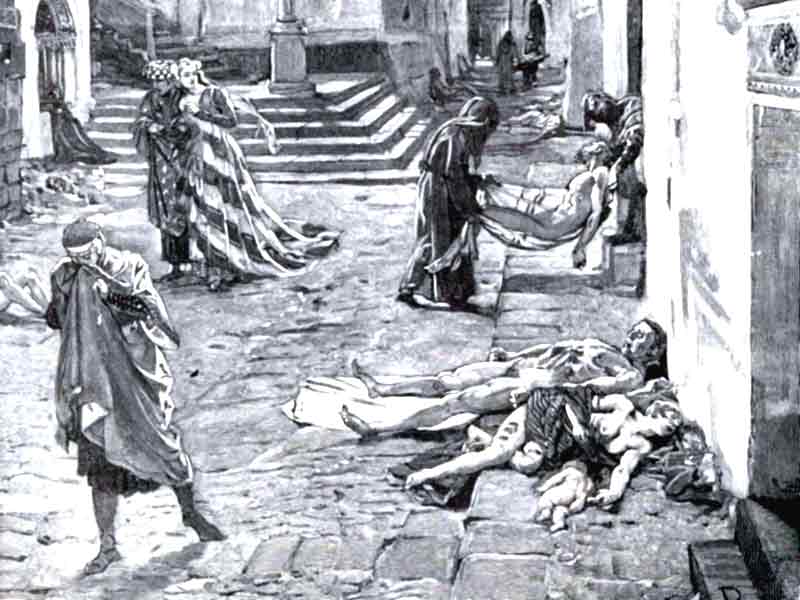
Nearly a thousand years later, these charlatan doctors were bamboozled by the Black Plague. It's hard to contemplate the physical as well as the psychological impact this had on Europe. The Pope had to bless the River Rhone so that corpses dumped into its currents would have a proper Christian burial (what that did to the drinking water, down river, I do not doubt). Whole frigates lost their crews and these ghost ships drifted unmanned in The North and Mediterranean Seas. And then there were the flagellants, who saw the plague as divine punishment for man's sins so as to spare communities (and themselves) they would publicly whip themselves to appease a vengeful God.
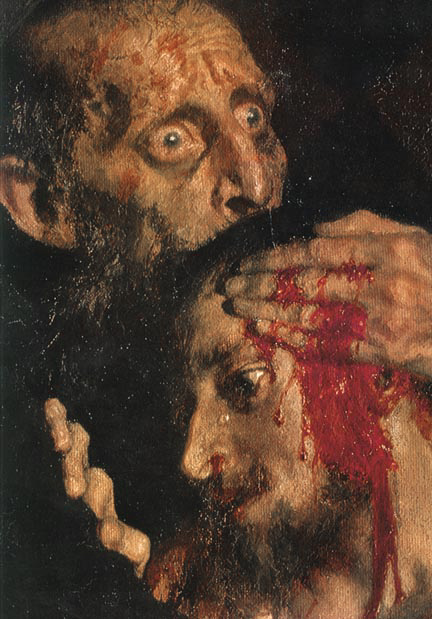
One of the first major consequences of the Age of Discovery, epistemologically speaking, was the introduction of syphilis into Europe. It might have come with Columbus from the New World or it might have come via Portugal with Henry The Navigator, who was then opening up to the possibilities of the slave trade in Africa, but its symptoms in Europe are first recorded in the early 16th century. Famous for being venereal, initially it was passed through skin or oral contact. Syphilis was devastating to the layman, but here Cartwright is concerned with its effect on two monarchies. As mentioned earlier, one of the phases of the disease is a complete abandonment of common sense. Judging by his moniker it is not much a stretch to guess Ivan the Terrible went a little nuts. He is a well-known sadist who did not find piety irreconcilable to his bloodlust, to wit: "Ivan prayed with such fervor that his forehead was permanently bruised from his prostrations. These bouts of prayer were relieved by visits to the torture chamber, conveniently situated in the cellars."

Of course, by suggesting the legendary Henry VIII was also a syphilitic, is a very great offense to a very great number of Anglophiles. But Cartwright makes some good points. Those familiar with Henry VIII know he suffered from gout, married six women, and famously broke with the Church (in better times he had been nicknamed 'Defender of the Faith' by Pope Leo X). Cartwright, looking at the evidence, can only speculate but he believes it was syphilis that had prevented the Mighty Lion from producing a healthy male heir. There were numerous miscarriages among his wives and his surviving children suffered from some defects. Edward and Mary were physically and mentally unstable and Elizabeth, the Virgin Queen, may have waived marriage fearing her own sterility and the pressures she would have undergone to produce an heir (syphilis is congenital, passed from mother to child in the womb). Impotence is also a symptom and perhaps Henry had become fickle with his wives, abandoning them when they failed to arouse him. Anyways, we're just having fun here at Henry's expense, but could possibly the Church of England (and eventually then the English Civil War) have evolved from a lapse of judgment caused by an STD? Nothing is impossible...

Any discussion about disease must eventually lead to talk of a cure and one of man's most ingenious developments as an empiricist was his innovative discovery of the vaccination. Smallpox was a notoriously terrorizing disease, killing off large numbers during outbreaks. But it was learned that should a person survive a mild case, he or she would develop immunity. Thus it made sense that a person should have some exposure to smallpox rather than none at all. This idea of "inoculating" a person-- contaminating a healthy person with a disease-- goes back a millennia to Chinese medicine but was regarded as suspicious by the medical establishment for decades until some brave, innovative physicians were able to prove its effectiveness. Today smallpox no longer exists in the developed world and is very rare anywhere.

During the twentieth century, we have been so successful at understanding disease-- its causes, symptoms and treatment-- that we have seen our numbers grow exponentially. This problem of population is what Cartwright discusses in his conclusion and he forms an argument that our problems largely stem from man's instincts of self-interest as well as his ethnocentrism. He pleas to our humanity: "If man destroys himself, his destruction will most probably result from his obsessive emphasis upon the differences rather than the similarities between the races and nations. The primitive hates and fears are still with us, ready to break through the thin skins of civilization. Hate and fear cannot form a basis for the world-wide cooperation by which alone Man can save himself."
It's a wonderful sentiment but unfortunately outside the ingenious capacity of scientists. Economic markets and the governments that move "the invisible hand" are not concerned with management of resources, observance to the environment, and the well being of man. For the health care and pharmaceutical industries the bottom line is that a major disease outbreak requiring vaccinations, pills and treatment would be good for business. Until this reality is met with serious reform and a wholesale evolution of popular sentiment then we shall remain at the precipice.
This, likely, will be the final verdict on man as a species; whether he is meant to endure or to be extinguished.
Saturday, December 12, 2009
It Don’t Worry Me

Robert Altman’s film, “Nashville” holds that mirror up and never drops it. This is a movie very much about time and place, which means it is about crossroads. Nashville, the city, is located on the Cumberland River in northeast Tennessee, an historic middle point, halving the country between North and South and until the railroads reached California, lay betwixt the settled Eastern seaboard and the Mississippi frontier (it was a “border” state that fought for the Confederacy in the Civil War).
Made at a troubled junction in time (post Vietnam and Watergate), the film is curiously tied together by the pervasive presence of a roving electioneering van. It plays the prerecorded voice of Hal Phillip Walker, a fictional candidate of the Replacement Party railing against the system in populist rhetoric, articulating the era’s disenchantment with taxes, cronyism, the job market. This demagogue’s blabbering matter-of-fact rationale goes mostly unnoticed by the characters of “Nashville,” many of whom are too self-absorbed to consider politics as something worth their commitment. The 1960s are over and anyways this isn't California, this is Nashville. (Jeff Goldblum's weird motorcycle man riding around in his Haight Ashbury duds on a low riding 3-wheeler is just about the only hippie and no one takes him seriously-- the Easy Rider generation at this point was more of a caricature than a threat to the lifestyle of good o' Southern boys, who have grown their own hair long anyways.) The characters of Nashville are not interested in what might make America a better country and they certainly wouldn't want to think about logistics: these are Me Generation people with personal agendas. In their various pursuits of power and satisfaction they are sexually promiscuous, high-strung, opportunistic, and yet, often, unfailingly idealistic about one’s possible place in the world. Thus, the American Dream, for all its nasty surprises and disregarded caveats, is very much alive here.
Made with the signature Altman flair, “Nashville” has no genuine hero (“heroism:” a troubling concept in this time anyways) but follows two dozen characters in the city of Nashville during a spirited five days of music, sex, and politics. The film is populated by country music stars, political kingmakers, aspiring singers, and this being about the music industry, groupies. These are imperfect men and women, but this isn’t a bad thing, necessarily—it’s honest and most of the time men and women are doing whatever they can to get ahead. This, the system may not condone but it has always looked the other way. Too rarely does a filmmaker suggest with his characters that the audience should watch their judgment, as in, “What about it? You think you’re better?”
To make it anywhere in America, talent may not be as crucial as ambition. You might even say it is more important to be than to do as in, “I’m a singer” rather than, “I sing.” Identity politics is the unconscious game as it conveys our usefulness to others. There are plenty of “celebrities” in Nashville, to whom an audience projects its sense of destiny. In Nashville this means we want to flatter them, fuck them and even murder them. Power is one of the most slippery slopes. The made-it country music stars understand that fortune fluctuates and that today’s hit is tomorrow’s oldie. They may sing sentimentally about love, but there’s not much of it to go around. Sex is about as far as the promise goes…
Typical of Altman, with so many characters to pick through, plot, at least in a classic conflict/resolution structure we’ve been weaned on, fails to materialize. There are performances at the Opry, political fundraisers, major traffic accidents, bedroom scenes. His touch is subtle. What seems unrelated, isolated, or random may be superfluous if plot is one’s goal but Altman is exploring ideas. As a result, the performances feel extremely natural, so that the experience becomes as voyeuristic as it is thoughtful. In spite of it being about the capricious and malleable quality of power, the theme never slips into darkness, for the film is too clever and humorous to make us feel awful about things. In other words, there is no “good” or “bad” in the film, there’s just humanism, which may be about doing the wrong thing at the wrong time, but surviving somehow. You may not identify with these kinds of characters but you can certainly sympathize with them.

As good as the acting is, “Nashville” may be most significant for its songs. This is the last great era of country music before Nashville as a sound became glossy, sterile, and trite. These are songs embodying the last years in which country music sounded ‘country’ in the way that it was “of the people, by the people, for the people.” Today, one rarely hears the human touch on a country music record. It sounds like music by committee, programmed for suburban Sony stereo systems.
In the opening credits Henry Gibson is recording an amusing patriotic ditty, drawling, “We must be doing something right to last 200 years.” Keith Carradine sings, “I’m Easy” to an audience that includes multiple lovers, each of whom fancy the song is a personal love letter. Ronnie Blakley plays Barbara Jean, a diva inspired by Loretta Lynn, a convincing cult of personality portrayed as a troubled angel, for whom fame is fated to be tragic.
And then there is Barbara Harris, who plays Winifred, a down-on-her-luck wannabe who is fleeing her husband. She has holes in her tights, lugs a big bag of laundry, poaches sandwiches at catering events. Moving like an animal, twitching, instinctive, looking by all conventional wisdom, a crazy. Yet, in the end, it is she who gets her big break on a stage before thousands in the most dramatic fashion possible. In a magnificent soprano backed by a black choir, she rehabilitates a traumatized audience, getting them to sing along with what might as well be a chain gang work song, whole-heartedly embracing lyrics that are upbeat, celebratory, earnest, yet completely absent of irony, “You might say I’m not free...It don’t worry me.”
There, before a political rally masquerading as entertainment, the violence of American life strikes and when it does, it does not need to be explained. It just feels inevitable. Yet in the ashes of gun smoke, a star is born. The audience applauds its appreciation. The Stars and Stripes flutters gracefully in the wind. The American Dream lives for another day. This “dream” may seem stingy to most of us but when it does strike for an individual, it gushes, like a geyser in a Texas backyard.

Saturday, December 5, 2009
What We Don't Talk About At Dinner or When We Go to the Movies
In America, good dinner etiquette entails avoiding certain contentious topics while suppering on Mom’s meatloaf and potatoes. Although for many Americans, it’s never the appropriate time to discuss politics or religion (at least in a manner that suggests some degree of dissent or irascibility), as a rule it’s an especial faux pas to wax your views with cutlery in hand. Whether it has more to do with possible digestive disorders that may develop from unpleasant –isms or a communal tendency towards harmonious dining, I do not know. If one diatribes too long, the pea soup gets cold. Politics—it may be more offensive to dining than putting your elbows on the table or licking your plate.
It’s fair to say that unless your politics fall within a certain spectrum accepted by the majority, audiences are not going to want to see it in a movie. Usually, only when a delicate subject has evolved into a moot point does Hollywood venture to encapsulate with academy award performances and a melodramatic score by Hans Zimmer. Exploring a hot-button issue while it is contemporary is a no-no but criticizing America is generally the nightshade in what constitutes “box office poison.” Going further, if you intend to take a stand against American hypocrisy and frame your frightening dystopian hypothesis within a pseudo-documentary format, you'll really be pushing it— in the case of Punishment Park, you’ve pushed your release date thirty years, which was how long the film was banned in America.
Made in 1970, the film is very guilty of being of its time. We’re talking now Weather Underground, Black Panthers, COINTELPRO, Vietnam, the 1968 Democratic convention in Chicago, Kent State shootings, the hyper-politicization of America’s youth and minorities and the great divide that stretched between those who thought America was the best of all possible worlds and those openly advocating social revolution. There were no two ways of seeing— there was one or the other, and the other was immoral. Were kids who forcibly shut down a draft board office heroes or traitors? In such hotheaded circumstances, objectivity was the last thing on anyone’s mind.
Punishment Park takes a real deal piece of legislation— 1950’s McCarran Internal Security Act, which authorizes detention for disloyal or subversive persons in times of war or internal security emergency— and examines the theoretical consequences should this law be enforced. As the narrator of the film explains in the opening shot of an American flag flapping in the desert:
“The President… is authorized without further approval of Congress to determine an event of insurrection within the United States and to declare the existence of an internal security emergency. The President is then authorized to apprehend and detain each person as to whom there is reasonable ground to believe probably will engage in certain future acts of sabotage. Persons apprehended shall be given a hearing without right of bail, without the necessity of evidence and then shall be confined to places of detention.”
This narrator is a member of a West German/ British documentary filmmaking team covering the trial of accused subversives as well as the punishment of another group. Over the course of three days, defendants are brought before a citizens’ tribunal where they attempt to justify the morality of their actions (there being no tangible evidence they are a genuine, violent threat, their charges are based on words, ideas, abstracts) and are even offered in some instances to recant their beliefs by signing loyalty oaths to the government.
Scenes from this trial are intercut with coverage of a group of prisoners struggling through ‘Punishment Park,’ an area in the California desert, where prisoners can win their freedom if they “capture the flag.” The flag they are to reach is 53 miles from their starting point. If that weren’t challenging enough, the detainees are sent into the desert with no food or water in stifling meteorological conditions, all the while being pursued by police and National Guard troops, hunted if you will. The park serves a two-old purpose: it becomes a training exercise for troops as well as a “punitive” trial for “subversives.” Moreover, if some dissidents are killed in pursuit, their deaths save the taxpayer money and keeps prisons a little less crowded. If convicted, they are “criminals” and thus their worth as human beings has become negligible.
The accused standing trial is a motley bunch, white and black, male and female, hairy, bearded, bell-bottomed, yet bespectacled and somber, suggesting intellectual habits. In fact these defendants are not garden-variety hippies or Sunday afternoon activists at all; rather they represent the philosophical voice of protest. Leroy Brown is an author, broadcaster, and political activist. Jay Kaufman is Cofounder of the Committee Against War and Repression. James Arthur Kohler is a conscientious objector. These people are thus organizers, pamphleteers, and pacifists. It is they who provide the intellectual arguments of protest. Prosecution makes perfect sense in this context. Cutting off the head is pure Machiavelli.
On the other hand, the tribune is entirely white with but a single woman affecting the demographic singularity. None of them are elected officials. They are amateurs working in a jurisprudential capacity wielding indiscreet judgments on lifestyle choices eminently unfamiliar to their own, in effect running a kangaroo court or star chamber in which the game is fixed before it’s even started. It is true that they are generally older, though it's not necessarily a generational gap thing— whether Frank Sinatra is more of a man than Jimi Hendrix, say-- but rather has everything to do with preferred paradigms. After all, the soldiers and police who enforce the decisions of the establishment are the dissidents’ contemporaries and are very much of the opinion that the “criminals... get what they deserve.”
In the deliberations between the court and the accused, everyone’s talking, no one’s listening. The exchange veers dangerously between philosophy and churlishness. Generally, the prisoners are derided for their immorality, as to the tribunal minds a crisis of conscious is intimately connected to the repudiation of American “values.” More than an authentic trial, the back-and-forth reminds one of bitter family spats, summed up perfectly when one tribunal member complains the kids could have used “less Spock and more spank,” a hit against the baby boomers’ parenting guru Benjamin Spock (who, incidentally, was a major figure in the anti-war movement and was arrested for attending numerous demonstrations). Because of their emotions they cannot rise to their responsibilities nor realize how hypocritical it is that they should imprison those who deny America’s claim to being a “free” country.
You could argue this is the filmmakers’ polemic. Or you might say Main Street is being defensive. Whatever the case, their inane remarks become fodder for the accused to define their dissent in very strong, if not poetic language. Leroy Brown, the black author comments, “America is as psychotic as it is powerful and violence is the only thing that can command your goddamn attention.” Allison Michener, an activist elaborates on this during her session, arguing, “People become violent when they are deprived of their basic human needs.”
In the field, the prisoners running for their freedom are tailed by the documentary cameramen who query them on their condition, disposition, attitude. A young man in a ragged shirt, dirty, bruised, asks, “If they kill me now what difference does my politics or any politics make? I’ll be dead.” Another prisoner on the run clarifies, “My view is not committed to revolution…it’s committed to sanity.” Was this sentiment not famously reconstituted by comedian Stephen Colbert when he suggested, “Reality has a liberal bias.” It is one of the field’s pacifists that puts the plight of the accused in the most accurate moral context when he says, “Right now, the honorable thing to do is to be a criminal.” It is a fair extrapolation: if the government’s laws are unjust and it cannot justify its wars or violation of civil liberties, then individuals who break those laws whether it is draft evasion or persuasive agitprop are arguably the moral example.
When the dissidents are running for their lives in Punishment Park, the narrative of survival becomes a treatment on the various approaches to protest. The prisoners quickly disperse into factions choosing very unique survival techniques: basically they can meet the system with violence or nonviolence. Thus philosophy materializes in a simulated environment with real consequences. What is the right way to reform society evolves into a matter of life and death. In very tense scenes in which police and National Guard troops apprehend the activists in various stages of flight, the answers prove disastrous. These are probably the very best moments of the film as they are rife with confusion, anger, desperation, and madness. The cameramen too, cannot remain neutral. They become hysterical at what they perceive to be injustice and spar with the police.
One speculates on the casting— these are non-professional actors working from an outline rather than a screenplay— were they chosen for their beliefs? The acting, if amateur, is good. It never feels put-on, even when the dialogue is occasionally outrageous (the character of Leroy Brown has two of the best lines in the film: “How the fuck are you gonna overrule the constitution, man?” and “You just want to sit on your fat dividend-drawn ass and draw dividends!”) Did the director play off the actors’ beliefs in order to maximize tension? (The Stanford Prison experiment was conducted around the same time.) There is an us-and-them feeling to the actors that is hard to fake. As far as pseudo documentaries go, Punishment Park feels frighteningly historical.
In his closing statements, the defense attorney reads a quotation that best illustrates the inherent dangers the tribune is engaging with conviction and arbitrary sentencing. The speech seems straight out of Richard Nixon’s playbook: “The streets of our country are in turmoil. The universities are filled with students rebelling and rioting. The communists are seeking to destroy our country. Russia is threatening us with her might. And the republic is in danger. Yes, in danger, from within and without. We need law and order or our nation cannot survive.”
But it’s not Nixon speaking in 1970, it’s Adolf Hitler in 1932. Once a country begins cutting civil liberties in the name of national security, the consequences of compromise are far-reaching. As one of our founding fathers, Benjamin Franklin, so aptly put it, “Those who sacrifice liberty for security deserve neither.”
What does it all mean now? Quite a bit, actually, even in the post-Bush years. The drama of Punishment Park is very much alive today, nearly forty years later. Even in the age of Obama, Guantanamo Bay remains open and an escalation of troops in Afghanistan is called a “surge.” And a “terrorist” is still very much a catch-all phrase for those who might try to fight the system, whether through violence or otherwise.
The director of Punishment Park is Peter Watkins, an Englishman. A number of individuals were offended that a foreigner had the gall to dramatize our society in such critical terms. But someone's gotta do it if we won't. There are some very important problems in our country. We would do well to talk about them, if not at dinner, at least over dessert and coffee.

Tuesday, November 10, 2009
In Defense of Self-Centered Young Men
This novel— an episodic mélange of prose, stream of consciousness, poetry, correspondence, and theatrical dialogue— is about one man’s quest for identity by means of love, work, and philosophy. This patchwork technique Fitzgerald employs is called “modernistic” by its defenders since it defies accepted conventions of structure. But it is because of careful structuring that we become emotionally involved in fiction; otherwise we forget the point of the reading and in this day of diminished attention spans, language alone may not be enough to guarantee the commitment of the reader. Thus, the precarious existence of This Side of Paradise today: it is famous for making Fitzgerald famous rather than for the work itself.
Interestingly enough, rather than feeling it was written by Fitzgerald it has the atmosphere of several writers—the writing has Wilde’s pithy wittiness, Waugh’s schoolboy sentimentalism, Joyce’s philosophical diatribes, even Sinclair Lewis’s radicalism, held together by Fitzgerald’s mischievous turn of phrase.
The story hinges on a hypothesis posited to Amory at a young and impressionable age. Every apprentice philosopher has his mentor and Amory’s is in the Catholic Church, described thus:
“Monsignor was 44 then, and bustling— a trifle too stout for symmetry… When he came into a room clad in his full purple regalia he resembled a Turner sunset and attracted both admiration and attention… He was intensely ritualistic, startlingly dramatic, loved the idea of God enough to be a celibate, and rather liked his neighbor.”
Although he doesn’t share his faith in the Church, The Monsignor is Amory’s intellectual hero. He is put to quest, Candidelike, when the Monsignor describes the difference between a personality and a personage and why the latter is most preferable:
“Personality is a physical matter almost entirely; it lowers the people it acts on—Now a personage, on the other hand, gathers. He is never apart from what he’s done… When you feel that your garnered prestige and talents and all that are hung out, you need not bother about anybody.”
It’s rather pretty, delicate, and incoherent but enough for Fitzgerald, at least, to build a novel on. The idea is put to the test at Princeton among the co-eds where Amory encounters a variety of “personalities,” that Fitzgerald doesn’t develop well enough to constitute a “personage.” In the case of Amory Blaine, his own lack of something substantial beyond the realm of ideas fails him at work, play, and love.
When a crisis is absent in a novel, it’s critical that we sympathize with the character. It’s not always easy getting along with Amory Blaine. He’s middle class middle American trying to make it in Princeton and New York in the late teens, early 1920s, a time just after what was then known as The Great War, when opportunities were opening up for ambitious young men. He runs with a literary set in college, writes poetry, falls in love. He is a thoroughly self-conscious individual, sensitive to class and caste and as his fortunes fail, feels acutely dissatisfied that he should be so powerless in spite of his rhetorical flair.
Never is this clearer than when he loses his love interest, Rosalind. Although this young debutante loves Amory’s wit and her chemistry with him is superb to all suitors she cannot commit to some advertising copywriter earning just $35 a week no matter how much potential there is in his pipe dreams. In other words, she willfully chooses money over love. Fitzgerald is at his most delightful when describing his characters and he has fun detailing Rosalind:
“She is quite unprincipled; her philosophy is carpe diem for herself and laissez-faire for others. She loves shocking stories: she has that coarse streak that usually goes with natures that are both fine and big. She wants people to like her but if they do not it never worries or changes her.”
This is beautiful stuff. He may as well be describing America itself but it’s supposedly based on Zelda Sayre, the Zelda, famous of all flappers, from which Fitzgerald was drawing inspiration. This Side of Paradise was cobbled together with an earlier draft of a novel called The Romantic Egotist, as well as unpublished poetry and scraps of prose diary entries—his and Zelda’s— in order to compose a salable novel that might win her favor. It’s no wonder that this was the same guy who could come up with Jay Gatsby, Daisy Buchanan, and the fashionable parties of West Egg.
Its flaws aside, This Side of Paradise, can be enjoyed for the insight it yields into a great American writer. Rosalind could be describing the Fitzgeralds’ untold future when she laments, “I suppose all great happiness is a little sad. Beauty means the scent of roses and then the death of roses.” Amory goes on a self-destructive two-week alcoholic binge once she breaks things off for good, an incoherent, solipsistic misadventure; the kind that Fitzgerald would become notorious for. “To hold a man a woman has to appeal to the worst in him,” Amory muses on the Atlantic City boardwalk, a line of thought that excuses our worst excesses in the name of love.
In a series of reversals, both self-inflicted and the fated kind, Amory has received his comeuppance, but in becoming a wandering, lovelorn derelict, he discovers his artistic sensibility and what it means not only to be a man, but a personage: "He found something that he wanted, had always wanted and always would want— not to be admired, as he had feared; not to be loved, as he had made himself believe; but to be necessary to people, to be indispensable.”
As a truism to live by, it’s as good as any, but worth the effort of the modern reader when there is so much tempting us? This Side of Paradise is too episodic to be a great novel; and any book that climaxes with a debate regarding the merits of socialism betrays its literary value as well as its narrative truancy. But there are many fashions in which to consider art. It must have been exciting when this declaration of intent was published with its pretensions towards power, greatness and wealth, signed by ambition. This Side of Paradise sold through its first printing quickly, earned the praise of H. L. Mencken, and put F. Scott on the map for good. And though his more famous novels are associated with the Jazz Age, it's this early effort that more clearly attempts to speak for his generation’s dissatisfaction with contemporary American life as they were finding it and ready-set to change it. It begins with recognition from within: “I know myself… But that is all,” so goes the novel’s famous last words and they tell all.
If it took writing the novel to get the girl, getting the girl meant, eventually, The Great Gatsby. As far as very public love letters and tell-all memoirs disguised as literature, this means the whole damn enterprise was well worth it.