Sunday, February 7, 2010

The Spirit of '76

The most humanistic pronouncement in the history of political tracts, that which asserts "life, liberty, and the pursuit of happiness" are among man's "certain inalienable rights," is the utopian secular American signature written into our Declaration of Independence. That was the spirit of '76 and a quality of political imagination that has been difficult to live up to ever since. Certainly, Thomas Jefferson's ebullient claims taken at face value are abstract but in the proper contexts they can be defined with certain qualifications. For example, the right to "life" would be the right to proper, affordable health care. "Liberty" would entail a transparent government, the closure of illegal detention centers, proper civilian trials and habeas corpus. The pursuit of happiness is the fuzziest of the three, yet so-called modern day patriots would probably equate it with mass consumption. But if the revolutionaries of 1776 knew their strenuous efforts were undergone so that their descendants could laze around sofas tweeting, facebooking, shopping, and eating "freedom fries," would they have risked their fortunes fighting the formidable British empire? Or might they have stayed home to tend their farms, lamenting that the American Dream in a philosophical sense would always be just that, a dream?

David McCullough's history of George Washington's Continental army in the very grim fighting year of 1776 isn't asking those questions. As an establishment historian, a winner of two Pulitzers, McCullough is strictly concerned with the facts, drawing so generously from a prodigious survey of primary sources it's easy to forget that he's even there. 1776 is a focused work meaning that 1775's Battle of Bunker Hill is mentioned in passing and the battles of Lexington and Concord not at all. Nor are Valley Forge, the Maquis de Lafayette, and Yorktown discussed. As any sixth grader who passed his civics test will tell you, 1776 is the year the Continental Congress signed the Declaration of Independence in Philadelphia, but even that monumental convergence of great philosophical minds merits just one paragraph. This book is about one man, George Washington, and his ragtag army.

As a fighting force it was a pretty pathetic sight, the Continental Army. Consider, in his own words, Washington's dire assessment of his underpaid, underfed, undertrained motley ranks:

"Men just dragged from the tender scenes of domestic life-- unaccustomed to the din of arms- totally unacquainted with every kind of military skill, which being followed by a want of confidence in themselves when opposed to troops regularly trained, disciplined, and appointed, superior in knowledge and superior in arms, makes them timid and ready to fly from their own shadows."

Your Average Soldier in Washington's Continental Army

1776 is divided into three parts: the siege of Boston, the battles of New York, and Washington's retreat through New Jersey, into eastern Pennsylvania. McCullough portrays the strategies of the British as well as the American forces in order to create a thorough narrative of the events in the early stage of the war (though to British high command, the word, 'war,' was never used as that would legitimize the conflict as one between sovereign states; 'rebellion' being the preferred epithet.) The British did not want to fight and would have been happy with a capitulation returning things more or less to the prior status quo. In fact, throughout the contest, the British eagerly proffered the olive branch, going so far as to publish a Proclamation granting amnesty to all revolutionaries conditional on their signing of a loyalty oath. That was refused by the rebels, even when it appeared the destruction of the Continental Army and therefore the American military seemed all but certain.

As many Americans would be today, many civilians at the time were perturbed by the revolution, more concerned with commerce than politics. Those so-called "Loyalists" were not necessarily monarchists, but just ordinary people at odds with a sweeping movement, more concerned with property and the safety of their family. Hoping to expedite the end of the war, many of them gave intelligence to the British, jeopardizing secret missions and troop deployments. Had Vegas odds been around in '76 only fools would have wagered on the rebels. Although in Massachusetts the Americans defeated the British in the challenge to command Dorchester Heights (instigating a humiliating Redcoat retreat), the situation went sour in New York, a city that was viewed by both sides as the key to the Hudson River and thus should it be taken by the British they would be able to split the rebels geographically, isolating New England, disrupting communication and supply lines. The Americans spent the spring of that year fortifying south Manhattan and Brooklyn against a formidable British siege: at one point one hundred frigates docked around Staten Island forming the largest Armada ever seen on the continent. But after the Americans lost The Battle of Brooklyn (it's interesting to place the fighting in a modern city context), Washington and his soldiers had to abandon Manhattan, the fortifications, and of course control of the Hudson River. It didn't do well for troop morale. Soldiers deserted in droves often taking their muskets home with them as souvenirs. Many of them, shoeless and hungry, deserted to the enemy.

Leading them in their flight was George Washington, a by-his-bootstraps surveyor-turned-wealthy planter with virtually no military experience prior to the war. What comes across from McCullough's exhaustive research is a plainspoken man of common sense, who was a small town fellow in over his head and knew it:

"Could I have foreseen the difficulties which have come upon us, could I have known that such a backwardness would have been discovered in the old soldiers to the service, all the generals upon earth should not have convinced me of the propriety of delaying an attack upon Boston till this time."

If Washington could have "justified the measure to posterity, and my own conscience," he would have, "retired to the back country, and lived in a wigwam." But that's why he's celebrated today as one of the Great American Heroes, because he believed in the Cause so fervently, that he was willing to risk his livelihood, and being a self-made man also had much to lose. Today he is revered as a national godhead but in the early stages of war, he lacked decisiveness and good judgment. Had the British known just how dire his situation was and had pursued the Americans beyond New Jersey and into Pennsylvania, it is likely the revolution would have failed and Washington would have disappeared into history books as a footnote. Perhaps, our journey to autonomy would have progressed like Canada's, evolving into dominion status, a bloodless passage towards sovereignty.
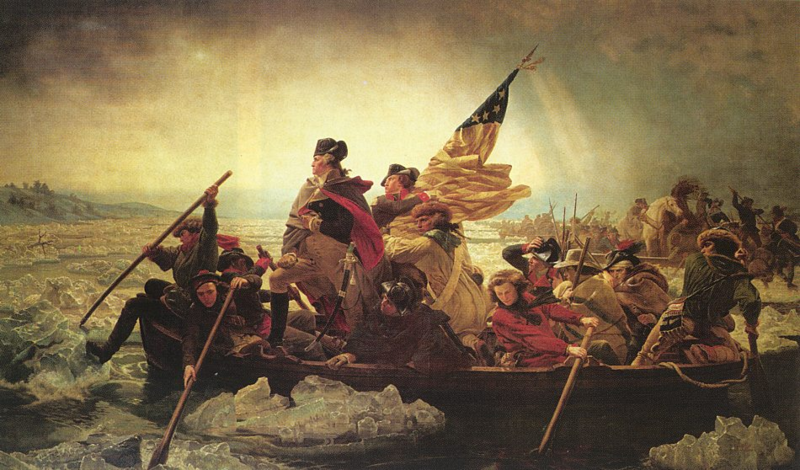
Crossing the Delaware

But Washington put on a good fight, which of course being primarily a military history, composes the climax of 1776. Famously on Christmas night, General Washington and his forces crossed the icy floes of the Delaware River in order to ambush the mercenary Hessian soldiers quartered in Trenton, New Jersey. The Hessians, perhaps drunk with holiday spirits, were properly surprised and routed. As far as battles go, it was hardly decisive in what would become an eight-year struggle. But McCullough treats it as a turning point in the war, a desperately needed morale injection as well as confirmation of Washington's leadership skills.

What makes 1776 a good read is the harrowing portrayal of how just how close Americans were to being vanquished. Then, just as now, to speak out and especially act against an unpopular government required tremendous courage. Had the rebels been forced to surrender under British terms they might have been executed or at the least had their livelihood ruined. They risked their lives because they seemed to really believe in what was at the time a newfangled concept of civil liberty, those certain unalienable rights. Without faith in these ambitions-- life, liberty, and the pursuit of happiness-- the revolution would have likely failed.

Brave Men Putting Their Names to Independence

Today should we be asking the same questions as our Founding Fathers regarding the legitimacy of government? Does Congress and the President really intend to guarantee the rights of all citizens and if it does not, what is to be done? If you want to go back to that same prized parchment penned by Mr. Jefferson, he suggests something overlooked and ignored by the establishment hypocrites and power brokers today, that is:

"That to secure these rights, governments are instituted among men, deriving their just powers from the consent of the governed. That whenever any form of government becomes destructive of the these ends, it is the right of the people to alter or abolish it, and to institute new government, laying its foundation on such principles and organizing its powers in such form as to them shall seem most likely to effect their safety and happiness."

It's something we should all think about come every 4th of July after the hot dogs and beer and pleasure seeking. Freedom is more than picking through the supermarket, the television, or the information superhighway, and its intrinsic value is revealed to us when we witness demonstrations in other countries, as seen most recently in Burma and Iran. What happened in 1776 was a movement, a collection of passionate philosophers who contemplated a better reality. This process, without proper liberal reform and better guarantees for the burgeoning poor and jobless, is likely to repeat itself once a crisis brings us to a breaking point.

The revolutionaries shocked the world. It happens from time to time. Let's just hope that when it happens again, it doesn't take eight years of war to recognize that a new humanitarian approach is the better way.

Friday, January 29, 2010

In Memoriam

Howard Zinn, on the cusp of politicalization

This past Wednesday, two larger-than-life writers, who had not insignificant effects on my world view, passed on. That Howard Zinn and J. D. Salinger died is not especially tragic-- Zinn was 87 years old and Salinger, 91, and certainly their very best days were behind them. Zinn's most famous work, The People's History of the United States, was published in 1980 and Salinger's The Catcher in the Rye in 1951. Both men are old enough that they served in the Second World War, Salinger participating in D-Day and Zinn as a bombardier, whose vigorous anti-war beliefs stem from being one of the first pilots to use napalm, dropping it on Royan, France, at the end of the war. Zinn and Salinger had paradoxical reactions to their successful careers in letters. As much as Salinger withdrew from public life, Zinn embraced it, lecturing at universities and rallies on the role of the average American in producing progressive change, teaching that it has been the participation and inspiration of ordinary individuals, the unsung heroes, who have effected whatever liberal programs we enjoy (and take for granted) today.

I've read People's History twice. The story of America's rise to power is an overwhelmingly tragic tale, from the theft of indigenous land to the brutal, cheap labor enjoyed by both Southern plantation owners and Northern capitalists, building industries and making fortunes on the work of slaves, and later, immigrants. If there is a thread that connects this history, it's one of blood and tears. Well-researched, much of People's History is told in the first person by Americans who were brave enough to challenge the power structure and its tight grip on the status quo. Zinn was a revelation for a number of modern historians (termed "revisionist" by a reluctant establishment) for taking on a view of history in which progress is not measured by the winning of wars but the championing of basic human rights deserving of all men and women.

J. D. Salinger

I've read The Catcher in the Rye three separate occasions: the first time was in High School when I was too young in life to "get" it; the second time was just after finishing university, having decided to pursue a writer's life but having no idea how I would make my way in the world otherwise, wary of the transformations necessitated by adulthood; and the third time was during my first extended stay in New York City when I was 25. That final time, I didn't get it either but it was because I had moved on from Holden's callow obsessions. In short, I felt that Holden was a sympathetic misanthrope, sympathetic to the extent that he felt powerless in a society that strips us of our innocence and that this was the world's biggest "f*** you" he could never efface. All of us, especially young readers, can relate to the realization of our limitations, which is the true, great pain of young minds raised on the myths of superheroes.

I wonder had the character, Holden Caulfield, read Zinn's People's History, might he embrace the idea that there is no absolutism in life and that adults are capable of amazing, beautiful and imaginary actions. A fictional character, Holden, on the edge of life: his fate is whatever we care to dream.


Monday, January 25, 2010

More Than Just Bad News on Page 25


Of the considerable technological achievements of the twentieth century-- the automobile, the jet airliner, the Internet, DNA fingerprinting, the bomb-- none have had as profound an effect on everyday life in Africa as the invention of the plastic bucket. Consider that for centuries that women used heavy clay or stone vessels to fetch water for the day's cooking, drinking, and washing. Traditional tribes unfamiliar with wheeled vehicles required the village women to carry this heavy container on their heads over great distances. The advent of the everyday and ordinary plastic bucket-- cheap and light and to us from the West oh so sundry-- revolutionized life in Africa. Longtime resident, the Polish journalist, Ryszard Kapuscinski, in his collection of writings on the continent, "The Shadow of the Sun," writes appreciatively for small things, aware that in Africa if a plastic bucket be a miracle, then to be grateful for small miracles nonetheless.

Kapuscinski, who died three years ago, spent decades reporting from Africa. Famously, as written in his author's bio, he "witnessed 27 coups and revolutions" and "was sentenced to death four times." In the compilation of his reportage from Africa, he suffers cerebral malaria, tuberculosis, nearly drowns in an ill-planned attempt to escape a coup in Zanzibar when his boat gets caught in the monsoon, survives several mechanical breakdowns in the bush, and is nearly bitten by a mammoth cobra in an abandoned hut. Critics have accused Kapuscinski of fabricating his experiences in the interests of the narrative-- while these are serious allegations, these criticisms miss the point of his writing, which although is harrowing is not the real story for Kapuscinski for all his nine lives does not seem at all boastful as he does compassionate. This not his story but the people of Africa's. If anything "The Shadow of the Sun" is a journey of a foreigner between optimism and disenchantment, an arc mirroring that of the African, who had higher hopes for the equitable distribution of wealth once his brethren took power. As anyone who pays any attention to international news at all, this transfer of power did not pan out very well. At one time or another, nearly every African nation has suffered the ignominy of failed state status. Kapuscinski, a convivial, friendly writer who seems to put his subjects at ease, translates this heartbreaking process in a variety of places and people, shattered sometimes by malicious greed, other times by tribal pathologies.

When Kapuscinski first arrived in Africa, in Ghana, in 1956, during the early years of decolonization, he found people who had been humiliated for centuries by Europeans via the slave trade and exploitation of resources, ready to demonstrate to the world their capacity for autonomous rule. But from the beginning the transition failed. As the journalist explains:

"On the one hand lay the deeply encoded remembrance of the history of one's clan and people, of the allies one could turn to in times of need and of the enemies one had to despise, and on the other hand was the awareness that one was supposed to be entering the community of independent, modern societies, a precondition of which was the renunciation of all ethnic egoism and blindness."

Here Kapuscinski is discussing Uganda but he may as well be talking about nearly every single African nation. As Kapuscinski notes later in his writings, there are comparatively few international wars within the continent. Africa's fiercest fighting is internal, between clans whose history of harmony or discord predates even the earliest European meddling. Kapuscinski illustrates this with the meeting of two men in Somalia. They give their names, family lines, clans, lineage, roots:

"Their personal rapport, their mutual sympathy or antipathy, have no meaning; their relationship, be it friendly or hostile, depends on the current state of affairs between their two clans. The human being, the singular, distinct person, does not exist..."

This is not to let the Europeans (or for that matter the Americans) off the hook. African nations have been incredibly self-destructive in their penchant for civil wars and corruption, but it is the sorrow of slavery that is most emasculating (and here, yet again, is the complicity of the African himself). But slavery has been a most complex burden, not only physical but spiritual and psychological, one that has engendered an inferiority complex.

Nowhere is the legacy of slavery so apparent as in Liberia, which Kapuscinski goes into graphic detail. There is much to tell but in summation, Liberia's story is a lesson on the extent of man's capacity for ruthlessness. By the early mid-19th century the entire coast of West Africa had been colonized by European powers save a narrow strip of land west of the Ivory Coast, disregarded; because of dense jungle thicket it was deemed impenetrable. This is where Robert Stockton, an agent of the American Colonization Society, docked in 1821, with designs to resettle former slaves in their homeland. Within a generation, these former slaves had adopted the plantation habits of their former masters including the columned mansions, The Good Book, the big gowns and stiff collared suits, as well as the enslavement of local tribes, who were denied citizenship, deemed heathens.

In Liberia, slavery lasted well into the 20th century. 1980 and 1989 witnessed two major coup d'etats and the country has been in perennial unrest ever since. It's a fascinating tragedy but I bring it up as a detail illustrating the structure of troubled African states as well as the inadequacy of aid programs:

"International relief for the poor, starving population is an exhaustible source of profit to the warlords. From each transport they take as many sacks of wheat and as many liters of oil as they need. For the law in force here is this: whoever has weapons eats first. The hungry may take only that which remains. The dilemma faced by international organization? If the robbers aren't given their cut, they will not let the shipments of aid get through, and the starving will die. Therefore you give the chieftains what they want, in the hope that at least the leftovers will reach those suffering from hunger."

Damned if you, damned if you don't has real life-or-death repercussions here and usually for want of a better option, the warlords reap the treasures and Africa itself is regarded as a colossal failure that cannot take care of itself, still even after colonization, "the white man's burden."


There are some Africans who feel that the mess was pre-determined, that the European colonials intended that the African nation states should appear incompetent without the direction of foreign officials. These protesters (legitimately) cite the promotion of uneducated tribal partisans (Ida Amin in Uganda, for example) and the ill-advised cartographical drawing of borders (something for which the British Empire in Kashmir, Iraq, and Palestine has blood on its hands, blood still being spilled in the world's biggest hotspots). In Africa, their mapmaking error was the creation of The Sudan. The Sudan comprises 2.5 million square kilometers incorporating the Sahara and Sahel, vast desert and savannah space as well as a very green, tropical south. More importantly, the people of the north are Muslims, the people of the South, animists. The origins of the longest running war in African history began nearly forty years ago when large landholding Arabs with access to money and arms ousted numerous fellaheen from the fertile Nile Valley, converting small subsistent farms into export crop estates producing cotton and rubber. The dispossessed Arabs were prodded south towards lands inhabited by what was defined to them as pagans and savages. When the war evolved it was no longer between armies but between roving bandits, armed and hungry. They follow the women and children since this is where they can find international aid, which is taken at gunpoint. But who is killing who, so well catalogued in the West has so few reference points in places like the Sudan, where:

"... even the longest and greatest war is quickly forgotten, falls into oblivion. Its traces vanish by the day after: the dead must be buried immediately, new huts erected on the site of burned ones."


The media constantly portrays Africa as a wasteland ravaged by war, AIDS, malaria, famine, poverty and crime. It is true of course that there is little of Africa that has not been touched by apocalyptic conditions but with such reportage concentrated on the horrible, it can render a place as large and significant as Africa a place useless and vile, easily regarded in a niche of hopelessness so despairing as to beyond realistic sympathies. The media does little to focus on the resilience of the average African. That they can live an entire life uncomplaining in conditions Europeans and Americans would find intolerable within 24 hours:

"Everything is eaten, down to the last crumb. No one has any supplies, for even if someone did have extra food, he wouldn't have anywhere to keep it, no place to shut it. You live in the immediate, current moment; each day is an obstacle difficult to surmount , and the imagination does not reach beyond the present, does not concoct dreams, does not dream."

The African can never take anything for granted, as Kapuscinski explains:

"Life here is a constant struggle, an endlessly repeated effort to tilt in one's favor the fragile, flimsy and shaky balance between survival and extinction."

Shade and water and the securing of these two fluid, inconstant things is what constitutes the average African's quest. Kapuscinski does not fetishize these simple desires nor does he feel sorry for them. What comes through in the telling of his time in Africa is that the continent's failings is not an African problem but a human one. There is no pie-in-the-sky solution offered by Kapuscinski as he is not a theorist but a journalist. If there is anything to be taken from his story is inspiration. Africa needs first person accounts, people who genuinely feel compelled to understand it via experience rather than judge it with headlines from the newspaper. That's your duty, then, yours and mine.

What Is It All Supposed To Add Up To, Singapore?

Acrobats on Orchard Road

If there is one thing visitors to Singapore complain about, they say it's boring and that once you've done your shopping you can move on. Certainly, consumers in revolt would find themselves disgusted by the buyer's impulse running the national engine. On Orchard Road alone-- a two-mile boulevard of wide sidewalks and tall fruit trees-- there are dozens of enormous shopping centers including Orchard Central, Ngee Ann City, and Wheelock Place, boutique-rich megalopises catering to a great gamut in tastes. Prominent are the big names and Armani, Gucci and Louis Vuitton enthusiasts with good credit can outfit themselves for the next dozen balls. Ubiquitous is the handsome lady with stooped shoulders, weighed down by designer label bags in both hands. Big spenders and small ones can cool their heels at any of the number of Starbucks cafes en route. And this is only Orchard Road, the grandest shopping district in a city designed for mass consumption and air conditioned pleasures.

It wasn't always this way. Singapore was a fishing village less than 200 years ago when one of the great visionaries of the British empire, Sir Stamford Raffles, declared the island a free trade port. The British, competing with Dutch and Portuguese merchants in the region, consolidated its regional commercial interests on the island. This was not an overnight task. It took years to clear the malarial marshes of the island (as well as hunt the man-eating tigers) and beyond the luxuries of the colonial administrators, much of the Chinese, Tamil and Malay population used for constructing the infrastructure suffered in terrible poverty. The island's darkest years came during the short, bitter Japanese occupation, in which thousands of Chinese were slaughtered as national security risks and survivors starved through rampant food shortages. During the great colonial uprisings of the 1950s and 60s when Asian and African colonies liberated themselves from European rule, Singapore was briefly ruled by Malaysia, finally becoming an independent city state in 1965.

Singapore today is the vision of one man, Lee Kuan Yew, who was the small nation's first prime minister in 1965 and has never relinquished power (his son is the current P.M. and Yew is involved in the government as a quasi regent in the post of Minister Mentor, created specifically for him). Yew is both revered and reviled for creating what Singapore is today: a consumeristic society managed and systemized by a paternalistic control-freak (chewing gum, anyone?) Singapore is not alone among twentieth century nations dictated by a strong personality; Fidel Castro, Ferdinand Marcos, Juan Peron, and Suharto are just a few individuals that having wielded considerable power become individuals indivisible from their nations. Many rightly despise Yew for his record on civil rights: dissidents are punished, polemic presses shut down. Nevertheless, there is something about the society that works.

Visitors (I was there three days) can only glean so much and their impressions will naturally be skewed by a highly selective experience. Yet, I was impressed with Singapore, which feels more first world than the First World itself. It has a solid infrastructure in place: numerous hospitals and a cheap, clean convenient public transportation system. Nearly everyone I met spoke good English, a sign of quality education (a great legacy of the British empire is the city state's multiculturalism and Anglophone communications). People looked fit and well-attired. I did considerable walking yet did not see anyone destitute or pan-handling. My hotel in Little India felt like India, Indians everywhere, but unlike the big cities of the sub-continent, Little India was spotlessly clean. The city was safe to walk at night. The food is of high quality, delicious, and affordable. Tap water is potable.

Singapore may be highly regulated but this is not to say that Japan, the U.S. and Europe are very cooperative involving citizens in the decision-making interests. Rarely in judicial cases does it seem that the citizen has more rights than the corporation. Democracy is often a canard, empty promises for elections. In much of the western world corporate interests finish first. Of course, corporations thrive in Singapore but it seems like the system is well regulated enough that the high taxes trickle down to the general population. Singapore has an enviable quality of life that we would do well to emulate (albeit with regards to civil rights, we should be careful). The island's success seems all the more significant when you consider that it has no natural resources and is so small.

Multiculturalism in Singapore:
the man on the left is the day's groom

But possibly it is its very size that is its reason for success, its manageability. While visiting I couldn't help thinking what Manhattan would be like if it seceded from the country to become a city state. It would no longer have its revenues plundered by a rapacious government in Albany or wasted by a fiscally irresponsible national government. It wouldn't even have to come to secession (which is pure fantasy as the majority of Americans will always love the concept of America in spite of its brutal realities). Perhaps regions could initiate programs of self-sufficiency in which the majority of taxes were paid to civic or state authorities rather than the bulk going to the national government. Perhaps citizens then would be more involved in the system in a proactive, civil capacity rather than the patriotic and emotional (and let's face it: empty) actions that characterize our participation today.

But what Singapore makes clear is that once we've solved the problems of hunger, homelessness, unemployment, and interracial violence, reaching more or less a Utopian state in which there is no crime or want and people sleep within four walls and eat three square meals, once man has had his comforts and needs satisfied the end journey is the line at the cashier. History, culture, and art becomes kitsch, lovingly assembled and packaged, available in various colors and sets. Some Singaporeans might argue that these conclusions are insultingly reductive, gathered from such a short visit but they are not exceptional. The general impression of Singapore is that of a shopper's paradise, for better or worse.

Singaporean lifestyle was not always so sanitized of course. As late as the mid-twentieth century opium was a legal indulgence within the Chinese community. You can learn that at the Chinese Heritage Museum where the old ways of life-- the opium den, the brothel, and the open street where most everyday people spent their time-- have been reconstructed in diorama settings. Once a lifestyle is memorialized in the museum the raw edges have been completely rubbed clean. The dens and whores are gone but so are the children in the street, involved as they are in video games, TV, virtual realities. Life is undoubtedly better, healthier, easier but the vividness is no longer evident. The streets of Chinatown today are often empty, people removed to their air-conditioned chambers. The peculiar ephemera that made life eclectic is the province of the antique store. Like newer, factory-produced items, it is for sale.


Singapore: old and new

In spite of the gentle comforts of utopian ease, some customs die hard. The Buddhist temples remained crowded with those for whom faith is not a superstition, joss sticks creating a smoky, heady atmosphere. In Little India, a live performance of the Ramayana attracted a huge crowd on the street. A man in drag played Sita, to be rescued by a hunk playing Rama. The spectators giggled and applauded as Rama defeated a clownish Lanka.


Tamil Temple in Little India

On my last day in Singapore I took a bumboat northeast of the island to Pulau Ubin, which is what Singapore looked like a century ago. I rode a bicycle through nationally protected green leaf wetlands, rife with a rich algae, crabs, and large lizards. There were herons fishing in the water and in the sky, but for a moment, a sea eagle gliding over it all. The island was quiet, shaded by mangrove trees and varieties of tropical forest. And I realized that this was not supposed to represent the past but the present, a natural getaway for the mall-weary utopiasts, a day trip on the occasional wistful Sunday, at least until developers find it with their creatively disruptive eyes. Look out for a gift shop selling yesteryear trinkets at the docks. That might be the beginning...


Wetlands in Pulau Ubin


Sunday, January 24, 2010

Being Happy

Todd Solondz's most famous film sums up its view of its characters, the audience, humanity, et. al in its opening scene in which Jon Lovitz's Andy, on the wrong end of a breakup in a chichi restaurant, tells Jane Adams' Joy, "You're shit and until the day you die...you will always be shit," the shattering silence shared between them fading into the film's title, written in glorious wedding cake font... "Happiness." You know you're in the 1990s thus, a time when irony enjoyed a carte blanche in our stultified, deadpanned culture, winking so much you might wonder if we didn't all suffer from some kind of nervous disorder of the oracular variety. Depending on whether or not you long for the Clinton years, Solondz's pretensions are the zenith or nadir of that careless affectation.

The story is set where the butt of most jokes originate, New Jersey. Revolving around the three sisters of the Jordan family, the story's center is Joy, who Solondz bludgeons with a series of Job-like trials that leave her loveless, ridiculed and cheated. Solondz, operating like a Judaic godhead with punitive bills to reckon, does not equate good works with success since Joy, a sweet-tempered aspiring musician floundering between day jobs, cannot seem to do right screwing up to the very end. Though self-righteous when making comparisons, Joy's sisters aren't much better off. One sister, Helen (Laura Flynn Boyle), is a successful, feted poet who takes advantage of the American tendency toward morbidity writing lurid poems about being raped as a child (knowing she's a phony for having lived an easy life). Molly Shannon's Trish is a perky, judgmental married mother of three, whose husband is the film's chief bait, a sympathetic pedophile.

Easily the creepiest scenes in a creepy movie are the father-son talks between Bill Maplewood (Dylan Baker) and Billy. It begins when 11-year-old Billy asks his father what cum is. This leads to an explanation of masturbation and even an offer from Bill to help Billy facilitate the operation of his gonads. He politely declines. Billy has a friend named Johnny Grasso on his baseball team, a boy whom Johnny's father confides to Bill is a "fag" (Bill is a psychiatrist, thus simple people feel safe telling him embarrassing stuff). Suspecting that little, effeminate Johnny Grasso is as his father suggests, Bill drugs him with a tuna sandwich during a sleepover, taking his perversions to the next level. Another friend of Billy's, Ronald Farber, is molested by Bill when his parents are out of town. He is eventually found out by the Grassos and arrested. The family estate house is scribbled with accusatory vitriolic graffiti and his wife walks out on him with the kids, abandoning him to his presumed ignominious fate.

Judging him by his actions alone, Bill is without question a monster. Violating the most sacred lines of decency, he drugs little boys and, in his words, "fucks them." But his character, perhaps because Solondz finds his double life so fascinating, is also the most developed: in this cast of selfish, self-absorbed, self-righteous whiners, Bill alone knows he is "sick," and feels real pain because he knows it's wrong-- abominably so-- but can't help himself anyway. In probably the most heartbreaking father-son heart-to-heart ever dramatized, Billy asks his father about his actions, learning that Bill, had he a second chance, would do it again. Billy then asks his father if he would ever "fuck" him, to which Bill replies, "No, I'd jerk off instead."

Don't Play Footsie With the Man at the Head of the Table


It's really difficult for me to understand what Solondz is really doing with this film: is he humanizing the child molester or is he just "fucking" with us? After all, there is no redemption in his world. In order to have a happy ending, a film's characters must feel motivated to resolve their crises. But when the crises are the humanity of the persons themselves you've got nowhere to go.

Cleverly, happiness exists in Solondz's New Jersey but only in the clichéd ideas of saccharine pop music. In such contexts happiness sounds outrageous (if a little ironic). Through films, music, and fashion magazines, we get a skewed view of how we are supposed to be happy and it's usually expensive. What is soft afternoon light, beautiful literature, and good food worth if we can only see Big Picture facts which are that we are not only not rich and famous but unattractive and uninteresting? The Jordans and their intimates are victims of a society that blueprints its ideas of success and respectability, judging those with and without into categories of winners and losers, a simple system, really, that the majority of us (i.e. losers) deal with by turning off just about everything connected to the thought process. Case in point, the sisters' parents (Ben Gazarra and Louise Lasser), who are undergoing a separation because the father wants "to be alone." He has an affair. After climaxing the woman tells him not to feel guilty. Instead, he claims, "I feel nothing."

The film, "Happiness," is like reality TV: man's most embarrassing traits are brought to bear to an audience feeling correspondingly sanctimonious about witnessing such flaws. Watching these people screw up we tell ourselves we are distinct, above, or at least, not that stupid. "Happiness" belongs to the genre of 'rubberneck' cinema, in which we feel guilty for watching but gladly suffer our curiosities.

Had Solondz chosen a less ironic title for his intersecting storylines their emotional impact might have had more resonance-- the title choice thus feels as catastrophic as the characters themselves. He might have intended it to represent something elusive and ethereal, the goal that no one succeeds, but in this day and age such a title feels trite. Happiness, ha ha, what a joke. What Solondz produced is courageous enough without needing that kind of bullet proof armor.


Monday, January 18, 2010

Of Four Horsemen, the First That Comes Riding Into Town

The End of the Romanov Dynasty

In 1884, a lovely 12-year-old princess, Alix, daughter of Grand Duke of Hesse-Darmstadt and granddaughter of the illustrious Queen Victoria, traveled to Russia for the occasion of her elder sister's wedding to the Grand Duke Serge, brother of Emperor Alexander III. It was at this relatively insignificant royal union that young Alix met young Nicholas, the Tsar's 16-year-old son. Nicholas fell hard for Alix and they were eventually married. She bore him four daughters and, finally, one son, Alexis, the heir to the throne. Alexis was a delicate child, bruising easily. He suffered from hemophilia, a condition in which blood fails to properly clot when wounded. Hemophilia is a genetic disease found in the female X chromosome and passed to male offspring. The elder women in Alix's family tree, including Queen Victoria, were carriers of the disease. Alexis was cared for by many doctors until the Royal Family--particularly the Tsarina--embraced the special healing powers of the wandering mystic, Rasputin. When the First World War broke in 1914, the Tsar left to lead the Russian armies on the Eastern Front. His wife, plotting with Rasputin, disputed with the Duma and the people. Rasputin, a notorious alcoholic and womanizer, abused his influence over the Tsarina to a breaking point. One day in March a bread riot turned political. The Russian Revolution had begun. Within a very short time, the Royal Family was captured by Bolshevik forces and a few years later, executed en masse in the foothills of the Urals at Ekaterinberg, in July 1918, ending more than 300 years of the Romanov dynasty.

Thus, in other words, a rare genetic condition is hugely responsible for the Russian Revolution and the not-small repercussions, or so the author, Frederick Cartwright, suggests in his fascinating collection of conjecture called, straightforwardly, "Disease and History." In it the usual suspects are rounded up: the Black Plague, smallpox and the indigenous Americans, malaria and the inaccessibility of the African interior. But there are some interesting speculations, particularly when diagnosing the madness of certain monarchs, most especially Henry VIII and Ivan the Terrible, who began their reigns as firm, even heroic kings, but straying into bizarre if not catastrophic policy, were most likely victims of syphilis, insanity being one of its chief characteristics.

Disease, of course, is most often spread during the initial contact between foreign cultures. When a population lacks immunity, disease spreads very much like a wildfire does, leaping from person to person. If we go back to antiquity, it's very well known that it was in the post-Christ decades that Imperial Rome began its serious decline. Mainly, this is attributed to corruption and incompetence at administrative levels as well as a series of barbarian invasions. But what goes underreported is the scale of disease brought with Germans and Huns. Disease meant agricultural fields were abandoned, leading to famine. In a situation of scarce resources, war becomes inevitable (Cartwright, though he writes like a secular humanist, loves invoking the Four Horsemen to drive his point). It was in this period of massive death that Christianity found many converts. This was partly because of the generous afterlife promised to believers, but also because many of the miracles attributed to Jesus (especially by Luke) are those in which divine intervention equates to the healing of the sick. Many Christians became physicians but not very competent ones. Like the Greeks and Romans before them, they propitiated, but to various saints, rather than demigods. Should a person fail to heal properly, they figured there had been an error in the protocol or the wrong saint had been appeased. Working as faith healers rather than as empiricists they would control medicine's school of thought as such through the Dark Ages.

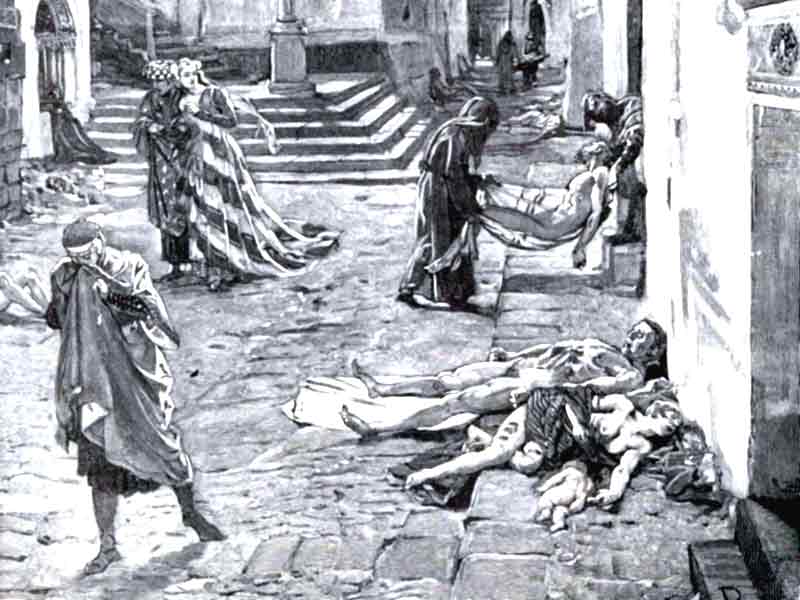
Street Scene, Black Death

Nearly a thousand years later, these charlatan doctors were bamboozled by the Black Plague. It's hard to contemplate the physical as well as the psychological impact this had on Europe. The Pope had to bless the River Rhone so that corpses dumped into its currents would have a proper Christian burial (what that did to the drinking water, down river, I do not doubt). Whole frigates lost their crews and these ghost ships drifted unmanned in The North and Mediterranean Seas. And then there were the flagellants, who saw the plague as divine punishment for man's sins so as to spare communities (and themselves) they would publicly whip themselves to appease a vengeful God.

Why Flagellate Without an Audience?

For the flagellants, their masochism wasn't worth a damn if they happened to encounter someone contagious. What made the plague of the 14th century so catastrophic was that it was pneumatic, meaning it was spread by cough, sneeze, drool, or sharing an ale. The Europeans failed to isolate the disease despite ingenious attempts (it is from the Black Death, we get the word "quarantine," as infected ships coming into port in Venice were isolated for forty days-- quaranti giorni). Cartwright has some interesting ideas regarding the consequences of The Black Death. For example, Jews in France and Switzerland were scapegoated and persecuted, instigating a voluntary relocation to Eastern Germany and Poland, thus connecting the plague to the Holocaust 600 years later. There was also the damage the plague did to the Church's reputation, which of course, appeared feckless in challenging the disease and saving its victims, doing much to expose its flaws as an institution. Many of the best parish priests died and were replaced with unscrupulous men. John Wyclif emerged in England, condemning these crooked priests for their sale of indulgences and other acts of avarice. Wyclif's ideas influenced John Huss of Bohemia, who in turn, turned on Martin Luther. Protestantism eventually led to the Puritan movement and their relocation to America (thus leading all the religious zealots to relocate to the New World).

Columbus's historic landing in the West Indies:
invisibly, bacteria are digging the moment most

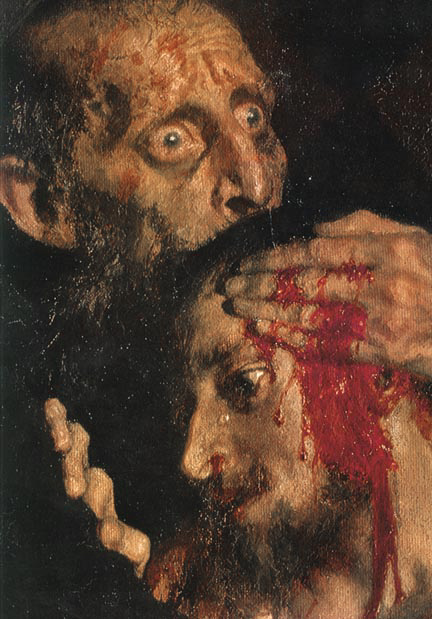
One of the first major consequences of the Age of Discovery, epistemologically speaking, was the introduction of syphilis into Europe. It might have come with Columbus from the New World or it might have come via Portugal with Henry The Navigator, who was then opening up to the possibilities of the slave trade in Africa, but its symptoms in Europe are first recorded in the early 16th century. Famous for being venereal, initially it was passed through skin or oral contact. Syphilis was devastating to the layman, but here Cartwright is concerned with its effect on two monarchies. As mentioned earlier, one of the phases of the disease is a complete abandonment of common sense. Judging by his moniker it is not much a stretch to guess Ivan the Terrible went a little nuts. He is a well-known sadist who did not find piety irreconcilable to his bloodlust, to wit: "Ivan prayed with such fervor that his forehead was permanently bruised from his prostrations. These bouts of prayer were relieved by visits to the torture chamber, conveniently situated in the cellars."

"What have I done?"
a depiction of Ivan having just murdered his son and heir

Of course, by suggesting the legendary Henry VIII was also a syphilitic, is a very great offense to a very great number of Anglophiles. But Cartwright makes some good points. Those familiar with Henry VIII know he suffered from gout, married six women, and famously broke with the Church (in better times he had been nicknamed 'Defender of the Faith' by Pope Leo X). Cartwright, looking at the evidence, can only speculate but he believes it was syphilis that had prevented the Mighty Lion from producing a healthy male heir. There were numerous miscarriages among his wives and his surviving children suffered from some defects. Edward and Mary were physically and mentally unstable and Elizabeth, the Virgin Queen, may have waived marriage fearing her own sterility and the pressures she would have undergone to produce an heir (syphilis is congenital, passed from mother to child in the womb). Impotence is also a symptom and perhaps Henry had become fickle with his wives, abandoning them when they failed to arouse him. Anyways, we're just having fun here at Henry's expense, but could possibly the Church of England (and eventually then the English Civil War) have evolved from a lapse of judgment caused by an STD? Nothing is impossible...

Henry VIII with Jane Seymour and Prince Edward

Any discussion about disease must eventually lead to talk of a cure and one of man's most ingenious developments as an empiricist was his innovative discovery of the vaccination. Smallpox was a notoriously terrorizing disease, killing off large numbers during outbreaks. But it was learned that should a person survive a mild case, he or she would develop immunity. Thus it made sense that a person should have some exposure to smallpox rather than none at all. This idea of "inoculating" a person-- contaminating a healthy person with a disease-- goes back a millennia to Chinese medicine but was regarded as suspicious by the medical establishment for decades until some brave, innovative physicians were able to prove its effectiveness. Today smallpox no longer exists in the developed world and is very rare anywhere.

Map of Africa, 1773:
notice how little of the interior is catalogued

Similarly, it was centuries before the Europeans were able to successfully explore the African interior. Until the mid-19th century, it was believed that Europeans could not travel in Africa because of unique racial composition: "Medical opinion held that the white man could not perform manual labor in the African climate without falling sick. Thus the white man's function was to direct and to govern; only the Negro could carry out heavy work." The reason for the widespread sickness was, of course, malaria, which comes from the Italian meaning "bad air;" it was yet another error in understanding the roots of the disease. Not until scientists learned mosquitoes were responsible for the transmission of malaria were they able to isolate the disease. When they discovered mosquitoes are bred in dank water, swamps were drained and canals cleaned, thus reducing not only the chances of malaria but that of cholera as well. There is still no immunization from malaria, but it was discovered that quinine, an active alkaloid from cinchona bark (a tree located in Peru), kills the malarial parasite and is somewhat effective in prevention and treatment.

During the twentieth century, we have been so successful at understanding disease-- its causes, symptoms and treatment-- that we have seen our numbers grow exponentially. This problem of population is what Cartwright discusses in his conclusion and he forms an argument that our problems largely stem from man's instincts of self-interest as well as his ethnocentrism. He pleas to our humanity: "If man destroys himself, his destruction will most probably result from his obsessive emphasis upon the differences rather than the similarities between the races and nations. The primitive hates and fears are still with us, ready to break through the thin skins of civilization. Hate and fear cannot form a basis for the world-wide cooperation by which alone Man can save himself."

It's a wonderful sentiment but unfortunately outside the ingenious capacity of scientists. Economic markets and the governments that move "the invisible hand" are not concerned with management of resources, observance to the environment, and the well being of man. For the health care and pharmaceutical industries the bottom line is that a major disease outbreak requiring vaccinations, pills and treatment would be good for business. Until this reality is met with serious reform and a wholesale evolution of popular sentiment then we shall remain at the precipice.


Malarial victims, Africa

This, likely, will be the final verdict on man as a species; whether he is meant to endure or to be extinguished.

Saturday, December 12, 2009

It Don’t Worry Me

For most Americans, the Bicentennial celebrations in 1976 suffered from lousy timing. In April, the prior year, Saigon fell to the Vietcong. If it's anything Americans hate losing, it's a war. If that wasn't bad enough, there was Watergate, the energy crisis, stagflation. New York City was nearly bankrupt, Elvis was weird and boogeymen were putting razors in Halloween apples. Drugs. Crime. Herpes. Yup, America was turning 200 and it was all grown up, pimple scars, STDs, baldness, skeletons in the closet— looking in the mirror maybe we didn’t like what we were seeing all that much.


Robert Altman’s film, “Nashville” holds that mirror up and never drops it. This is a movie very much about time and place, which means it is about crossroads. Nashville, the city, is located on the Cumberland River in northeast Tennessee, an historic middle point, halving the country between North and South and until the railroads reached California, lay betwixt the settled Eastern seaboard and the Mississippi frontier (it was a “border” state that fought for the Confederacy in the Civil War).

Made at a troubled junction in time (post Vietnam and Watergate), the film is curiously tied together by the pervasive presence of a roving electioneering van. It plays the prerecorded voice of Hal Phillip Walker, a fictional candidate of the Replacement Party railing against the system in populist rhetoric, articulating the era’s disenchantment with taxes, cronyism, the job market. This demagogue’s blabbering matter-of-fact rationale goes mostly unnoticed by the characters of “Nashville,” many of whom are too self-absorbed to consider politics as something worth their commitment. The 1960s are over and anyways this isn't California, this is Nashville. (Jeff Goldblum's weird motorcycle man riding around in his Haight Ashbury duds on a low riding 3-wheeler is just about the only hippie and no one takes him seriously-- the Easy Rider generation at this point was more of a caricature than a threat to the lifestyle of good o' Southern boys, who have grown their own hair long anyways.) The characters of Nashville are not interested in what might make America a better country and they certainly wouldn't want to think about logistics: these are Me Generation people with personal agendas. In their various pursuits of power and satisfaction they are sexually promiscuous, high-strung, opportunistic, and yet, often, unfailingly idealistic about one’s possible place in the world. Thus, the American Dream, for all its nasty surprises and disregarded caveats, is very much alive here.

Made with the signature Altman flair, “Nashville” has no genuine hero (“heroism:” a troubling concept in this time anyways) but follows two dozen characters in the city of Nashville during a spirited five days of music, sex, and politics. The film is populated by country music stars, political kingmakers, aspiring singers, and this being about the music industry, groupies. These are imperfect men and women, but this isn’t a bad thing, necessarily—it’s honest and most of the time men and women are doing whatever they can to get ahead. This, the system may not condone but it has always looked the other way. Too rarely does a filmmaker suggest with his characters that the audience should watch their judgment, as in, “What about it? You think you’re better?”

To make it anywhere in America, talent may not be as crucial as ambition. You might even say it is more important to be than to do as in, “I’m a singer” rather than, “I sing.” Identity politics is the unconscious game as it conveys our usefulness to others. There are plenty of “celebrities” in Nashville, to whom an audience projects its sense of destiny. In Nashville this means we want to flatter them, fuck them and even murder them. Power is one of the most slippery slopes. The made-it country music stars understand that fortune fluctuates and that today’s hit is tomorrow’s oldie. They may sing sentimentally about love, but there’s not much of it to go around. Sex is about as far as the promise goes…

Typical of Altman, with so many characters to pick through, plot, at least in a classic conflict/resolution structure we’ve been weaned on, fails to materialize. There are performances at the Opry, political fundraisers, major traffic accidents, bedroom scenes. His touch is subtle. What seems unrelated, isolated, or random may be superfluous if plot is one’s goal but Altman is exploring ideas. As a result, the performances feel extremely natural, so that the experience becomes as voyeuristic as it is thoughtful. In spite of it being about the capricious and malleable quality of power, the theme never slips into darkness, for the film is too clever and humorous to make us feel awful about things. In other words, there is no “good” or “bad” in the film, there’s just humanism, which may be about doing the wrong thing at the wrong time, but surviving somehow. You may not identify with these kinds of characters but you can certainly sympathize with them.

As good as the acting is, “Nashville” may be most significant for its songs. This is the last great era of country music before Nashville as a sound became glossy, sterile, and trite. These are songs embodying the last years in which country music sounded ‘country’ in the way that it was “of the people, by the people, for the people.” Today, one rarely hears the human touch on a country music record. It sounds like music by committee, programmed for suburban Sony stereo systems.

In the opening credits Henry Gibson is recording an amusing patriotic ditty, drawling, “We must be doing something right to last 200 years.” Keith Carradine sings, “I’m Easy” to an audience that includes multiple lovers, each of whom fancy the song is a personal love letter. Ronnie Blakley plays Barbara Jean, a diva inspired by Loretta Lynn, a convincing cult of personality portrayed as a troubled angel, for whom fame is fated to be tragic.

And then there is Barbara Harris, who plays Winifred, a down-on-her-luck wannabe who is fleeing her husband. She has holes in her tights, lugs a big bag of laundry, poaches sandwiches at catering events. Moving like an animal, twitching, instinctive, looking by all conventional wisdom, a crazy. Yet, in the end, it is she who gets her big break on a stage before thousands in the most dramatic fashion possible. In a magnificent soprano backed by a black choir, she rehabilitates a traumatized audience, getting them to sing along with what might as well be a chain gang work song, whole-heartedly embracing lyrics that are upbeat, celebratory, earnest, yet completely absent of irony, “You might say I’m not free...It don’t worry me.

There, before a political rally masquerading as entertainment, the violence of American life strikes and when it does, it does not need to be explained. It just feels inevitable. Yet in the ashes of gun smoke, a star is born. The audience applauds its appreciation. The Stars and Stripes flutters gracefully in the wind. The American Dream lives for another day. This “dream” may seem stingy to most of us but when it does strike for an individual, it gushes, like a geyser in a Texas backyard.

Saturday, December 5, 2009

What We Don't Talk About At Dinner or When We Go to the Movies

In America, good dinner etiquette entails avoiding certain contentious topics while suppering on Mom’s meatloaf and potatoes. Although for many Americans, it’s never the appropriate time to discuss politics or religion (at least in a manner that suggests some degree of dissent or irascibility), as a rule it’s an especial faux pas to wax your views with cutlery in hand. Whether it has more to do with possible digestive disorders that may develop from unpleasant –isms or a communal tendency towards harmonious dining, I do not know. If one diatribes too long, the pea soup gets cold. Politics—it may be more offensive to dining than putting your elbows on the table or licking your plate.

It’s fair to say that unless your politics fall within a certain spectrum accepted by the majority, audiences are not going to want to see it in a movie. Usually, only when a delicate subject has evolved into a moot point does Hollywood venture to encapsulate with academy award performances and a melodramatic score by Hans Zimmer. Exploring a hot-button issue while it is contemporary is a no-no but criticizing America is generally the nightshade in what constitutes “box office poison.” Going further, if you intend to take a stand against American hypocrisy and frame your frightening dystopian hypothesis within a pseudo-documentary format, you'll really be pushing it— in the case of Punishment Park, you’ve pushed your release date thirty years, which was how long the film was banned in America.

Made in 1970, the film is very guilty of being of its time. We’re talking now Weather Underground, Black Panthers, COINTELPRO, Vietnam, the 1968 Democratic convention in Chicago, Kent State shootings, the hyper-politicization of America’s youth and minorities and the great divide that stretched between those who thought America was the best of all possible worlds and those openly advocating social revolution. There were no two ways of seeing— there was one or the other, and the other was immoral. Were kids who forcibly shut down a draft board office heroes or traitors? In such hotheaded circumstances, objectivity was the last thing on anyone’s mind.

Punishment Park takes a real deal piece of legislation— 1950’s McCarran Internal Security Act, which authorizes detention for disloyal or subversive persons in times of war or internal security emergency— and examines the theoretical consequences should this law be enforced. As the narrator of the film explains in the opening shot of an American flag flapping in the desert:

“The President… is authorized without further approval of Congress to determine an event of insurrection within the United States and to declare the existence of an internal security emergency. The President is then authorized to apprehend and detain each person as to whom there is reasonable ground to believe probably will engage in certain future acts of sabotage. Persons apprehended shall be given a hearing without right of bail, without the necessity of evidence and then shall be confined to places of detention.”

This narrator is a member of a West German/ British documentary filmmaking team covering the trial of accused subversives as well as the punishment of another group. Over the course of three days, defendants are brought before a citizens’ tribunal where they attempt to justify the morality of their actions (there being no tangible evidence they are a genuine, violent threat, their charges are based on words, ideas, abstracts) and are even offered in some instances to recant their beliefs by signing loyalty oaths to the government.

Scenes from this trial are intercut with coverage of a group of prisoners struggling through ‘Punishment Park,’ an area in the California desert, where prisoners can win their freedom if they “capture the flag.” The flag they are to reach is 53 miles from their starting point. If that weren’t challenging enough, the detainees are sent into the desert with no food or water in stifling meteorological conditions, all the while being pursued by police and National Guard troops, hunted if you will. The park serves a two-old purpose: it becomes a training exercise for troops as well as a “punitive” trial for “subversives.” Moreover, if some dissidents are killed in pursuit, their deaths save the taxpayer money and keeps prisons a little less crowded. If convicted, they are “criminals” and thus their worth as human beings has become negligible.

The accused standing trial is a motley bunch, white and black, male and female, hairy, bearded, bell-bottomed, yet bespectacled and somber, suggesting intellectual habits. In fact these defendants are not garden-variety hippies or Sunday afternoon activists at all; rather they represent the philosophical voice of protest. Leroy Brown is an author, broadcaster, and political activist. Jay Kaufman is Cofounder of the Committee Against War and Repression. James Arthur Kohler is a conscientious objector. These people are thus organizers, pamphleteers, and pacifists. It is they who provide the intellectual arguments of protest. Prosecution makes perfect sense in this context. Cutting off the head is pure Machiavelli.

On the other hand, the tribune is entirely white with but a single woman affecting the demographic singularity. None of them are elected officials. They are amateurs working in a jurisprudential capacity wielding indiscreet judgments on lifestyle choices eminently unfamiliar to their own, in effect running a kangaroo court or star chamber in which the game is fixed before it’s even started. It is true that they are generally older, though it's not necessarily a generational gap thing— whether Frank Sinatra is more of a man than Jimi Hendrix, say-- but rather has everything to do with preferred paradigms. After all, the soldiers and police who enforce the decisions of the establishment are the dissidents’ contemporaries and are very much of the opinion that the “criminals... get what they deserve.”

In the deliberations between the court and the accused, everyone’s talking, no one’s listening. The exchange veers dangerously between philosophy and churlishness. Generally, the prisoners are derided for their immorality, as to the tribunal minds a crisis of conscious is intimately connected to the repudiation of American “values.” More than an authentic trial, the back-and-forth reminds one of bitter family spats, summed up perfectly when one tribunal member complains the kids could have used “less Spock and more spank,” a hit against the baby boomers’ parenting guru Benjamin Spock (who, incidentally, was a major figure in the anti-war movement and was arrested for attending numerous demonstrations). Because of their emotions they cannot rise to their responsibilities nor realize how hypocritical it is that they should imprison those who deny America’s claim to being a “free” country.

You could argue this is the filmmakers’ polemic. Or you might say Main Street is being defensive. Whatever the case, their inane remarks become fodder for the accused to define their dissent in very strong, if not poetic language. Leroy Brown, the black author comments, “America is as psychotic as it is powerful and violence is the only thing that can command your goddamn attention.” Allison Michener, an activist elaborates on this during her session, arguing, “People become violent when they are deprived of their basic human needs.”

In the field, the prisoners running for their freedom are tailed by the documentary cameramen who query them on their condition, disposition, attitude. A young man in a ragged shirt, dirty, bruised, asks, “If they kill me now what difference does my politics or any politics make? I’ll be dead.” Another prisoner on the run clarifies, “My view is not committed to revolution…it’s committed to sanity.” Was this sentiment not famously reconstituted by comedian Stephen Colbert when he suggested, “Reality has a liberal bias.” It is one of the field’s pacifists that puts the plight of the accused in the most accurate moral context when he says, “Right now, the honorable thing to do is to be a criminal.” It is a fair extrapolation: if the government’s laws are unjust and it cannot justify its wars or violation of civil liberties, then individuals who break those laws whether it is draft evasion or persuasive agitprop are arguably the moral example.

When the dissidents are running for their lives in Punishment Park, the narrative of survival becomes a treatment on the various approaches to protest. The prisoners quickly disperse into factions choosing very unique survival techniques: basically they can meet the system with violence or nonviolence. Thus philosophy materializes in a simulated environment with real consequences. What is the right way to reform society evolves into a matter of life and death. In very tense scenes in which police and National Guard troops apprehend the activists in various stages of flight, the answers prove disastrous. These are probably the very best moments of the film as they are rife with confusion, anger, desperation, and madness. The cameramen too, cannot remain neutral. They become hysterical at what they perceive to be injustice and spar with the police.

One speculates on the casting— these are non-professional actors working from an outline rather than a screenplay— were they chosen for their beliefs? The acting, if amateur, is good. It never feels put-on, even when the dialogue is occasionally outrageous (the character of Leroy Brown has two of the best lines in the film: “How the fuck are you gonna overrule the constitution, man?” and “You just want to sit on your fat dividend-drawn ass and draw dividends!”) Did the director play off the actors’ beliefs in order to maximize tension? (The Stanford Prison experiment was conducted around the same time.) There is an us-and-them feeling to the actors that is hard to fake. As far as pseudo documentaries go, Punishment Park feels frighteningly historical.

In his closing statements, the defense attorney reads a quotation that best illustrates the inherent dangers the tribune is engaging with conviction and arbitrary sentencing. The speech seems straight out of Richard Nixon’s playbook: “The streets of our country are in turmoil. The universities are filled with students rebelling and rioting. The communists are seeking to destroy our country. Russia is threatening us with her might. And the republic is in danger. Yes, in danger, from within and without. We need law and order or our nation cannot survive.”

But it’s not Nixon speaking in 1970, it’s Adolf Hitler in 1932. Once a country begins cutting civil liberties in the name of national security, the consequences of compromise are far-reaching. As one of our founding fathers, Benjamin Franklin, so aptly put it, “Those who sacrifice liberty for security deserve neither.”

What does it all mean now? Quite a bit, actually, even in the post-Bush years. The drama of Punishment Park is very much alive today, nearly forty years later. Even in the age of Obama, Guantanamo Bay remains open and an escalation of troops in Afghanistan is called a “surge.” And a “terrorist” is still very much a catch-all phrase for those who might try to fight the system, whether through violence or otherwise.

The director of Punishment Park is Peter Watkins, an Englishman. A number of individuals were offended that a foreigner had the gall to dramatize our society in such critical terms. But someone's gotta do it if we won't. There are some very important problems in our country. We would do well to talk about them, if not at dinner, at least over dessert and coffee.


Tuesday, November 10, 2009

In Defense of Self-Centered Young Men

The title of the first chapter of F. Scott Fitzgerald’s first novel, This Side of Paradise, warns the reader that our hero might be a real-deal momma’s boy. It’s called, “Amory, Son of Beatrice,” and deals with Amory Blaine’s delicate childhood and ends with him enrolled in a prestigious prep school, precociously formulating a “sort of aristocratic egotism,” that would enable him to “‘pass’ as many boys as possible and get to a vague top of the world…” Well, even for geniuses this road is never easy and you’ve got to take a few spills before anyone is going to say you've made it.

This novel— an episodic mélange of prose, stream of consciousness, poetry, correspondence, and theatrical dialogue— is about one man’s quest for identity by means of love, work, and philosophy. This patchwork technique Fitzgerald employs is called “modernistic” by its defenders since it defies accepted conventions of structure. But it is because of careful structuring that we become emotionally involved in fiction; otherwise we forget the point of the reading and in this day of diminished attention spans, language alone may not be enough to guarantee the commitment of the reader. Thus, the precarious existence of This Side of Paradise today: it is famous for making Fitzgerald famous rather than for the work itself.

Interestingly enough, rather than feeling it was written by Fitzgerald it has the atmosphere of several writers—the writing has Wilde’s pithy wittiness, Waugh’s schoolboy sentimentalism, Joyce’s philosophical diatribes, even Sinclair Lewis’s radicalism, held together by Fitzgerald’s mischievous turn of phrase.

The story hinges on a hypothesis posited to Amory at a young and impressionable age. Every apprentice philosopher has his mentor and Amory’s is in the Catholic Church, described thus:

“Monsignor was 44 then, and bustling— a trifle too stout for symmetry… When he came into a room clad in his full purple regalia he resembled a Turner sunset and attracted both admiration and attention… He was intensely ritualistic, startlingly dramatic, loved the idea of God enough to be a celibate, and rather liked his neighbor.”

Although he doesn’t share his faith in the Church, The Monsignor is Amory’s intellectual hero. He is put to quest, Candidelike, when the Monsignor describes the difference between a personality and a personage and why the latter is most preferable:

“Personality is a physical matter almost entirely; it lowers the people it acts on—Now a personage, on the other hand, gathers. He is never apart from what he’s done… When you feel that your garnered prestige and talents and all that are hung out, you need not bother about anybody.”

It’s rather pretty, delicate, and incoherent but enough for Fitzgerald, at least, to build a novel on. The idea is put to the test at Princeton among the co-eds where Amory encounters a variety of “personalities,” that Fitzgerald doesn’t develop well enough to constitute a “personage.” In the case of Amory Blaine, his own lack of something substantial beyond the realm of ideas fails him at work, play, and love.

When a crisis is absent in a novel, it’s critical that we sympathize with the character. It’s not always easy getting along with Amory Blaine. He’s middle class middle American trying to make it in Princeton and New York in the late teens, early 1920s, a time just after what was then known as The Great War, when opportunities were opening up for ambitious young men. He runs with a literary set in college, writes poetry, falls in love. He is a thoroughly self-conscious individual, sensitive to class and caste and as his fortunes fail, feels acutely dissatisfied that he should be so powerless in spite of his rhetorical flair.

Never is this clearer than when he loses his love interest, Rosalind. Although this young debutante loves Amory’s wit and her chemistry with him is superb to all suitors she cannot commit to some advertising copywriter earning just $35 a week no matter how much potential there is in his pipe dreams. In other words, she willfully chooses money over love. Fitzgerald is at his most delightful when describing his characters and he has fun detailing Rosalind:

“She is quite unprincipled; her philosophy is carpe diem for herself and laissez-faire for others. She loves shocking stories: she has that coarse streak that usually goes with natures that are both fine and big. She wants people to like her but if they do not it never worries or changes her.”

This is beautiful stuff. He may as well be describing America itself but it’s supposedly based on Zelda Sayre, the Zelda, famous of all flappers, from which Fitzgerald was drawing inspiration. This Side of Paradise was cobbled together with an earlier draft of a novel called The Romantic Egotist, as well as unpublished poetry and scraps of prose diary entries—his and Zelda’s— in order to compose a salable novel that might win her favor. It’s no wonder that this was the same guy who could come up with Jay Gatsby, Daisy Buchanan, and the fashionable parties of West Egg.


Jazz Age Cats

Its flaws aside, This Side of Paradise, can be enjoyed for the insight it yields into a great American writer. Rosalind could be describing the Fitzgeralds’ untold future when she laments, “I suppose all great happiness is a little sad. Beauty means the scent of roses and then the death of roses.” Amory goes on a self-destructive two-week alcoholic binge once she breaks things off for good, an incoherent, solipsistic misadventure; the kind that Fitzgerald would become notorious for. “To hold a man a woman has to appeal to the worst in him,” Amory muses on the Atlantic City boardwalk, a line of thought that excuses our worst excesses in the name of love.

In a series of reversals, both self-inflicted and the fated kind, Amory has received his comeuppance, but in becoming a wandering, lovelorn derelict, he discovers his artistic sensibility and what it means not only to be a man, but a personage: "He found something that he wanted, had always wanted and always would want— not to be admired, as he had feared; not to be loved, as he had made himself believe; but to be necessary to people, to be indispensable.”

As a truism to live by, it’s as good as any, but worth the effort of the modern reader when there is so much tempting us? This Side of Paradise is too episodic to be a great novel; and any book that climaxes with a debate regarding the merits of socialism betrays its literary value as well as its narrative truancy. But there are many fashions in which to consider art. It must have been exciting when this declaration of intent was published with its pretensions towards power, greatness and wealth, signed by ambition. This Side of Paradise sold through its first printing quickly, earned the praise of H. L. Mencken, and put F. Scott on the map for good. And though his more famous novels are associated with the Jazz Age, it's this early effort that more clearly attempts to speak for his generation’s dissatisfaction with contemporary American life as they were finding it and ready-set to change it. It begins with recognition from within: “I know myself… But that is all,” so goes the novel’s famous last words and they tell all.

If it took writing the novel to get the girl, getting the girl meant, eventually, The Great Gatsby. As far as very public love letters and tell-all memoirs disguised as literature, this means the whole damn enterprise was well worth it.