Wednesday, April 20, 2011

Dangerous Ground

Many friends have suggested I try to write about my experiences since the events of March 11th. Living in Tokyo, I would be a poor candidate for such an endeavor. The ongoing catastrophe is about two hundred miles north of the city and I have not yet experienced any hardship, save the frazzling of multiple aftershocks and concerns over elevated radiation levels. My good fortunes aside, there are many with a deeper background in seismology, nuclear energy, and Japanese political history— journalists, researchers, writers— devoted to the task of chronicling, analyzing, and piecing together what this calamity means for Japan. My larger personal concerns are not what has happened but what shall come to pass.

The changes in Tokyo are more superficial than substantial. Shibuya is no longer a flaming candle, streetlamps are off, and the subdued lighting in train and subway stations is a dingy hue that might lead to a revival in pickpockets’ fortunes. Everyone dreads the summer when rolling blackouts will make it very difficult to overcome the humidity. Air conditioning will once again acquire its luxurious quality. Tokyoites have been asked to conserve energy. Self-restraint is not a problem in brilliant spring weather. But these inconveniences are banal when set against worst-case scenarios—that is, the inevitable monster shake known as the Tokai Quake that happens in the Shizuoka region just west of Tokyo with some regularity every 150 years. The last quake was in 1854.

As tragic as this year’s triple whammy of earthquake-tsunami-meltdown has been, it may pale when measured against the consequences of the inevitable Tokai Quake. Not only may it lead to another tsunami and an eruption of Mt. Fuji (which is seeing some activity for the first time in a long while), but perhaps worst of it all is that Japan may have to deal with the fallout of yet another nuclear crisis that would be much more detrimental to Tokyo— the meltdown of its nuclear power plant at Hamaoka, built almost directly above what is believed will be this disaster’s future epicenter.

Essentially, it does not seem sound judgment to build a nuclear reactor on top of a historically active fault line, especially when your country’s preeminent seismologist argued against the hubris of such an undertaking before construction even began. Dr. Kiyoo Mogi has long argued for the responsible application of nuclear technology on Japan’s vulnerable territory. Unfortunately for hundreds of thousands whose livelihoods have been destroyed by the manmade disaster of Fukushima (residents, farmers, fishermen) Dr. Mogi’s good judgment has been vindicated. The authorities at Hamaoka swear that the plant can withstand a major quake but the same corporate suits made the same fail-safe promise at Fukushima.

It seems then in the court of common sense, the government should have taken a proactive role in shutting down the nuclear plant at Hamaoka weeks ago. Already global public opinion is mixed on Japan— there is sorrow for the victims and their families and bitterness at the country’s mismanagement of the crisis. Radiation leaks affect all of us, more or less, since we understand the ecosystem to be something shared by all of us, from the air we breathe to the fish on our plates. It’s not hippiespeak to say we are of one world.

Every human drama needs a villain, if only to lash out our frustrations and humiliations. The fact that there has been lying, mismanagement, deliberate cover-ups, and general incompetence on the part of Tokyo Electric Power Company (TEPCO) has led to some consternation on the part of the international community. What would conventional wisdom make of Japan should a similar if not more catastrophic meltdown were to occur in short succession? I am helplessly reminded of the aphorism reserved for the gullible: “Fool me once shame on you, fool me twice shame on me.”

Being a foreigner, it is hard to know exactly what the public’s sentiments are. Most people would like to be let alone of the issue and trust a benevolent fate. The Japanese are trying to go on with their daily lives and in this beautiful spring weather it is easy to forget the carnage of the north and the direness of the near future. Only occasionally do the aftershocks rattle us into reality, returning the fear that trembles our hearts. But even these, frequent as they are, subside easily enough into the mundane elements of more trivial pursuits.

But many Japanese have been politicized for the first times in their lives. Like Middle Easterners uprising against their governments the Japanese are using Facebook, Twitter and other social media to organize. On April 10th a major demonstration in the Tokyo neighborhood of Koenji drew at least ten thousand protesters. It was a very Japanese affair— more like a parade than a march: wonderful costumes, peaceful inclinations, gentle shout-outs. At the head of the parade, was a simulacrum of a New Orleans jazz band, dressed in razzle-dazzle kimonos and playing popular yesteryear numbers. Some attendees were unironically costumed in radiation suits and gas masks. Most wore sanitary face masks, a usual seasonal big seller for protecting the allergic against hay fever, but now a symbol of our very flimsy protection against radioactivity.

Making good use of the if-no-one-hears-the-tree-falling-in-the-forest theory, Japan’s mainstream media managed to drop the story. It was an election day in Tokyo (the incumbent, Shintaro Ishihara, who publicly claimed the earthquake and tsunami were divine punishment for Japanese greed, was handily reelected) and moreover, that Sunday was the most beautiful weekend day for hanami, cherry blossom viewing. After the protest I took the train to Yoyogi, Tokyo’s largest park and site of the biggest parties. Arriving just after the sunset, it was surreal to see this forest of pink flowers in twilight, where tens of thousands frolicked, wasted on good sake and cold beer, pleasuring against all arguments to be somber and self-restrained. I couldn’t blame them.

On the 16th this month there was another protest in Shibuya but it was much smaller and I’m worried that the so-called Sakura Revolution might be losing its momentum. That would be a shame since it is the most appropriate week to get out and fight for peace-of-mind. Today, April 20th is Earth Day, and next week on the 26th is the 25th anniversary of Chernobyl.


Understanding Japan’s limited availability of resources, I am not against nuclear energy per se, but am very much in favor of safe and responsible use. It’s bad enough to worry about earthquakes and tsunamis, the sudden catastrophic moment where everything changes. This is more than enough than the average person needs to worry about.

Friday, March 4, 2011

The Terrified and the Bored

“They were still on the treadmill; the misery, the ennui, the dislocated horror…. Things would happen and time would pass, but there was no hope, no anticipation. There would be nothing but the deep cloudy dejection that overcast everything.”

--Norman Mailer

An author, like any artist mindful of his or her spread in the busy, kinetic, attention-free pop galaxy, must consider the brand as well as the art if hopeful for a multiple book contract, which is altogether negotiable depending on the number of readers willing to put down money for good storytelling. While a few like J. D. Salinger and Thomas Pynchon built their reputations with reticence, some like Norman Mailer bet on bombast, creating a trademark presence but with it the baggage of distraction. Before I’d read any of Mailer’s books, I knew him as the writer who stabbed his wife the night he threw a party announcing his presidential candidacy in 1960. That and he was the guy who wrote the first How To book for hipsters, The White Negro. But for all the talk shows and celebrity gladhanding, Mailer wrote better than anyone. Many detested him for his theatrical pretensions, but very few for his literary verve.


The Late Great Norman Mailer

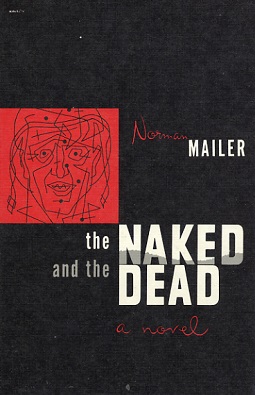
Mailer made a name for himself by capturing the zeitgeist before anyone else, whether it be beatniks, hippies, or mass murderers. Writers write what they know and Mailer had survived the great drama of the Second World War with enough notes for a book, publishing The Naked and the Dead in 1948 when he was just twenty-five years old, catapulting him into the high chair of literary enfants terribles. Ostensibly, it is a book about a reconnaissance platoon, a motley collection of soldiers ordered by military brass to survey the Japanese behind their position on the invented island of Anopopei during the Filipino campaign, but The Naked and the Dead is very much a modern American novel, which means it is a subversive criticism on American social life, economic opportunity, and an illusory freedom of choice.

Very few of the soldiers in the platoon are there by virtue of patriotism or sense of duty. They’re there because war was happening and there was not much else going on for them in the economic maelstrom of the 1930s and early 1940s. They are true grunts: outcasts, farmhands, street punks, and failed entrepreneurs stinking of bad luck. As General Cummings, a philosophical mouthpiece for Mailer, explains, “The individual soldier in that army is a more effective soldier the poorer his standard of living has been in the past.” The Army, first in line as cannon fodder, would not work so well as a fighting unit had it educated men who might second guess suicidal mission objectives.

In spite of its grandiose subject and prolix verbosity (it’s more than 700 pages long) not much happens in the novel. The platoon participates in the landing mission where there is little resistance. There are some small, deadly skirmishes where the army is digging into the Japanese line. The soldiers make and break camp as necessity sees fit. And the recon unit goes on its difficult mission. The major battle is not described except in dispatches to the command center. The reality has little to do with the PR campaign that had fueled recruitment drives and positioned every private a starring role in his own personal movie: “He had always imagined combat as exciting, with no misery and no physical exertion. He dreamed of himself charging across a field in the face of many machine-guns; but in the dream there was no stitch in his side from running too far while bearing too much weight.”


Island Hopping GI Joe Style

Major episodes describe the futility in keeping your tent secure in a typhoon; of loathing yet another rations can of ham and eggs; of fighting sleep deprivation on guard duty; of fantasizing over the “million dollar wound,” some injury that wouldn’t cripple them but was bad enough it would warrant a ticket home, thus becoming a veteran, a survivor, and guaranteeing the opportunity to tell young women, “I was there…”

Daydreaming about what they’ll do after the war does little to make their labor bearable: most duties are makeshift and disposable, the temporary conditions of camp living producing no sustenance. The tedium is only more tolerable than the logistical errands necessary to reorder military positions in constant flux. Endurance is taxed and tolled mercilessly, so much that a man’s humanity is crushed by the dead weight of his task as when the platoon is ordered to move heavy artillery guns through muddy paths to a new position on the front: “By the time an hour passed, nothing existed for them but the slender cannon they had to get down the track. The sweat drenched their clothing and filled their eyes, blinding them. They grappled and blundered and swore, advanced the little guns a few feet at a time with no consciousness any longer of what they were doing.”


an American platoon

And who are these guys suffering for the sake of their country anyway? There is no central hero in The Naked and the Dead— at least, there is no one with outstanding moral qualities— instead they are neither good nor bad, but merely human, reacting to the violence, tedium and proximity to death in a myriad of ways. Wilson, a philandering Southerner wants to get drunk and swap sex stories; Red is a hard-luck cynic mistrustful of authority; Goldstein is a New York Jew who wants to be liked and is easily hurt by discrimination; Gallagher is a high-strung Commie-baiter; Martinez is an excellent scout brave in spite of his fears; Hearn is a college grad from a good Midwestern family dabbling in socialism, assigned to lead the platoon on their recon mission after a falling out as General Cummings’ secretary; only Croft, a tough bastard from Texas, truly fits the ideal soldier, a man with a “crude, unformed vision in his soul… rarely conscious of it.”

In the 50th anniversary addition of the novel, looking back Mailer calls his first calling card opus the work of an “amateur.” If there are any flaws in The Naked and the Dead it may only be Mailer’s conceit of using a Freudian device he calls THE TIME MACHINE, in which in a very close third person (adapting local vernacular whether Boston or Brooklyn street, Georgia hillbilly, or Texan Mexlish) Mailer explains characters’ backstories. Not that they are superfluous— they are all piece and parcel of Mailer’s most persuasive point: that America is an unequal society and that these men, should they survive, had very little to look forward to coming home short of some good home cooking and a few rowdy nights of casual sex: “…it did not matter because both girls would look the same in thirty years and Wyman would never amount to very much. He saw a future vista of Wyman’s life, and rebelled. He wanted to be able to tell Wyman something more comforting than the fact it didn’t matter. But he could think of nothing.”

Recently, I was discussing with my family the famous essay by economists Stephen Dubner and Steven Levitt and their controversial assertion that the great drop in crime over the last twenty years has its origins in Roe vs. Wade. They contend that legalized abortion has resulted in a million fewer unwanted babies a year, arguing this as a causal effect since statistically most criminals come from single parent, low income backgrounds. Something the economists never touched on and is worth bringing up is the role of America’s large standing army.

It’s a long time passed since the Army has relied on Uncle Sam posters for recruitment. Nowadays, the big draw for those ambitious to leave the ghetto are things not generally associated with masculine glory: steady pay, technical skills, health insurance, and government pension. Even in garish TV recruitment commercials in which soldiers and marines fight CGI monsters, some of these essentials do not go unmentioned. Nowadays glory is the fringe benefit; security is where it’s at, even if it means risking deployment in Somalia, Afghanistan, and Iraq— for a number of men this trumps the quiet desperation that afflicts so many civilians. As Mailer’s General Cummings puts it perfectly, “The natural role of twentieth century man is anxiety,” especially true in a nation whose safety net is worn through and breaking.

Cummings again: “The Army functions best when you’re frightened of the man above you, and contemptuous of your subordinates.” But Mailer might as well be talking about his vision of America, the scramble for earnings, the problem of love and marriage in circumstances of poverty, the hypocrisy of the American Dream being realized for so few. I was shocked to discover The Naked and the Dead on Bill O’ Reilly’s Top Ten list. Had he completely missed Norman Mailer’s essential idea?

Today, The Naked and the Dead is hardly known for its brutal realism and tough stance on American inequity. If anything, it is notorious for the censorship of it’s language, as in “Ain’t none of your fuggin’ business,” or “The fug you say!,” an unintentionally humorous tact Mailer’s editors employed as to not offend Middle America’s sensitive moral palate. Tuli Kupferberg called his marvelous freak-rock band, The Fugs, and the actress, Tallulah Bankhead, apocryphally said to Norman Mailer upon meeting him, “Oh, you’re the young man who doesn’t know how to spell…” It’s a good story but the book deserves more than an anecdotal cocktail throwaway— it is essential reading for anyone interested in the American’s precarious existence.

The men of the recon patrol lead a Sysyphean existence. So little of their exhausting work produces real meaning or tangible results. Even that most vital human instinct most of us in our technocentric lives never have to exercise, that of survival, is dulled from arduous exercise so that a bullet in the head would mean a welcome respite from this trial called life. The rare moments they have in combat, the hero's stance is not charging the field but merely holding one's ground and not running. Winning the war then becomes the accumulation of small victories. You might not like the soldiers in recon but you know them and you feel for them because at the extreme other of the killing in war is that elusive quality called human empathy. A corpse is not just a corpse; he is a storehouse of love, life and stories that have ceased to exist. Even Mailer’s battle-hardened, sarcastic grunt, Red, is alive to this:

“Very deep inside himself he was thinking that this was a man who had once wanted things, and the thought of his own death was always a little unbelievable to him. The man had had a childhood, a youth, and a young manhood, and there had been dreams and memories.”


Sunday, December 26, 2010

A Bend in the Bias

For all its inherent drama and uncompromising tragedy, Africa figures comparatively rarely in literature. Despite the continent’s mad kings, power brokering, tribal rivalries and wild frontiers, as fiction goes it remains one the great untapped resources available to storytellers. But writers beware of treading this path for good reason: the difficulty, particularly for foreigners, and thus non-Africans, of telling a story truthfully, without prejudice or simplification. The background in violence that bewitches some storytellers in the first place too easily becomes the point of it all, the overarching theme left standing in the smashed and scattered debris.

In A Bend in the River, the Trinidadian writer V. S. Naipul, has penned a novel indicative of the worst stereotypes. One need not go further than the first sentence to get to the heart of his ideology: “The world is what it is; men who are nothing, who allow themselves to become nothing, have no place in it.” Such vile, free market cold-blooded Darwinian absolutism sets the tone for a story short on human compassion, long on self-centered palaver.

It begins with Salim, a coastal Indian Muslim, escaping anti-foreigner violence at the end of colonialism, when much property of the former power structure was appropriated by revenge-minded nationalists. From a family friend, he buys a dry goods shop in an unnamed town in Africa’s interior, where later he is joined by one of his family’s slaves. There is a rebellion early on and a soldier who takes power in the capital becomes a megalomaniac dictator referred to by everyone as The Big Man. Early on, his powerful presence stabilizes the country. Violence and tribal rivalries fade and there’s an economic boom. Europeans arrive to advise and build infrastructure as well as chronicle this significant step in African history. The narrator’s shop business is thriving and he has a torrid love affair with a European woman married to someone close to the President (“The Big Man’s White Man”). Being close to the machinations of power, gives the main character a sense of identity and destiny, though it is illusory of course. The new boss is the same as the old boss: inevitably corruption and violence return, proving history to be cyclical, putting the narrator in a conundrum about whether to stay or flee.

A Bend in the River was shortlisted for the Booker Prize in 1979 and Naipul has won the Nobel Prize for literature. Such acclaim is difficult to comprehend considering the genuine failure of this, his most famous story. Like many writers, Naipul takes real-life historical events and frames them in a dramatic narrative, creating a mask disguising an author’s political philosophy, one of the great tricks of literary art. Yet it’s one thing for a writer to have appalling political viewpoints (i.e. Ayn Rand), so long as the writing itself works but having drearily sludged through several of his other books, I can spot a naked Emperor when I see one. V. S. Naipul is a very bad storyteller, on all the essential points.

Salim, for example, our narrator, is supposed to be a member of the Muslim diaspora, but he’s also a man who’s lost communion with his spiritual and cultural roots, practicing beliefs more out of habit than faith. But there is little to suggest the character is a real Muslim (Naipul is suspected of Hindu nationalist sympathies). In Salim, there is no piety, no loyalty, no moral compass. He needs an adulterous affair to feel better about himself. He constantly looks for the weaknesses in others, obviously to salve his own self-esteem issues. Naipul seems to suggest that the only way to survive in such dog-eat-dog circumstances, one must act selfishly as Salim behaves in all his interactions. He is a cold person, calculating, envious of the success of others, a thinking man but at the expense of real emotions.

Then Naipul’s storytelling instincts can feel distinctly out of step. Every time something vaguely dramatic occurs, his character withdraws from the action for analysis, an annoying habit of one step forward, three steps back. Stylistically, these digressions can be very long-winded—one hears not the narrator but Naipul’s presence, his pedantic blah. This is especially evident at a critical moment in the story, when Salim and Yvette commit adultery. Naipul elaborates in his typically sexless form:

“To write about the occasion in the manner of my pornographic magazines would be more than false. It would be like trying to take photographs of myself, to be the voyeur of my own actions, to reconvert the occasion into the brothel fantasy that, in the bedroom, it ceased to be.”

Does anyone, particularly a shopkeeper, bother with such pseudo-existential jabberwocky in the throes of an exciting, illicit affair? But this romance, an expendable subplot that has little to do with the big theme (which is what exactly…? Africans, they can’t do anything right?), is problematic. There is little to suggest why an educated and ambitious woman would fall for Salim. Naipul doesn’t bother to illustrate an attraction nor a courtship. It just happens, chemistry be damned. In fact, the affair, only serves to alienate us further from the narrator, as it climaxes in misogyny and unbelievably, masochistic submission, a ridiculous male fantasy concept which betrays Naipul’s complete incapacity to draw out and understand women.

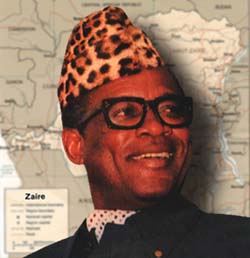
Though Naipul has a Victorian tendency towards exasperating exactitude, he never directly mentions the town nor the country he is in by name, though it is obviously The Congo (formerly Zaire) and The Big Man (portrayed in leopard print hat and cane in ubiquitous reproduced photos) is clearly Mobuto Sese Seko. Why this conceit, unless Naipul believes that the violence and anarchy affecting the story’s region is not a Congo problem but an African one? It’s all but clear that Naipul has calculated for this disastrous state to represent the continent as a whole. The problem of violence and corruption then is not specific but general.

Mobuto Sese Soko, the Big Man

Though not as odious as ideology, tedium can be offensive in its own distasteful fashion. What is most incredible about Naipul’s effort is that it could take the Congo, Africa’s literary “heart of darkness” and all its attached sex, violence, wildness, history and promise and make it dull. That is what he does and it is because of his prose. Naipul writes like a neutered academic, a showoffy dinner companion one endures at a wedding due an ill-fated seating arrangement. One expects some kind of payoff from all this talk but after so many words, one learns the point is the words themselves and not the story and that it is for his benefit, not yours. I’m talking about the worst kind of storyteller— know-it-all, masturbatory, self-indulgent, offensive. Ugly. What’s just as remarkable is that for all the praise Naipul receives for his language, there is not a single beautiful sentence in the entire novel. Nothing amuses nor surprises. Nothing enchants.

There is little incentive then to read beyond the book’s opening lines, “The world is what it is; men who are nothing, who allow themselves to become nothing, have no place in it.” Africa and its Africans is a failure, and thus have no place at the world’s dinner table. One can, as Naipul does, ignore the complexities of tribalism, the holocaust of the slave trade and the exploitation of the colonial system and blame Africa’s problems on the Africans themselves. It’s easy, it’s clean, and it makes for a good, bloody yarn. For all its circular syntax and complicated contextualizing then, the purpose of the novel, under the cover of flashy, intellectual grandstanding, is simplification cynically celebrated: Those Africans… they deserve it.

Thursday, September 23, 2010

The Life and Times of a Stoner

In the first few paragraphs of John Williams' novel, Stoner, we learn that the title character was born to rural farmers, taught English literature at a University and died rather quietly at age 64. By putting all of his cards on the table early Williams leads us to understand that this is not a dramatic story. Drama, however, is inessential if a character is drawn well enough. In such circumstances it doesn't hurt either if a modest life is explained in luminous prose. Williams succeeds on both counts and perhaps his sympathetic portrait is as good as it is because the omniscient voice is marked by its precision and economy. Williams may have published Stoner in 1965 but the novel has the serenity of late Victorian storytelling rather than the breezy tongue-in-cheek style of so many of his contemporaries.

The story is simple. William Stoner, a dirt poor Missouri farmer tends his father's fields for a share of diminishing returns. When he is 18 he receives an opportunity to escape destiny and destitution attending a university in the nearby town of Columbia. Though he matriculates as an agronomics student he falls under the spell of his English professor, Archer Slone, and embeds himself within the fixed course of academia, receiving his degree, his masters, his doctorate, and finally a teaching position. His life, once isolated by the strict demands of land becomes just as restricted by his love of English Renaissance poetry, an esoteric interest that he cannot share with his wife, Edith, an attractive yet frail blonde from a more successful family. There is no way that Stoner can merge his old life with his new. Stoner's family understands the irreconcilability of this:

“His mother was facing him, but she did not see him. Her eyes were squeezed shut; she was breathing heavily, her face twisted as if in pain, and her closed fists were pressed against her cheeks. With wonder Stoner realized that she was crying deeply and silently, with the shame and awkwardness of one who seldom weeps.”

But as exclusive the collegiate universe is to Stoner's parents it's just as difficult accommodating Edith. She and Stoner do not ever truly understand each other and being mutually inexperienced in life, they struggle to fill their middle class masks while also failing spectacularly at the lovemaking that produces their only daughter, Grace. Williams can write extreme melancholy and human awkwardness with the best of them as he does here describing the Stoners' sex life: “If she was sufficiently roused from sleep she tensed and stiffened, turning her head sideways in a familiar gesture and burying it in her pillow, enduring violation…”


"Office in a Small City"
Edward Hopper

Their marriage is an unhappy one but Stoner is not necessarily unhappy himself. He genuinely loves his work, even if he never got over his childhood clumsiness and whose bearing is marked by "stooped shoulders." As a scholar he enjoys the challenge of rigorous academic interpretation, helping students on their dissertations and publishing his own specialized and obscure monograph. Though he may feel lost outside the campus, Stoner thrives in his work environment, perhaps --as explained by one of his only friends, Dave Masters, an intellectual killed in the First World War-- because he could do no better anywhere else: "It (the university) is an asylum…a rest home, for the infirm, the aged, the discontent, and the otherwise incompetent…”

Events in the novel debunk this assertion, setbacks which if not destroying Stoner, strips him of what might have been a happier life. A petty rivalry between Stoner and Holly Lomax, a gnome of a person obsessed with his crippled leg, stymies his career. Lomax runs the English department, assigning Stoner the least desirable classes and inconvenient scheduling. And when Stoner's uneventful life becomes thrilling when he falls in love with Katherine Driscoll, an intelligent and intriguing graduate student, gossip among faculty and students is the seed for a scandal that dooms the only true happiness Stoner had ever experienced. Indeed, the university members who pride themselves on living outside the social contract prove themselves to be outsiders by pretense only. The asylum never actually existed or for Stoner, it retreated to a small basement room that existed on borrowed time, a small, dark ordinary place but made magical by a secret love, shared intimately and solely with his lover:

“It was a world of half-light in which they lived and to which they brought the better parts of themselves—so that, after a while, the outer world where people walked and spoke, where there was change and continual movement, seemed to them false and unreal. Their lives were sharply divided between the two worlds, and it seemed to them natural that they should live so divided.”

But there is no duality of living, there are just moments and in these moments one is either safe or exposed, either happy or distraught. Stoner the academic never loses the posture of Stoner the farmer. The wife he tolerates is the one he once fell madly in love with. If there are any compartments, they are manmade, invented by a reasoning, imaginative mind to organize the world into a more satisfying existence. Doing so, however, entails the peril of losing that safe, trusted place.

My Fated Disappointment with War and Peace, Briefly

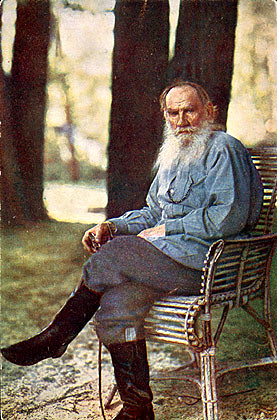
When people found out I was reading War and Peace this summer the most common question posed was, “Is it worth it?” To which I generally shrugged, sighed and said, “Yes and no.” For those who love literature and are interested in the evolution and idea of the novel, then it probably should be read. But for most of us, with all the options of books, not to mention various entertainments and outdoor diversions available, the answer leans towards No, that it is not worth it and that life is too short to read War and Peace. You can lead a wonderful life without ever knowing the Rostovs or the Bolkonskys or even its pontificating author.

This is not to say that I feel War and Peace is a bad book per se. Tolstoy does some marvelous work dramatizing one of the most cataclysmic events in Russian history. (Who will dramatize the Russian Revolution? It seems incredible that no Russian novelist has tackled that event and transformed it into a literary epic.) Tolstoy demonstrates a thorough capacity for detail, describing the nuances of aristocratic manners and the gruff speech of common foot soldiers with persuasive savoir-faire. His characters are lively and unique and undergo profound changes, grappling with responsibilities of war and career, marriage, finances, births, and death-- in other words, life in all its glory and banality. As some critics have suggested, should the earth write a novel, it might sound like Tolstoy.

But the Earth is not perfect and neither is Tolstoy’s book for that matter. We can generally gauge the quality of a novel using three primary benchmarks: the story, the characters and the style. War and Peace suffers from many digressions into the lives of periphery characters but remains compelling due to its dramatic historical nature. The main characters, as I mentioned, are mostly sympathetic, their humanity drawn out beautifully. It’s difficult to discuss style since War and Peace is a translation (I had the Anthony Briggs edition) so while we cannot judge Tolstoy by his prose, we can nevertheless opine on his structuring of the novel and the general pool of language he has chosen to tell that story. It is here that Tolstoy astonishes me with his narrative miscalculations. The problem is the author inserting himself into the story to make declarative points that relate to his celebration of a divine force. The unfortunate consequence on the reader is having to bear the lecturing of a writer guilty of a god complex. Little is left for us to interpret on his or her own. Everything must be explained according to the way Tolstoy intended it. He violates the cardinal rule of storytelling: show, don’t tell.

In doing so, Tolstoy comes off as an insufferable dinner companion. He never hesitates to interrupt the narrative with long-winded discussions regarding the scientific basis for understanding history (an irritating device that has no place in a novel! None!) but literature, though an aesthetic branch of the arts, is understood by rules established between authors and their audience. Of course these rules are malleable (art being more lenient than science) but to disregard them is done at the writer’s peril.

As everyone knows, whether consciously or intrinsically, good storytelling makes for an irresistible yarn: the writer instills in the reader the need to know what happens. Napoleon’s invasion of Russia was an incredible event, changing the course of history. Historical narrative is drawn out in both micro and macro formats-- the lives of individual characters contrasted with the nation’s larger struggle. I found Tolstoy’s telling at the micro level engrossing. For example, on the eve of the French entering Moscow, during the collapse of public order Count Rostopchin’s justification for throwing a criminal (traitor) into the mad violence of a crowd is apropos of Tolstoy’s insight into human character, in this case, a politician’s:

“Since time began and men started killing each other, no man has ever committed such a crime against one of his fellows without comforting himself with the same idea. This idea is the ‘public good…’” (Vol. III, Part III, Ch. 25)

Could a historical novel involving George W. Bush’s faith in the Iraq War be written any different? In a thoughtful meditation on the wastefulness of armed conflict, Tolstoy, speaking through Andrei Bolkonsky in a midnight oil heart-to-heart with Pierre the night before the Battle of Borodino would destroy the young prince, suggests:

“If we didn’t have all this business of magnanimity in warfare, we would only ever go to war when there was something worth facing certain death for, as there is now.” (Vol. III, Part II, Ch. 25).

Here is Tolstoy at his very best, pensive and theoretical, but, importantly, expressing himself through his characters. His narrative problems come when he enters the scene, for example, carrying on about troop movements, particularly the fate of the French army making the catastrophic blunder of retreating on the Smolensk road, which had seen the land around it plundered and destroyed and so would not provide the needs for Napoleon’s massive army. Tolstoy wastes our time with endless dissections of this blunder, reveling in it, repeating it, and in the end, boring us with such eye-glazing assertions and unnecessary sarcasm:

“This was done by Napoleon, the man of genius. And yet to say that Napoleon destroyed his own army because he wanted to, or because he was a very stupid man, would be just as wrong as claiming that Napoleon got his troops to Moscow because he wanted to, and because he was a clever man and a great genius. In both cases his individual contribution, no stronger than the individual contribution of every common soldier, happened to coincide with the laws by which the event was being determined.” (Vol. IV, Part II, Ch. 8)

This paragraph propels two important theories of Tolstoy’s. First, that historians put too much weight on single individuals (personalities) guiding history-- in doing so, they fail to cite the billions of contingencies that determine world events (which are God’s doing). Secondly, it’s another opportunity for Tolstoy to criticize Napoleon. Sometimes it feels he wrote the book for the purpose of excoriating Napoleon to a general reading public. Throughout the novel but especially in the epilogue, Tolstoy goes out of his way to downplay his achievements, arguing that Napoleon was simply an egotistical, arrogant opportunist at the right place and the right time.

This is the book’s greatest failure: not his antipathy for Napoleon-- Tolstoy is entitled to his likes and dislikes-- but that his arguments overwhelm the storytelling in pompous cant. According to biographers, Tolstoy turned to literature as a young writer after being disenchanted with history. In his second epilogue, he spends more than 40 pages (in technical, colorless, dull language) disparaging the work of historians on the premise that they are unable to differentiate the actions on mankind, whether it be free will or motivations built from necessity. What he seems to suggest, dramatically in Napoleon’s retreat and the marriages of Pierre and Natasha and Nikolay and Marie is that they were predestined by a supernatural force. It was all meant to be:

“And just as the indefinable essence of the force that moves the heavenly bodies, the indefinable essence that drives heat, electricity, chemical affinity or the life force, forms the content of astronomy, physics, chemistry, botany, zoology and so on, the essence of the force of free will forms the subject matter of history.” (Epilogue, Part II, Ch. 10).

A decade before Tolstoy composed his thoughts on this subject, Charles Darwin had published his Origin of Species, whose arguments of evolution refute Biblical infallibility. Probably, its evidence threatened Tolstoy’s vision of the world. Obliquely referencing Darwin’s thesis, he argues that,

“in the frog, the rabbit and the monkey we can observe nothing but muscular and nervous activity, whereas in man we have muscular and nervous activity plus consciousness.” (Epilogue, Part II, Ch. 8)

But this confuses me. What is the importance of consciousness if everything is divinely predetermined? Is it so we can recognize and celebrate God? And why are we even getting into this? On abstract terms rather than through the prism of the characters’ actions or dreams? Imagine John Steinbeck ending The Grapes of Wrath not with that lovely and tragic scene of the Joads’ pregnant daughter sharing her breast milk with an emaciated stranger but the novelist spending thirty pages examining the causal effects of the Great Depression and the merits of the New Deal. I’d love to read Steinbeck’s views on politics, but preferably in a chapbook or a magazine interview format.

In the epilogue Tolstoy ignores the Rostovs and Bolkonskys, only bothering to mention Napoleon (for one last drubbing) in his final descent into didacticism. Beyond whether or not Tolstoy is persuasive in his argument is besides the point. The best storytelling weaves philosophy into its narrative without resorting to pedantic posturing. I found Tolstoy’s voice irritating, his arguments confusing, his language obfuscating. Not to mention hypocritical. After lambasting historians for telling us how to interpret events, he goes and instructs us himself. The nerve of great minds!

Tuesday, September 14, 2010

The Good, the Bad, and the Beautiful

“We’re on the cutting edge of reality itself. Right where it turns into a dream.”


It’s hard to believe that there has been no great Vietnam War novel. The war has been better served by memoirs (Ron Kovics’ Born on the 4th of July and Neil Sheehan’s Bright Shining Lie) and especially cinema (Apocalypse Now and Coming Home, among others). Perhaps the best story about the conflict may be Graham Greene’s The Quiet American but that was written by a Brit in 1955, before the conflict became a national security issue making front page headlines. Back then it was but one of the many stories of decolonization rapidly transforming geopolitics in Asia and Africa in the 1950s. At the time of Greene’s novel it wasn’t quite yet the war it became, an ideological civil war between North and South lasting more than 15 years. The great World Wars were comparatively brief. Is it for this reason that Vietnam defies the ambition of writers in recasting the war in a poetic narrative? Is it just too damn big, ugly, and morally wrong? Where would you even begin?


It shouldn’t be so. After all, moral dilemmas make for some of the best reading. Into this discussion rides Denis Johnson and his Vietnam novel, Tree of Smoke. At first glance, it wouldn’t seem that Johnson, famous for his poetic tales of dropouts and ex-cons in books like Angel and Jesus Son would be the kind of guy to give the Vietnam War its just due. But this isn’t quite about politics or platoons as it is about personalities, dreams, and God. The hall-of-mirrors confusion of such a setting is perfect for a writer like Johnson, a writer that revels in tricky storytelling and moral ambiguity. Rather than going there, he prefers tumbling down the slippery slope of Manichean worldviews. When everyone is just trying to stay alive in a place as brutal as ’Nam, who are the good guys anyway? Literature being a Western art form, in a cross-cultural conflict we tend to write from our side of things. Among various detailed atrocities, to save us from a supposed Communism menace, our government employed seven-ton super bombs against North Vietnam, capable of decimating 8000 square meters. Into this inferno we also dropped Spiders, small grenades with near-invisible antennas that were detonated upon touch. They were designed to kill survivors helping the wounded or putting out fires. And for what purpose in the end? The defeat of an exaggerated Communist means. No, the end never justified the means. While Johnson describes little of the fighting itself (besides the Tet Offensive), at times he captures the situation’s moral ambivalence perfectly:

“They threw hand grenades through doorways and blew the arms and legs off ignorant farmers, they rescued puppies from starvation and smuggled them home to Mississippi in their shirts, they burned down whole villages and raped young girls, they stole medicines by the jeepload to save the lives of orphans.”

The closest we come to a concept of a hero (in the Greek sense: military honors, hubris, appetites, tragic trajectory) is an alcoholic raconteur, Colonel Sands. Running a renegade CIA outfit with his nephew and a few aids, he understands that the Vietnamese goal of self-determination may be too powerful for the U.S. to win the war no matter how many bombs are dropped. However, he believes in a certain hearts & minds strategy:

“This land under our feet is where the Vietcong locate their national heart. This land is their myth. We penetrate this land, we penetrate their heart, their myth, their soul. That’s real infiltration. And that’s our mission: penetrating the myth of the land.”

Ironically (or perhaps not very much so), the colonel’s base is above Cu Chi, the famous tunnel network from which the Vietcong conducted guerilla warfare. The Colonel is a true Cold War Warrior, a legend of his own time, with nearly three decades experience in Asia battling “evil.” In Vietnam his status or relationship to the Top Brass is enigmatic and it seems his scheming is likely outside of the military hierarchy or jurisdiction. Even his relationship to leadership in the CIA seems sketchy. Like an artist or perhaps a conman, he is looking beyond military strength to defeat the enemy. In the colonel’s world, mindfucking can be just as powerful as strategic bombing, as this memo conveys:

“…Consider the possibility that a coterie or insulated group might elect to create fictions independent of the leadership’s intuition of its own needs. And might serve these fictions to the enemy in order to influence choices.”

The Colonel’s number one point man in carrying through his plans with a double agent is his nephew, Skip. Skip likes languages and has a mustache. “Always a sucker for sardonic, myopic, intellectual women,” he enjoys a fling with Kathy, a missionary in the Philippines, who also relocates to Vietnam to help orphans and who writes Skip digressive letters that make him uncomfortable. Kathy “wasn’t, herself, beautiful. Her moments were beautiful.” But Skip is mostly alone in a countryside villa that once belonged to a French colonial doctor who went mad in isolation and whose obsession with tunnels was his mortal ruin. Skip, bored with a pre-Internet burden of cataloging everybody or everything associated with the war up to that point spends hours translating the deceased doctor’s diary entries, including the following:

“Is the mind a labyrinth through which the consciousness gropes its way or is the mind the boundless void in which certain limited thoughts rise up and disappear?”

It feels like Johnson’s own consciousness is in on this labyrinth. The novel feels piecemeal at times, following satellite characters to dead ends. The book often reads like a screenplay or a poem, shifting between bizarre conversations and weird prose. Johnson is capable of lovely, nuanced language and it is for the writing more than anything else that one reads Denis Johnson. However, sometimes you just don’t know what to make of him. Getting carried away with the kooky, psychedelic nature of the war, Johnson occasionally fails to articulately establish setting:

“He crouched by the window and listened shuddering to the sound of ripped high-voltage wires out there stroking the darkness, humming closer and farther, feeling along the darkness after fear. The voltage sucked along the shaft of fear toward any heart emanating it and burned the soul right inside it. That was the True Death. Thereafter nobody lived in that heart, nobody saw out of those eyes. The stench of such burning floated in and out of the room all night.”

But I’m nitpicking. If the story and its scenarios are confusing, it’s only mirroring the war. The novel’s titular Tree of Smoke has Old Testament connotations as well as, of course, an atomic reference to widespread devastation. It’s also about something that has a shape but no actual being, much like what happened to our soldiers who fought there. War is brutal enough when it’s waged with something at stake. But when we have to invent principles, the line between tragedy and farce blurs, just as our notion of heroism. In such battlefields, many one-eyed kings are crowned:

“You’re sad about the kids, sad about the animals, you don’t do the women, you don’t kill the animals, but after that you realize this is a war zone and everybody here lives in it. You don’t care whether these people live or die tomorrow, you don’t care whether you yourself live or die tomorrow, you kick the children aside, you do the women, you shoot the animals.”


Wednesday, July 28, 2010

Touchdown for the Man

"But it's all part of being alive, man. The pleasure and the pain. You can't have one without the other."
-- Quarterback Seth Maxwell


What is it about football that is peculiarly American? Is it the intricacy of its strategies? The use of padding offering the illusion of controlled violence? The peculiar use of slang coloring the insiders' lexicon (fumblerooski, slobber-knocker, pooch punts)? The utilitarianism of every player on the field to some designated responsibility? The celebration of heroes and roasting of scapegoats? A harmonious association with High School memories? That it is best pleasured with mass quantities of beer?

Of the three great sports the U.S. has produced, only football has failed to create an international following-- it seems it will never qualify as an Olympic competition. If a character in a film once said, "Football is a game of inches," giving the sport a sense of delicacy and precision, a real-life coach also said, "Winning isn't everything; it's the only thing." The latter quote more accurately explains the game's ferociousness and the human capacity to brutally subjugate common sense and physical pain to the more immediate attainment of victory. When one considers the sacrifices your average American makes in compliance with his country's values-- substandard health care, comparatively little vacation time, the costs of extraordinary consumption, and most importantly, a fetishism of work and income as the definition of a man's worth-- then it seems we would expect our athletes on the gridiron should rally to that ideal as well.

In the early 1970s, a second-string flanker for the Dallas Cowboys named Peter Gent retired from the game and wrote what is perhaps the best novel ever written about the sport, North Dallas Forty (produced in 1979 into a mediocre comedy with Nick Nolte, all the nuances of Gent's themes stripped in favor of dumb jock jokes). The novel takes place over the course of eight days in the life of a wide receiver named Phil Elliot. Elliot is the team's joker but also a thinking person, who does not go for Vince Lombardi's philosophy on the merits of winning, hoping only to perform with enough aplomb as to guarantee himself more playing time and better pay. His logic, to wit: "Reading a contract is vastly more important than reading a blitz. A great negotiator makes much more money than a great running back." Of course, if money was what it was all about Elliot would be much more careful about toeing the company line but as he is, he cannot abide by any regulation or philosophy that marginalizes the individual. Through confrontations with management, players, and the society that celebrates the group effort of winning, Gent dramatizes this theme of the individual vs. the collective.

Winning means a number of adjustments on the players' parts. In fact, it seems that the only way the team can come together on Game Day is through liberal use of a psychoactive and pharmacological cornucopia. Injured players (particularly Elliot) pop Codeine like candy to combat the pain and linebackers swallow handfuls of Dexamyl (a once popular methamphetamine "upper") in order to reach the proper psychological level where body and mind can be properly tuned to a level of violence required to destroy opponents. Elliot self-medicates with "grass" on his down time and team parties are rowdy and debaucherous. The human body has limits but the devastating toll is tomorrow's problem: "The body wears out quickly but with training and chemicals the mind is conditioned not to notice." In this sense trainers and physical therapists are as essential to a team's well-being as a solid coaching staff. Without the ingenuity of team doctors, careers would be cut short and playing levels suffer. In the end, it's the player's responsibility to bear the pain as his body is not of his own but is contracted out to the sports franchise: "Don't worry about health; after all the body belongs to the club. Deal in pain thresholds and analgesics, amphetamines and anesthesia. Short circuit that bothersome equipment that communicates pain, numb it, bind it, but get the property back to work."

This idea of belonging to the club not as a person but as a thing is a vision unique to Elliot. The patriotism that affects Americans worshiping the flag is the same fever infusing team loyalty. In spite of claims as to being part of a "family," the team is a corporation and a person is a commodity whose value is conditional to his usefulness:

"We're just the fucking equipment to be listed along with the shoulder pads and headgear and jockstraps. This is first and foremost a business, with antitrust exemptions, tax breaks, and depreciations. And all the first and tens, all the last-second touchdowns, and ninety-five-yard passes, are just items on a ledger to be weighed along with the cost of precooked steak and green eggs..."

Coach Tom Landry: Gent's coach in Dallas

Of course, this fulmination against systems is not unique to football and the rules of the market apply just as boldly to the American worker, many of whom desperately cling to their jobs for mortgages, health insurance and overall livlihood. In the the event of downsizing or a family illness, the catastrophic loss of home, health, and savings is of no concern for a company concerned with its own financial welfare. As Elliot puts it so bluntly, "The past was worthless, the present anxious, and the future impossible." The player as a metaphor for the worker, this is American life, love it or leave it.

Although Elliot can clearly see the faults in the system, in no way does he desire to leave it. It may be a job but it does have its intangible benefits, particularly glory, fame and associated perks. "I'm a contemporary folk hero," is how he explains his profession to a group of stoned college feminists (who assume from his banter that he's a musician rather than an athlete). Men want to shake his hand and women want to bed him. He really is a contemporary folk hero, the kind whose efforts you can watch on television or read about in newspapers and the pleasure of being so well-regarded by friends and envied by enemies is intoxicating, even for someone as level-headed as Elliot.

But the team is not propelled forward by success, by wine and women nor by bold print and statistical averages, motivated instead by a more primal urge: "Fear, man. It's fear and hatred that supply us with our energy. They're what keep us up." Fear is in the newspaper headlines and the radio bulletins: this is Dallas, Texas in the early 1970s, a city suddenly wealthy on petrol profits, yet still mired in racist ideology that prefers apartheid to progressivism. The Vietnam War is ratcheting up the body count numbers and there are always typical, localized catastrophes: "A young housewife was found dead with her throat slashed." This is a society negotiating the delicate route between violence and fear. When these become our only alternatives, the consequences are terrifying. As Elliot puts it, "I am a man who has learned that survival is the reason of life and that fear and hatred are the emotions. What you cannot overcome by hatred you must fear. And every day it is getting harder to hate and easier to fear." Worded in even starker terms is an invective posted on the locker room's bulletin board by Thomas Richardson, a black fullback benched for his political views:

"MODERN MAN NO LONGER FEELS, HE MERELY REACTS.
CREATIVITY HAS BEEN REPLACED BY CONFORMITY.
LIFE HAS LOST ITS SPONTANEITY:
WE ARE BEING MANIUPLATED BY OUR MACHINES.
THE INVIDIDUAL IS DEAD."

Elliot's closest companion on the team is Seth Maxwell, the team's star quarterback (who enjoys possibly one of the best hagiographic introductions in literature: "There wasn't a pass he couldn't throw, a team he couldn't beat, a pain he couldn't endure, or a woman he couldn't fuck, given the right time and combination of pieces. That was how he lived. Time took care of itself; he collected the pieces.") Elliot's conversations with Maxwell on the conflicting values of individual vs. team success are the framework of the novel. In the end, Elliot has the last word on what it means for the individual once the game ends and the party's over:

"There is a basic reality where it is just me and the job to be done, the game and all its skills. And the reward wasn't what other people thought or how much they paid me but how I felt at the moment I was exhibiting my special skill. How I felt about me. That's what's true. That's what I loved. All the rest is just a matter of opinions."

Not everything: the only thing!

These provocative ideas are woven into a novel with a very grounded and well-tested framework: the team has a big game in New York and Elliot hopes to perform well. The author, Gent, is clever in his mingling of politics within the narrative. North Dallas Forty is never preachy though it is tragic. The determination of Elliot's fate has nothing to do with his talent, his marijuana, or the fact he is caught sleeping with the team president's woman but everything to do with the following mindset, a logic that should figure Phillip Elliot as a major (however under-appreciated) character in modern American literature: "There is no team, no loyalty, no camaraderie; there is only him, alone."

Monday, July 5, 2010

The Walking Contradiction

“Dreaming was as easy as believing it was never gonna end.”

--Kris Kristofferson from the song, “Leaving Her Was Easier.”

The music scene in the 1960s saw a lot of stars break out and just as many break down. The lucky ones were the one-hit wonders that just faded away, slipping into nostalgia and collecting royalties, as the next inevitable big thing came along. Many more were casualties of alcoholism, drugs, madness, guns, and the law. The 1972 drama, Cisco Pike, starring Kris Kristofferson as the eponymous Cisco, explores the idea of a once upon a time rock star living through the aftermath, dreaming only of a comeback.

You see, Cisco’s been busted twice for dealing and now that he’s set up in a small apartment in Venice Beach with his yogi girlfriend, Sue (the ubiquitous rock and roll cinema muse Karen Black), he just wants someone in the record business to appreciate his new recordings. Right away, we know Cisco is hard up— when we meet him, he’s walking into a music store intent on pawning an acoustic guitar autographed by Dylan, Cash, and other legends. The storeowner (poet Roscoe Lee Browne) is more interested in some “coke from Cuzco” than the guitar.

Gene Hackman’s Officer Leo Holland, a weird and wired-up policeman with a jogging penchant, has busted Cisco twice. Officer Holland has lately uncovered a Mexican pot ring, scoring a mother lode of marijuana and rather than report it to his precinct, desires Cisco’s help in unloading it for him. Cisco is naturally suspicious that this might be some kind of set-up but his nemesis seems “honestly crooked.” Holland needs ten grand pretty bad— bad enough that he’s promised Cisco he can keep whatever superfluous profits remain. Only problem, he needs the money by Monday, less than 72 hours away, or it’s big trouble.


Let's Make a Deal

Much of the film is Cisco journeying through Los Angeles in this hourglass timeframe, hooking up with characters in back streets and bars, recording studios and venues, in an altogether eccentric cityscape like something out of a lost world: dealers named Buffalo in pimp fashions eating at a local diner, Hare Krishnas dancing in front of the Troubadour, and Beverly Hills millionaires buying ten kilos of grass in their tennis wardrobes. Though these characters are holding on to the good times blazed by the sixties comet-- hip with the fashions and the lingo-- they're not nineteen anymore and the fast life is beating them down.

Kristofferson, Viva and Hare Krishnas outside The Troubadour, '72

This is no more apparent than when Cisco’s old bandmate shows up unexpectedly. Jesse (Harry Dean Stanton) hasn’t slept in three days— he’s a meth addict, completely oblivious to the tension between Cisco and Sue (caused by the former’s return to dealing). Once he’s got his high going, Jesse babbles manically about getting the band back together: “Hey, listen, this time we save our money, man. No more color TVs or Hollywood sports cars. We take our time, get it tight and then slip it in there slick as shit, man!” It’s a junkie’s ramble, a dream of second chances, a receding future put off by one more hit. Cisco’s no dummy: he knows that as things stand, it will never be like it was.

‘Who’s to say you’ve thrown it away for a song?’ sings Kristofferson over the enveloping personal disasters. The song, “The Pilgrim- Chapter 33,” is more famous for Cybil Shepherd’s Betsy describing to Robert De Niro’s Travis Bickle his strange personality in Taxi Driver: “He’s a prophet, he’s a pusher… partly truth and partly fiction… a walking contradiction.” But the language ably fits Kristofferson’s character. Who is Cisco Pike? Is he a musician who deals or a dealer who plays music? Cisco carries his product in his guitar case, further confusing the identity issue. When he meets Merna (Warhol superstar Viva) and she pins him as a dealer, he sighs, “I used to be a teenage idol.” Cisco may sign to a new label but he’ll never be a teen idol again. “You wouldn’t believe it, Lynn,” Merna tells her young groupie friend. “Things were insane then.” It’s only 1972, but already the 1960s are a long time ago, as happens when a personal narrative veers terribly off track.

Hackman’s corrupt policeman, explaining his problems, says, “You do things and then you wonder why you’re doing things:” a conundrum transcending humanity, from the dealer to the cop. How you handle yourself once you’ve figured this out determines whether you are a fatalist or not. But change is not easy, even for the beautiful and the brave. In some films you have to go through hell to get there.

Wednesday, June 30, 2010

What Sort of Sun Is Rising?

“Serious sport is war minus the shooting.”

--G. B. Shaw

As a person who believes geographical allegiances should be local rather than national and who has only the dilettante’s interest in competitive sports, I find the fanatical devotion characterizing the World Cup as amusing as the tournament itself. The World Cup produces intense feelings, which manifest themselves in a variety of aspects including facial paint, lucky charms, bizarre costumes, wild inebriation and customized cheering. For most followers of the competition, the World Cup is an opportunity to feel a uniquely communal agony or levity, dependent on the outcome of a match to which the fan has had no part in but who undergoes the winning or losing as if it were one’s own experience.

In Japan, this loyalty involved some ungodly match times due the time difference East Asia enjoys in relation to South Africa. When Japan advanced to the Round of 16 after defeating Denmark, 3 – 1, thousands of fans erupted into the streets to celebrate the victory. It was just after 5:00 AM on a muggy Friday morning and Hachiko Crossing, the busiest pedestrian intersection in the world, had erupted in such pandemonium that the casual non-fan might have been forgiven for believing that Japan had defeated Brazil to win the tournament itself rather than just the first of five rounds, a feat accomplished by fifteen other teams. Were such celebrations a spontaneous outburst born from low expectations? Was it a fit of pride, anomalous good news for a nation suffering through two decades of slow growth that has seen their economic cachet dwindling against China and other emerging East Asian markets? Or was it simply inevitable that thousands of young fans staying up all night drinking beer would want to get down and party when their team won?

To say the least, witnessing such an outburst in Japan is highly unusual for a culture famed for its social reticence. The Japanese may open themselves to others but rarely do they thrust their joys so deliriously upon strangers. The peculiarly Japanese cartoon types— exuberant in blue superhero suits, Yukio Hatoyama gag masks, and bright blue afro wigs (blue being the team color)— worked the fans like deft cheerleaders, gathering crowds and stirring them into a frenzy. Thousands of people streaming from Shibuya’s teeming bars towards the central train station threw off their exhaustion to improvise a jig with strangers, actions they would view with bewilderment in more sober circumstances.

The atmosphere had that rare whiff of danger, as one might expect in an environment compounded by sleeplessness, alcohol, and a sports victory. Yet this danger did not seem so much physical as it did psychological. You could hear it being screamed and sung in wild cacophonous eruptions, “Nippon! Nippon! Nippon!”— a cry as aggressive as any outburst of “USA! USA! USA!” to those not given to national self-mythologizing. They say one man’s meat is another man’s poison; thus the peril, which sometimes requires the competitive energy of a sporting event to make evident, is nationalism.

Like nearly all countries, Japan has its share of right-wingers, nativists, and xenophobes. Though they are ostensibly a minority, their soapboxes and bullhorns, ubiquitous at train stations and embassies, mean they are politically loud. However, they seem to be a dying bunch, grumpy old men with long memories of losing a great war.

I was thus surprised then to witness Japan’s Imperial Flag brandished by a heap of twentysomething soccer fanatics. There it was billowing in the morning wind with all the suggestiveness of history dyed in the bright red rays emanating from a rising sun. You might call it beautiful if you didn’t know better but for those who do, it symbolizes Japan’s catastrophic attempt at empire: colonies in Manchuria and Korea, gory battles in Iwo Jima and Okinawa and of course, the apocalypses of Hiroshima and Nagasaki— the fluttering cloth becoming an object of collective pride for hundreds of young, intoxicated, impressionable young men.

But soccer teams, like governments, do not always succeed in what they set out to do. Promises cannot always be kept. Despite a plucky performance the Japanese team was eliminated from the tournament in a tense, hard-fought finish against Paraguay. Those fans screaming the loudest will have to process the humility in losing with their convictions of national pride. This synthesis can only bring them into the greater fold of humanity, which may be the point of the World Cup after all.

Sunday, June 20, 2010

Why the Disenchanted Enchant

“Fame, romance, success—these things were so precious that no one could be entrusted with their possession for more than a moment.”

-- Budd Schulberg via Manley Halliday

If we are to employ the old standby, “There are two kinds of people in the world…” to Americans, we would say there are winners and losers, but it is not a black & white world of course and there are permutations to the categorization— what about losers who come to win and more spectacularly, winners who come to lose? What is it about déclassé failure that makes us feel better about ourselves? Are Mike Tyson, Richard Nixon, Michael Jackson, and Mark McGwire, to name but a few great legends that received their comeuppance, more famous today for their declines than their greatness? Are they not interchangeable? For example, can you talk about Nixon without mentioning Watergate or McGwire without steroids? It’s fascinating that the term for taking pleasure in others’ pain, schadenfreude, is a loanword borrowed from the Germans, since, with all the pleasure we take in our heroes’ downfalls, you would have thought by now we could have come up with our own Americanism for the blissful joys reaped from the public disgrace of others.

One of the greatest novels ever written on the subject is Budd Schulberg’s The Disenchanted (1950), which is a dramatization of Schulberg’s experience teaming with the legendary F. Scott Fitzgerald, who by the time he was hired out to work on an inane studio script was more legendary for his boozing than The Great Gatsby. Fitzgerald died before he could finish his comeback novel (from whose notes for The Last Tycoon include the famous, clairvoyant line, “There are no second acts in American lives.”) But Schulberg, most celebrated for his screenwriting credit for On the Waterfront, made the most of this opportunity, developing a story that not only indicts Hollywood, but the Jazz Age itself, the generation that spawned Fitzgerald and the excesses that would create the Great Depression.

Budd Schulberg

In The Disenchanted, art imitates life: it is the winter of 1939, the world is heading towards another war (“how calmly they floated towards the falls”) and Shep Stearns, a lit-grad and idealist leaning towards Marxism, has taken a low-level screenwriting job because he believes movies are “the great new folk art.” Shep is youthful, enthusiastic, and can talk the talk, even though he knows Hollywood-speak is “a world fenced in with exclamation points… a world where hyperbole is the mother tongue.” But he’s accommodating since he desires to marry his sweetheart and avoid a regular job, i.e. inheriting his father’s studio car rental business. So Shep’s written a stinker of a college romance called “Love On Ice,” which he knows bears no relation to realities or art but “is the most convenient of apologetics: the means to an end.”

The studio head, Victor Milgrim, a rags-to-riches nouveaux riches aristocrat emblematic of the early studio founders, sees potential in Shep’s script but wants to polish it so he’s hired Manley Halliday to work on the script. Halliday is a legendary but mostly forgotten Jazz Age novelist. He is also a recovering alcoholic trying to glue himself back together long enough to finish his final literary masterpiece. Milgrim wants them to travel cross-country together to Shep’s alma mater, the fictional Webster College in New Hampshire, to shoot background scenes at the Mardi Gras festival. He believes the adventure will inspire their writing endeavors (though Halliday is sure that Milgrim, an intellectually insecure millionaire, is pushing for an honorary degree and wielding Halliday as bait for the prize). Manley, dependent on his live-in girlfriend, Ann, agrees to go in spite of grave misgivings regarding what might befall him on the journey. His fears are perfectly ground. The great novelist soon falls off the wagon and the consequences are disastrous.

The problem is that screenwriting is all wrong for Halliday, an idiot savant, prolific with the most exquisite prose but incapable of correctly folding his suits. Screenwriting “wasn’t writing; it was diplomacy” and as a younger man, powerful, free and a bit of the snob, “he’d been able to indulge in a lofty contempt for movies.” But Halliday needs quickie cash and lots of it— he’s paying down the debts racked up from the wild living: back taxes, back alimony, back rent, his ex-wife’s analysis, his son’s prep school education. As in the case of Shep, the lure of Hollywood money is more powerful than pride or convictions.

But the young screenwriter turns out to be a tonic to the old artist: Shep has not only read all of Halliday’s books, he quotes liberally from them and whose generation he inexplicably, guiltily, envies and admires. On the flight to New York, Shep shares with Halliday a few bottles of champagne, which is the first burst of the floodgates. The taste of booze is the flavor of memory and once they arrive in New York, Manley operates in a twilight consciousness revolving around a glorious past, a catastrophic decline, and an inebriated, less than elegant present. And rather than writing, Shep is compelled to live up to his name, shepherding Manley safely through numerous crises, mostly of the self-inflicted variety.

Like Fitzgerald suffering his beautiful Zelda, Halliday’s bête noir was a flapper named Jere. Much of the novel’s thick middle is close third person stream of consciousness covering the couple’s witty banter, bad behavior, terrific parties, and wholesale crack-ups not dissimilar to the Fitzgerads’ very own. It’s a life of gay yachting parties on the Riviera and grim sanitariums in Upstate New York. And though we veer from the plot (will Manley get it together and solve the damn cipher of this silly movie?) the digressions provide some of the most exquisite prose in the novel. After falling in love in Paris, Armistice Night, 1918, Jere “made his young manhood a time of bewitchment, when springtime was the only season and the days revolved on a lovers’ spectrum of sunlight, twilight, candlelight and dawn.” As long as Halliday had the Golden Touch they thrived vivaciously: “we weren’t a-Freud of anything.” But neither Manley nor Jere could transition to the austere 1930s, as “the trouble with both of them… was that they thought youth was a career instead of a preparation.”

The Good Old Days:
Two Flappers and a Gentleman

Failure has embittered Halliday, who can’t help but loathe the new generation. Jealous of the youthful love between Shep and his girl, he comforts himself with the knowledge that “the happiest of people were machines running down.” Pressured by Milgrim and Shep to produce something usable pronto, Halliday fortifies his incapacity to create with his condescending view of writers that churn out material by demand: “Writing comes easy… when you’re a natural hack an’ haven’t got any self to express.”

Nevertheless, Halliday sees himself as a professional. When it’s sink or swim, Manley can riff on the plot, adding poetry and dimension to the staid college romance formula. Shep’s impressed, but dubious, for “it was much too good for what they needed. But for what they needed, not good enough.” Unfortunately for them (but felicity for the schadenfreude-happy reader) when they finally reach Webster, Halliday is “too stupefied to tell day from night, gin from vodka, love from hate.” When the great writer humiliates himself at a college mixer to the delight of colleagues and students, Shep is furious: “Manley was drunk and he was a spectacle. But they seemed glad this had happened to him. That is what galled.” It’s that damn devil, envy, working itself into a fit again, expressed in shits and giggles. Halliday knows the source of their spiteful laughter all too well, as from a time when he nearly conquered his own demons through self-reflection:

“Ruthlessly he made a list of all his faults and found them all to be the same fault, an over-supply of vanity, an over-developed concern to hear his name at the end of the cheers. The wish to be publicly admired. To be a Success. Like the others he had sneered at the Babbitts with their ordinary business success, their abysmal bourgeois ignorance that passed for ‘being a smart operator’ and yet inadvertently he had allowed himself to be caught in the great American net.” 

Thus written is the central dilemma of living in a consumerist society: this is the mother of our disenchantment and our insatiable appetite for the new and the next. It may even be defined by that vague catchall word, “cool.” We have an unfortunate tendency to compare our fortunes to those of others, whether it be money, knowledge, gadgets, or style. When we fall short, for we inevitably do because there is always someone better, faster, cooler, loathing is the default emotional reaction. There is only one great truth to salve such insecure feelings, true then, now, and forever and for a moment, Halliday nearly grasped it:

“Men as far apart as the Bible poets, the Elizabethans and the French symbolists all seemed to agree that if there was a single wisdom it was simply To thine own self be true… All he had to do now was decide what was his own self.”

Manley Halliday only seemed to really understand Manley Halliday in the process of writing, in great confessional prose that excoriated his blunders and romanticized the things that were worth making beautiful. In a difficult culture where morals are compromised and pride despised, art is the single greatest outlet afforded the honest man. In Halliday’s own intoxicated language, “No good work of art I mean there’s no good work worthwhile work of art without the artist exposing himself.”

The Great F. Scott, circa 1938

In the end, Halliday has exposed too much in real life and it destroys him. When he is dying in a hospital at the end of the story, Shep, in spite of the promise of his hero’s unfinished manuscript, believes that only in death will his friend reach immortality: “Let him be lowered into his grave so that disciples may begin to worship, so that readers may savor the pleasure of rediscovery. Let us bury the remains. Let the Halliday revival begin.”

Sometimes life follows the inspirations of art. F. Scott Fitzgerald died at the young age of forty-four. Posthumously, he has become a larger-than-life success, The Great Gatsby being quite possibly the most beloved book of our culture, the so-called Great American Novel. Death, it seems, can save a reputation. Schadenfreude has only so much emotional reach before sentimentality overwhelms it and we Americans are more famous for being maudlin anyway.

Unfortunately, forgiveness comes too late but at least it does arrive in time for posterity.