Wednesday, May 12, 2010

The Long Egyptian Night Coming


In his novel, The Yacoubian Building, author Alaa Al Aswany employs a clever literary technique: a single, crumbling edifice and its population within serves as a metaphor for the decline of Egypt. Literature works well with restrictions and better with the ghosts of nostalgia and this trick could be well disposed for use among other residential landmarks with storied pasts (the Beverly Hills and Chelsea Hotels with its long-term guests come to mind, as does the Chateau Marmont Hotel on the Sunset Strip, a setting that could strip rock and roll to its essence, and perhaps, its popular decline). Decline is a popular theme in literature and for the fictional residents of the Yacoubian Building old enough to remember, change is not usually a good thing. Present circumstances, at least (the novel’s setting is the winter of 1991 during the onset of the first Gulf War), prove intermittently corrupting, debilitating, and horrible—those of a delicate cast, it seems, do not fare very well in modern Cairo.

Built by an Armenian businessman in 1937, the real life eponymously named Art Deco structure once housed Cairo’s elite but Third World capitals have their own kind of ‘white flight’ not dissimilar to ours (the rich gravitate towards greater space for their golf courses, swimming pools, manicured lawns— not so different from their Long Island or Montecito counterparts— it is a flat world, after all) and the inhabitants within Al Aswany’s novel represent various paradigms of contemporary society: political wannabes, Francophile dipsomaniacs, gay journalists, scheming tailors, and Islamic terrorists. Okay, perhaps not exactly. Rather than being an honest survey of urban Cairo this description of characters might appear handpicked at prima facie but Al Aswany has written a great book, one to my mind, is very nearly to his Cairo as Salmon Rushdie’s Midnight’s Children is to Bombay, The Master and Margarita is to Mikhail Bulgakov’s Moscow and What Makes Sammy Run is to Budd Schullberg’s Hollywood— a novel that is so evocative of time and place it defines a society as well as its culture’s plight, better (and certainly more poetically) than any history is capable of. And like these other great novels, there’s a lot of anger there. Its stand against a social system, with which it finds fault, is a brave one.

There is no central plot in The Yacoubian Building— Al Aswany weaves between characters, whose stories do not always intersect: Zaki Bel el Dessoui is a wealthy, aging, alcoholic womanizer reminiscing over the glorious pre-revolutionary past; Taha el Shazili is the doorman’s son who fails at his policeman’s test and is politicized enough to become a suicidal terrorist; Malak is a shirtmaker conspiring to hustle himself into a better apartment; Hatim Rasheed is a gay journalist who’s in love with a married soldier from the country, whom he bribes with gifts to woo his affection; Hagg Muhammad Azzam is a self-made millionaire opportunist aspiring into politics, an individual whom betrays his religious averring when he drugs his concubine mistress in order to force an abortion against her will.

But to my mind, the hero of the story is Busayna el Sayed, a young, beautiful woman who has to work to support her family, which involves indulging the sick petting of her boss for a mere ten Egyptian pounds reward (about two dollars worth). Like another character in the building, Abashkharon, a factotum to the philandering fleshpot el Dessouki wielding a prosthetic leg as “moral blackmail,” Busayna is compelled to use her body for whatever tiny, if not shameful, gains available to her. Inspired by her fetching figure, the charming lecher, el Dessouki, hires her as his assistant but eventually falls in love with her integrity. With his fond memories of an elegant, pre-revolution Cairo, El Dessouki might despise the impoverished, insular, religiously fundamentalist nation Egypt has become (Al Aswany’s prose describes drinking alcohol in Cairo as very nearly a speakeasy affair) but the old gentleman flinches when Busayna mocks his nationalism in the most important speech of the novel:

“You don’t understand because you’re well off. When you’ve stood for two hours at the bus stop or taken three different buses and had to go through hell every day just to get home, when your house has collapsed and the government has left you sitting with your children in a tent on the street, when the police officer has insulted you and beaten you just because you’re on a minibus at night, when you’ve spent the whole day going around the shops looking for work and there isn’t any, when you’re a fine sturdy young man with an education and all you have in your pockets is a pound, or sometimes nothing at all, and then you’ll know why we hate Egypt.”

Busayna is speaking of her own hardships, but she may as well be reporting for all the world’s fellaheen, whether they are Indians, Africans, or even Americans. The language resonates, particularly in its locale and environs: The Yacoubian Building was the decade’s biggest selling Arabic novel. It’s remarkable that such a book could be published and popularized in a country notorious for its censorship (it’s even been adapted into a film and TV series though in sanitized forms). As a work of art that challenges the status quo, the novel spits in society’s face: the government is portrayed as corrupt, barbarous, nepotistic, irreligious, and despotic— torture is described vividly. Malice, perversity, and cravenness pervade the motivations of much of the remaining characters. Egyptian society, here at least, seems to be tearing itself apart.

But how does one of the country’s annual seven million tourists perceive this? Well, he or she doesn’t. Although the Egyptian government fails to provide for the poor, an infrastructure catering to the needs of tourists is very well established. And why not considering the profits? High admission prices, luxury hotels, comprehensive tour programs are big, big business. In the popular press, Egypt is safe enough to visit but dangerous enough that individuals are advised against doing so on their own, a happy medium for a government quite enthusiastic to exploit a rich heritage they had absolutely no part in creating. This concern for travelers’ safety is a fallacy predicated on Egypt being a Muslim, and therefore dangerous, nation. Handholding becomes de rigueur so that in their ten-day ‘adventure,’ the average tourist’s interaction with Egyptians is limited to souvenir peddlers, waiters, concierges, bellboys, drivers, and the ubiquitous tour guide, an air-conditioned experience filtering the traveler’s participation to a culturally predetermined test formula.


Another way of looking at the Cairo skyline

It’s often the case that in the interests of tourism a country’s glorious history will overshadow present-day realities. In perhaps no other country is the disconnect between myth and reality so vast as it is in Egypt. Moreover, the historical gap between the marketed fantasy and the onerous reality is equally prodigious. Between the New Kingdom and modern Egyptian state, the fellaheen have suffered incompetent and taxing governments under Persians, Greeks, Romans, Circassians, Turks, and the British. Even religion has a long and varied history so that between Aman Ra and Allah, believers might have prayed to Zeus, Jupiter, and Jesus Christ— you can witness this textured history in ancient temples where stone-cut reliefs of Horus have been plastered over with painted Last Supper scenes, the facial features chiseled out by Muslim iconoclasts.

In most countries, it’s common to see as many locals as tourists at famous monuments, but not in Egypt. In fact, in the interest of state-sponsored tourism (and thus tourists) whole neighborhoods are being razed in order to recreate the glory of ancient Egypt, as in the Nile Valley region where the Sphinx road between the Luxor and Karnak Temples is being restored, displacing entire neighborhoods and thousands of people who are not being adequately compensated for the loss of their homes. For the casual tourist or amateur Egyptologist, the government’s initiative may seem a matter of course. After all, when the scales are weighed between the visual recreation of a glorious dynasty and the miseries of a few thousand peasants, which side do you think the majority of Nefertiti fetishists will find purchase?

Tourism: an inexhaustible machine

Egypt’s President Mubarak came to power in 1981 after the spectacular assassination of Anwar Sadat. Egyptian society has been in a “state of emergency” ever since. What this means is the suspension of habeas corpus, civil rights, and an impartial justice system. Dissidents, radicals, journalists, religious fundamentalists, and free thinkers are routinely jailed and tortured. Yet, Egypt is often held up as a model of the region’s potential for democracy. These tone-deaf proclamations as well as financial support (Egypt is the second highest recipient of U.S. aid— two thirds of which goes to military spending and police espionage used to oppress its citizenry) reveal the utter depths of American hypocrisy. Mubarak is eighty-four years old and expected to die soon. One of his sons, his rapacious reputation preceding him, is being groomed as the heir apparent. This is not a happy prospect for the impoverished Egyptian and in the cafés, many Egyptians, even those in middle-class positions who have benefited from the regime’s policies but whose moral instincts are disgusted by its behavior, are open to a people’s revolution. The land, so fertile with history, may burst into the international spotlight yet again.

As for fate of the characters in The Yacoubian Building, most end tragically, but the final scene finishes the novel on a happy note, one of love redeemed and survived in spite of the brutal reasons it shouldn’t. It may seem maudlin to some after so much tragedy, tagged on by a publisher’s recommendation, softening the political hammer but in its own way it works. Because readers, and by that extension human beings, need a reason to hope.

Sunday, May 2, 2010

That's the Way the Tortilla Crumbles

Although globalization has sped the process that colonialism began, integrating and importing different cultures and people into foreign lands, America remains foremost among the world as a nation of immigrants. The indigenous excepted of course, all Americans come from somewhere else. The ancestors that founded our American lines thus once upon a time endured a very brave journey to be here. There is no shortage of mythologizing these romantic origins and my family is no different. Collecting and adding up various stories of apocrypha, my great grandfather and progenitor of the American Lotmans was born in the Ukraine port city of Odessa. An army captain stationed in the Black Sea during the First World War, when the Russian empire collapsed into revolution, civil war and a pogrom against Jews, Captain Lotman went AWOL, gathering his wife and his brother’s family and fleeing the violence. It took nearly three years for them to walk across Europe—a Europe at the time devastated by war, revolution and the Spanish influenza— three years sleeping in barns and stealing chickens before they made it to the South of France where there was a little money and a ship to take them to New York and beyond, to Chicago, where lived a cousin with a tailor shop. Was this really how my American line was born or was it much more ordinary, bureaucratic, sanitized? I prefer to celebrate my great grandfather’s adventure regardless of disputations. As the famous line from the John Ford western advocates, “When the legend becomes fact, print the legend.”

Even the most hard-line, bigoted nativist waxes starry-eyed fables about the time his or her ancestors came over, glossing over the fact they were once aliens, maybe illegal, probably culturally and linguistically confused and likely despised for their efforts in trying to make a better life. The hatred reserved for Mexicans, Guatemalans, Salvadorians and the bulk of our South-of-the-border neighbors was once reserved for Wops, Micks, and Pollocks. Immigration is one of those issues that will never go away. Just last month, the Arizona state government passed Arizona SB1070, legislation also known as Support Our Law Enforcement and Safe Neighborhoods Act, which proposes police activism in interrogating suspected aliens regarding their papers and facilitating punitive measures for those in violation. Boosters of the bill deny any kind of racial profiling involved but it’s hard to imagine a white guy driving a Lexus being asked to provide proof of citizenship. Elsewhere this week an Alabama gubernatorial candidate in his TV ad proclaimed sanctimoniously that if elected he’ll make sure that Driver's Ed. tests are administered only in English and in California, a Republican congressman wants to deport U.S. born children of illegal immigrants, defying the Constitution.

Even those sympathetic to our melting pot heritage have precarious loyalties in moments of national crisis. Just look at attitudes towards Germans during the First World War, the Japanese at Manzanar, and Middle Easterners and South Asians after the terrorist attacks on September 11th. In normal times as well fear has been the catalyzing agent for the proclamation of draconian measures. While it may be true that immigrants commit crimes, you could argue just as exhaustively that it is poverty, more than culture, that is the inspiration. What is nearly always missing from the talking heads in the bully pulpits is some compassion and desire to understand the roots of the problem. It does not require tremendous common sense to realize that a human being will seek out his best opportunities for food, shelter, and work. What’s a thinking man with a strong body to do when his country suffers forty percent unemployment and his country’s biggest source of revenue is work remittances from the United States? It’s a problem, all right, and always it seems the solution is the reflexive ‘kick ‘em out, build a wall,’ answer. Never mind that California and the whole Southwest was once Mexican territory until an imperialistic war of the 1840s saw it ceded to the U.S. for a paltry sum. Never mind that we’ve damned the Colorado River and built so many aqueducts that by the time the river reaches Mexico, it’s so small and insignificant farmers are going bankrupt by the thousands. Never mind that without illegals picking lettuce out in San Bernardino farms for three dollars an hour, we couldn’t enjoy the very cheap produce we love drenching our low-fat Ranch dressing over. Never mind all that. It’s their fault, not ours, that people are scared, starving and killing each other.

It is not the artist’s responsibility to put the issue in perspective, but he or she can dramatize it in such a way that creates a sense of powerful empathy. T.C. Boyle does this admirably in his novel, The Tortilla Curtain. Published fifteen years ago, it feels as contemporary, relevant and urgent today as it did then. Compared favorably with John Steinbeck’s The Grapes of Wrath, a similar story of migrants, prejudice and their tragic trajectory, Boyle quotes Steinbeck’s character in the lead-in to his novel, “They ain’t human. A human being wouldn’t live like they do. A human being couldn’t stand it to be so dirty and miserable.”

Dehumanization is omnipresent in Boyle’s story, beginning when Delaney, a liberal white naturalist, runs over Cándido, an illegal alien crossing Los Angeles’s Topanga Canyon road at an inauspicious moment. Delaney doesn’t speak Spanish, the injured Cándido knows no English, and the unfortunate action is resolved by Delaney’s handing over twenty dollars to the battered Cándido. Explaining the resolution to his incredulous wife, Kyra, later, Delaney says, “I told you, he was Mexican,” as if that reduces the transaction into its simplest terms.

Nevertheless, their lives are herein interwoven and Boyle adroitly switches chapters between his characters without ever losing momentum. Delaney and Kyra represent the wealthy liberal’s contradictions. They live in a gorgeous, secluded enclave named Arroyo Blanco. The neighborhood, which owes its name and architectural style (Spanish Mission) to the culture of the undesirables it aspires to keep out, decides to put up a security checkpoint and when that doesn’t seem far-reaching enough, a steep wall is erected to enclose the community to the exclusion of others— Arroyo Blanco works as a fair enough metaphor for America itself and the futility of preventing the outside world from coming in. Kyra, a hotshot realtor, is particularly sensitive to the clustering of Mexican day laborers in certain convenience store parking lots and its inverse relation to property values. Although, she must have awareness such an action will have dire repercussions for those doing what they can to eke a living, she makes a phone call to immigration to “clean up” the streets. She doesn’t even feel guilty about this nor does she appreciate the choice of language. For Delaney, whose sympathies are always with the natural world he writes about, it doesn’t take much— a stolen car, a piece of graffiti, a low rider with tinted windows and rumbling bass speakers ominously encountered— before his feelings towards illegals are destabilized so that a personal vendetta develops in his mind between himself and the man he hit to a degree that violence becomes a rational solution.

As interesting as his psychological descent may be, what makes Tortilla Curtain so powerful is Boyle’s compassionate portrayal of Cándido and his young, pregnant wife, América. Cándido has been coming to El Norte for years to do backbreaking work, from Idaho’s potato fields to West Hills landscaping, never managing to secure that elusive tarjeta verde. América has come with him on the premise of a better life, which in her estimation is as little as a small apartment and three meals a day, not the stuff of Horatio Alger riches, but then Cándido, though clever, industrious, and diligent, is working in a cruel, violent world, which is one in which an individual, no matter how much his efforts, good intentions or small contributions to the local economy, runs the risk of deportation and the loss of everything accumulated and saved.


The Tortilla Curtain

Cándido is a victim of bad luck and the capacity of human beings for greed, thoughtlessness, and self-absorption. Promising América a better life, he is ripped off in Tijuana, humiliated at the border, reduced to squatting homeless in a creek bed, hit by a car, robbed in Canoga Park, and when things are finally beginning to improve for him and his pregnant wife, Cándido unwittingly sets off a catastrophe that not only ruins everything he’s worked for but nearly kills him. It is not for a lack of effort that prevents Cándido from getting ahead but a complex social structure that despises him for his efforts:

Cándido was a sinner like any other man, sure, but no worse. And here he was, half-starved and crippled by their infernal machines, bounced from one to another of them like a pinball, first the big jerk with the Elvis hair and then the pelirrojo who’d run him down in the road, the very one, and his gangling tall awkward pendejo of a son who’d hiked all the way down into the canyon to violate a poor man’s few pitiful possessions. It was too much. He needed to go to confession, do penance, shrive himself somehow. Even Job would have broken down under an assault like this.”

Of course, there is some symbolism suggested in the choosing of a character’s name such as Cándido; a point is being made, an apologue being wrought and an interesting one at that. His namesake, a character created by a secularist in pre-Revolution France, leaves his native village behind in order to discover if it is true as his mentor Dr. Pangloss teaches, that this is the best of all possible words. Like Job, like Cándido, he discovers it to be a violent, soul-stricken place. In the end, the Candide of the French imagination returns home reassured that though the world may be horrible one can run a clean, lovely garden— your joys and ambitions will not fail you if they remain small scale. The big difference between the Candide of French literature and the Cándido in America is that our Cándido doesn’t need philosophy or its gratuitous hypotheses—his goals have always been a small home, food, maybe some house plants, and a woman and children to love. Of course these humble dreams are not uniquely Cándido’s own but remain a universal value to nearly every brave, hardscrabble immigrant who has ever strode boldly into the unknown world.

Friday, April 23, 2010

The Bottom of the Bowl

“Nothing in the world was more terrible than an empty bottle! Unless it was an empty glass.”

One of the worst transformations undergone in the publishing industry over the last generation has been the elevation of the personal memoir. Self-centered celebrity tell-all books notwithstanding, it is the testimony of former addicts, alcoholics, sinners and the apologetic like whose personal anecdotes of shame and redemption that tend to be very popular with an inquisitive public. These stories of decadence share a typical trope: wanton excesses are laid out for our prurient (and natural) curiosities, which are then incontrovertibly condemned by a puritanical (and programmed) morality. Other than refuting Blake, Huxley and Jim Morrison’s cause-and-effect advocacy regarding excess and wisdom, these books do not reveal the reason why some of us are destroyed by substance abuse while for others drugs and alcohol remain an indulgence, if not an occasional delight.

If you’ve read one 12-steps recovery tale of self-aggrandisement, you’ve read them all and, yet, you’re still no closer to understanding what was the point of all this embarrassing solipsism. Generally, it is understood that addiction is a terribly personal affair, a lonely misadventure so desolate that for the addict lost in lostness, “sunlight could not share his burden of conscience of sourceless sorrow.”


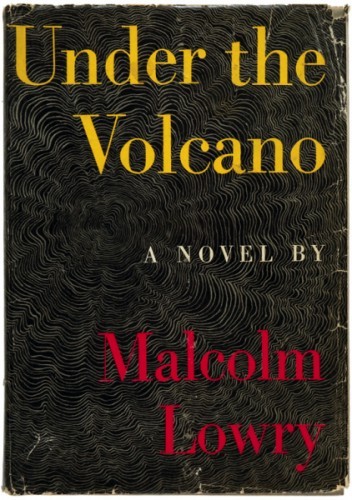
You will never find the above quote— so exacting in its prognosis of alienation—in any contemporary memoir. It belongs to literature, specifically Malcolm Lowry’s Under the Volcano, published in 1947, during a time when alcoholic and drug fiends—if they wanted to be published— transubstantiated their brutal experience into an exquisite poetry that demanded from the reader a severe attention if he or she decided to go along for the ride. For Lowry, an alcoholic who never beat his demons but exorcised them in this literary masterpiece, the devil doubled as the muse.

Under the Volcano is the story of Geoffrey Fermin, an ex-British consul drinking himself into oblivion in Quauhnahuac, Mexico. The story, like Joyce’s Ulysseus, comprises a single, eventful day, the Dia de Las Muertes, November 1st, 1938, a day that begins with his estranged wife, Yvonne, an American B-actress past her sell-by date, returning from California after a year’s estrangement. Along with the Consul’s half-brother, Hugh, they decide to travel to the nearby town of Parain. En route, they witness a crime that has later tragic repercussions.

The setting and time are important, related as they are to the major global event at the time, the Spanish Civil War, which, ideologically, had been a contest between anarchy and communism against fascism and, industrially, a testing ground for the weapons of mass destruction that would follow within a year, once Hitler’s Germany invaded Poland. The progressive ideas coming out of communism, particularly that of nationalization of resources, was a testy subject in Mexico, beset with its repressive Catholic heritage as well as its own Revolution’s legacy and the State’s very recent takeover of its oil reserves.

The best novels feature an interconnectedness between the greater world and the interior one and this complex relationship is evoked within the characters in different ways. Hugh, a failed commercial troubadour and utopian-minded drifter-dreamer, feels guilty that in spite of his convictions and the knowledge that the Spanish Republic’s defeat is a fait accompli, wonders if he has missed the one opportunity to do something honorable and meaningful in life. Of course, he disagrees with the Consul’s self-destructive apathy, yet he is not unaware of man’s survival instinct to let well enough alone what is not his battle to fight. This is eloquently expressed following the incident of the crime and his witnessing of the other passengers’ reaction: “Death they knew, better than the law, and their memories were long… in these old women it was as if, through the various tragedies of Mexican history, pity, the impulse to approach and terror, the impulse to escape, having replaced it, had finally been reconciled by prudence, the conviction it is better to stay where you are.”

The Consul, well aware of the benefits of isolationism, has his own contentions. His alcoholism is not a pleasure nor is it a form of escapism. It is a sickness, and the drinking is necessary for him to reach a physical and psychological equilibrium. The DTs strike whenever he attempts to empower himself any degree of free will over his disease. Just as bad is the sense of doom that pervades sobriety, liable to wipe out any sunshine or cheer. Sitting at a café, in view of a fair celebrating the holiday, the setting “had suddenly become transcendentally awful and tragic, distant, transmuted, as it were some final impression on the senses of what the earth was like, carried over into an obscure region of death, a gathering thunder of immedicable sorrow; the Consul needed a drink…”


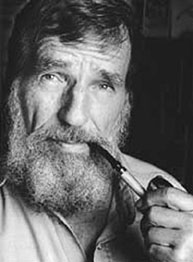
Malcolm Lowry

Mexico, which Lowry once wrote in a letter to friend was "the most Christ-awful place in the world in which to be in any form of distress, a sort of Moloch that feasts on suffering souls," is a grandiose theater from which this tragedy plays out: Mexico and its ruined palaces, Gothic churches, hideous ravines, pullulating flowers, clandestine scorpions, and canvas-like skies where "high overhead sailed white sculpturings of clouds, like billowing concepts in the brain of Michelangelo." There is also its tequila and its mescal, the sad-eyed drunks and the corrupt police. In the turning point of the novel, when the Consul, Yvonne and Hugh encounter a brutalized Indian lying injured on the side of the road, one of the other passengers not only pockets the man's money and pays his fare with it but shamelessly keeps the pelf on his lap conspicuously for all to view. Was it any wonder then, that Europe was rushing headlong and heedless into another great war and that for those who knew better, the human race would not be worth dying for?

But in the end this is a love story and it is the Consul's tumultuous relationship with Yvonne that is the real source of his despair. Yvonne, having come to rescue him from Mexico and its addictions, has agrarian dreams, one in which they withdraw from the world onto their own farm, in the country, a place where Geoffrey would be able to write (he is working on a book on Mayan ritual, the Kabbalah, and other occult matters) while she tends their living space, looking after him, being his friend, his housewife, his lover. It doesn't matter that she knows nothing of the day-to-day affairs of such an endeavor, for after all, it is but a dream and one that can be easily discredited by reality. Though they never discuss it outright, Geoffrey suspects it's on her mind and though he loves the novelty of such an enterprise, he believes more in futility than fruition. Early in their reunion, he hints at the hopelessness of her schemes, his query, “What’s the use of escaping from ourselves?” quickly forgotten. There was not even real regret that this inevitable failure was something to feel bad about: “the past was irrevocably past. And conscience had been given man to regret it only so far as that might change the future.”

That the Consul may be pessimistic about his predestined perdition doesn’t make the reader any less sympathetic to Yvonne’s cause—her imagining of the farm comes as a contrast to a brutal sporting event—since the marriage, in spite of its flaws and blemished disgrace seems worth saving, as these two people, for all their mistakes, need each other desperately. The novel's greatest substance comes from the construction of the small details communicated between a man and a woman with a long tragic history, beautifully evoked in Lowry’s prose: “…as he approached she turned this hand palm upward…like an unconscious gesture of appeal: it was more: it seemed to epitomize, suddenly, all the old supplication, the whole queer secret dumbshow of incommunicable tendernesses and loyalties and eternal hopes of their marriage.”

Yvonne is no innocent: her affair with M. Laurelle, a childhood friend of the Consul is what makes it so hard for them to reconcile. It is not clear whether his alcoholism was responsible for the affair or the affair responsible for the alcoholism. This chicken-or-the-egg argument has no bearing for Geoffrey and Yvonne in their current predicament. They are doomed lovers, a Romeo and Juliet denied any future union of consummation not due to external parties but from deep within themselves. Being responsible for so much unintentional pain upon the other, is it any surprise “how alike are the groans of love to those of the dying…?”

The Consul understood the inarticulateness of his debilitation and that though every drunk’s tragedy might be as mass-produced as the liquor he drank, his very real pain was personal in its broken-tongued head-spinning downfall, a sui generis descent into a forgettable void. People might help you, they might care for you, but in the end, you were on your own: “In the final analysis there was no one you could trust to drink with you to the bottom of the bowl.”

This may be true. But as an old barkeep consoles Geoffrey on his long day’s journey to the end, there can always be a sense of companionship among the lost nevertheless, for “I have no house only a shadow. But whenever you are in need of a shadow, my shadow is yours.”

Sunday, April 18, 2010

The Writing’s On the Wall

"I’m an artist. When you tell people that they usually say, what's your medium? I always say, 'Extra large.'"

-Jean Michel Basquiat

Nobody as far as I know has written about the cultural significance of walls and that may be too bad, for though their subject may be pedestrian at first glance, their prominence within history and art is undeniable. Jerusalem has a Wailing Wall where wishes are wedged into the stone by faithful worshippers. Israel has another wall built recently, used as a border to filter Palestinian people through security checkpoints in and out of Gaza and the West Bank. Berlin once had a wall utilized for similar reasons and Pink Floyd has a depressing album about one. China’s wall you can see from the moon and Jean-Paul Sartre’s most readable short story is called The Wall.

Walls have been with us ever since man has sought shelter from his environment. They have various necessary and symbolic functions, the most obvious of which is providing structural support for homes and business. While accommodating privacy they also separate us, shutting people away from each other. Walls are boundaries; they suggest limits, establishing private property, telling us where we can and cannot go. They can be white, padded, and locked if one is deemed insane. Should they be covered with squiggly marks done in aerosol paint, they jeopardize real estate values. Walls are intended to protect us yet too often in these terrifying times they are adorned with barbed wire, their symbolism taking a ghastly, violent poise. We forget this but walls are also potential canvases. Huge, inspiring, storytelling space.

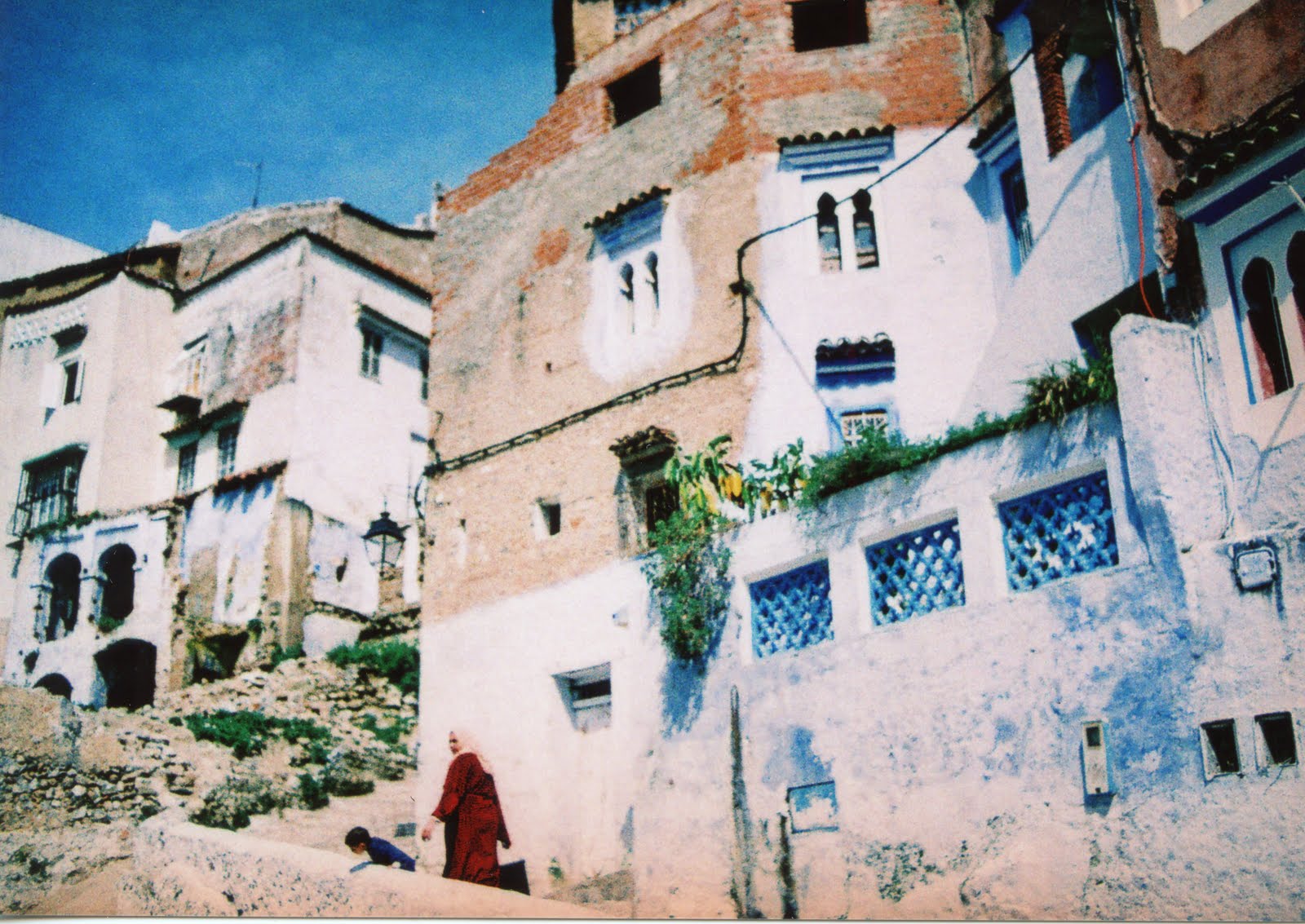
While the kingdom of Morocco may be famous for its deserts, bazaars, and couscous, it may be the vividness of color that strikes the visitor on a level that might be described as ecstatic. Psychologists have long pointed out the connection between mood and color and that melancholy can be a consequence of grayness. Throughout the large cities and small towns of Morocco, windows, gates, and doors are gilded with reds, pinks, and orange. Although it can feel slapdash and improvised, if not whimsical, the effect of urban color on the spirit is deliberate and powerful.

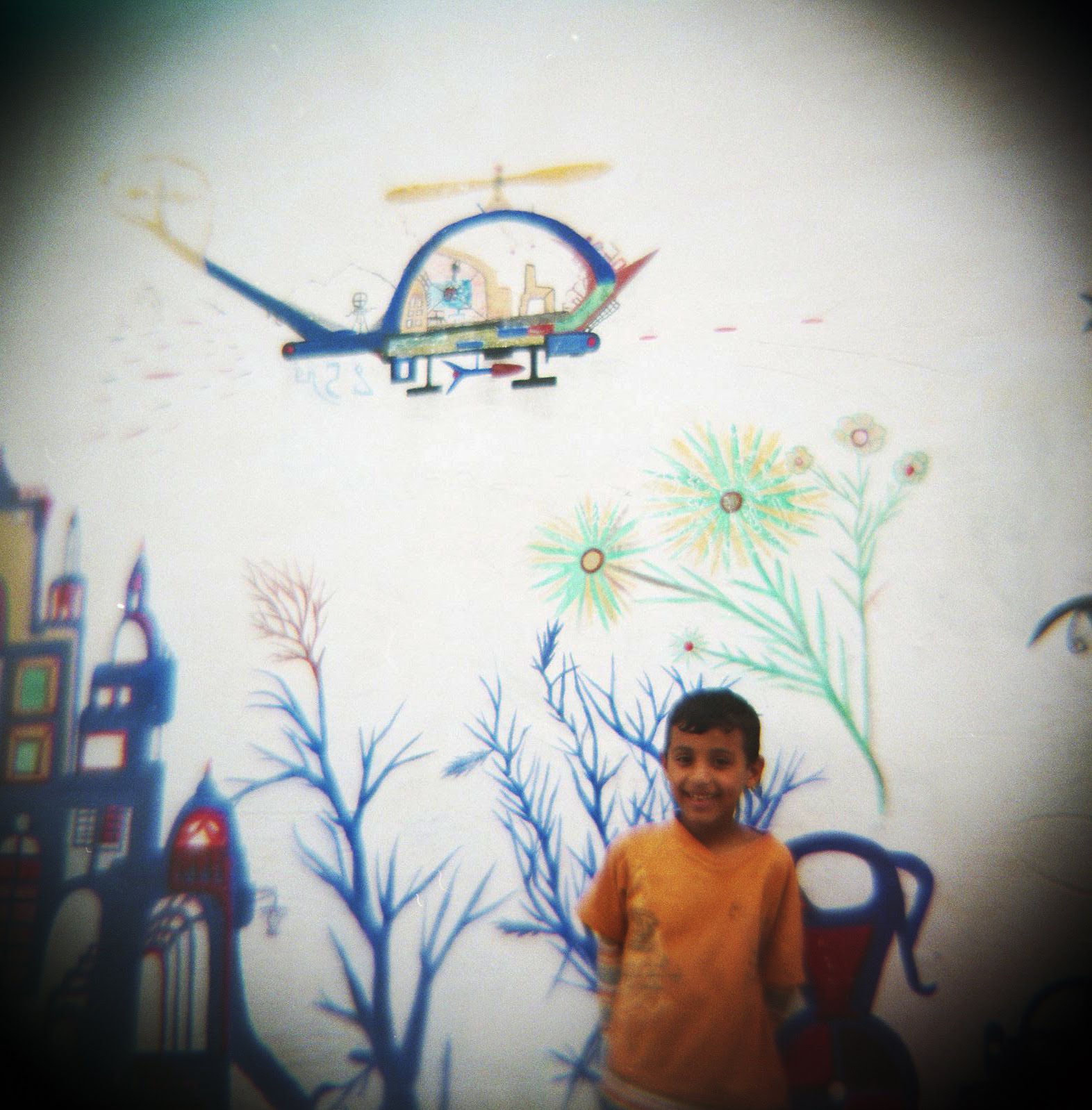
Asilah, a small Atlantic seaside town just south of Tangier, annually commissions international artists to create large, painted murals. Some are representational while others are abstract: visible are elements of cave paintings, cubism, and Cy Twombly. Like most inner-city medinas in Morocco, Asilah's central layout is a complex maze of plazas, streets, and alleys that takes some time to orient oneself. Throughout the medina these huge murals can be found, though the best ones are located by the main elementary school, which hopefully, is an inspiration to the passing children.

This is a wonderful thing. To keep art in museums-- as opposed to the streets-- is to suggest that art is 'historical,' and thus has little relevance to contemporary culture. Worse, secluding its appreciation to privileged circles within the museum complex, society withholds art's everyday effect from the ordinary citizen. To do this in Morocco, a country with double-digit unemployment would be spiteful and absurd. The streets of Moroccan towns are never silent. In cafes men smoke and talk. Women converge to gossip on doorways and park benches. Home for many is a cramped, dark place so it makes sense the street would be a viable contrast in brightness.

Chefchaouen is another city remarkable for its color. Most of the town center has been painted a rich knockout blue and has been since the 15th century. This bold use of a uniform color has a tremendous effect. It gives the city a visible personality. Moreover, it welcomes the visitor into its space effortlessly, so that old men in djellaba cloaks, children playing with water guns, cats lazy from the sun and you, yourself, have all become characters within this rich and beautiful canvas.

If one walks long enough (and in such surroundings one is inclined to walk all day), a person will eventually witness cracks in the walls, exposed brick and wood, childishly scrawled graffiti. Rather than imperfections, these marks seem to define character and age: not all dilapidation is bad just as not all shiny surfaces are beautiful. In fact, the flaws insinuate the aura of collaboration between time, nature and human creativity as on evidence is the work of the stonemason, the carpenter, the journeyman laborer, and the eleven-year-old boy.

As the world moves closer in globalized sameness it becomes imperative that we adopt a flair for color so appreciable within the towns of Asilah and Chefchaouen. Doing so would bring people out of their techno-cocoons and into the street for games, talk, and friendship. There is no excuse. After all, we have plenty of wall space to fill.

Friday, March 5, 2010

Burning Billboards and Other Literary Matters


Edward Abbey’s The Monkey Wrench Gang begins with “the aftermath” of the novel itself, the detonation of a bridge in the Four Corners Region of the American Southwest. Like an inspiration born of yippies or Al-Qaeda, the bridge is a high-profile target, sabotaged during a media event with officials glad-handing, local TV news crews videotaping, and the public witnessing: the bigger the spectacle, the larger the message, which is more or less, neo-Luddist.

It is generally a risky move to make literature overtly political (as opposed to presenting your polemics with subtlety, which is the greater trend; done right, nuance can be just as powerful). Fictional agitprop generally does not sell well with the public nor does it charm the midlist critics. Notable exceptions would be Harriet Beecher Stowe’s Uncle Tom’s Cabin and Upton Sinclair’s The Jungle, both of which went on to affect the public conscience on such vigorous levels that their narratives entered the national debate over slavery and food safety, respectively.

Abbey’s The Monkey Wrench Gang was published in 1975, a fascinating period in liberal dissent, in which some radicals had more or less abandoned sit-ins and peace marches in favor of violence. Members of The Weather Report and the Symbionese Liberation Army really did believe that terrorist acts against institutions that promote or profit off the industry of war and oppression were fair targets and through their destruction would come significant change. Putting down the love beads and picking up the Molotov cocktail, they were fearless, if not misguided individuals operating in a social climate that was moving comfortably towards The Hustle and cocaine on pleather love seats.

Abbey’s Monkey Wrench Gang is not a clan of hippies indoctrinated by the burgeoning Earth Day celebrations but are men of the earth who have soil in their fingernails and the wherewithal to live by their philosophy, that is that technology and industry are incompatible with the pristine beauty of nature. As Seldom Seen Smith, the polygamous, blonde, lanky, good-humored Mormon whose living, livelihood and life is the marvelous Colorado River, says:

"The river, the canyon, the desert world was always changing, from moment to moment, from miracle to miracle, within the firm reality of mother earth. River, rock, sun, blood, hunger, wings, joy-- this is the real... all the rest is androgynous theosophy. All the rest is transcendental transvestite transactional scientology or whatever the fad of the day, the vogue of the week."

Philosophically, he is right on with Doc Sarvis, a middle-aged surgeon with a pathological antipathy regarding highway billboards, of which he indulges in his pyrotechnic habits. Doc Sarvis views man’s fate through fiery-tinted apocalyptic goggles, the Devil’s Advocate in any conversation related to man’s inherent goodness:

"The wilderness once offered men a plausible way of life. Now it functions as a psychiatric refuge. Soon there will be no wilderness... then the madness becomes universal. And the universe will go mad."

Over a campfire of rations, whiskey, and beer, they discuss possible targets, Doc Sarvis working himself into a rage as he lists nature’s worst transgressors due a mean reckoning:

"And don't forget the billboards. And the strip mines. And the pipelines. And the new railroad from Black Mesa to Page. And the coal-burning power plants. And the copper smelters. And the uranium mines. And the nuclear power plants. And the computer centers. And the land and cattle companies. And the wildlife poisoners. And the people who throw beer cans along the highways."

Doc Sarvis’s secretary and chauffeur-cum-lover, Ms. Bonnie Abbzug, is a Bronx Jewish beauty who is the Patty Hearst of the gang, a city gal politicized by charismatic company and the delight of detonating bulldozers. As the men get carried away with their visions of sabotage, she reminds them that prudence would be key to survival. She’s the voice of the 1960s, bright, lovely, idealistic, meditative, and yet she can see the more clearly than the others:

"But they have everything. They have the organization and the control and the communications and the army and the police and the secret police. They have the big machines. They have the law and drugs and jails and courts and judges and prisons. They are so huge. We are so small."

Her philosophical rival within the group is George Washington Hayduke, a hairy, squat, muscular, vulgar Vietnam Vet with itchy trigger fingers and an incapacity to resist any kind of sabotage, as much for the fun factor as for the environmental statement itself. Though told in the third person, it’s clear that Hayduke is the story’s protagonist, if not Abbey’s altar ego, as he is the most offended by the pathetic turn in materialist America. Hayduke is a kind of rampaging Greenpeace Rambo whose end-all pastoral vision of America is compromised by his ingrained pessimism:

"When the cities are gone and all the ruckus has died away, when sunflowers push up through the concrete and asphalt of the forgotten interstate freeways, when the Kremlin and the Pentagon are turned into nursing homes for the generals, presidents and other such shitheads, when the glass aluminum skyscraper tombs of Phoenix Arizona barely show above the sand dunes, why then, why then, why then by God maybe free men and wild women on horses, free women and wild men, can roam the sagebrush canyonlands in freedom--goddammit!--herding the feral cattle into box canyons, and gorge on bloody meat and bleeding fucking internal organs and dance all night to the music of fiddles! banjoes! steel guitars! by the light of a reborn moon!-- by God, yes! Until... the next age of ice and iron comes down and the engineers and the farms and the general motherfuckers come back again."

Take or leave the politics, this is passionate prose, and the story flows with energy and humor. Progress of the narrative is simple and inevitable: after forming the Monkey Wrench Gang (also called the Wooden Shoe Conspiracy as the word sabotage is derived from the French sabot or ‘wooden shoe,’ as in “from damage done to machinery by sabots (Webster’s)), they progress from simple to complicated operations that lead to evermore close calls with the law, including some extraordinary chase sequences that would make great cinema (though it’s very unlikely corporate Hollywood would spend the big bucks financing such a piece). Throughout the Four Corners region, they have supplies cached for regrouping, survival, and the next act of mayhem. In case you were wondering, the typical inventory was such:

“The stores consisted of (1) food: tinned goods, dried meats, fruits, beans, powdered milk, sealed drinking water; (2) field equipment: medical kits, tarps and ponchos, fire starters, topographical maps, moleskin and Rip-Stop, sleeping bags, canteens, hunting and fishing equipment, cooking gear, rope, tape, nylon cord and (3) the basic ingredients: monkey wrenches, wrecking bars, heavy-duty wirecutters, bolt cutters, trenching tools, siphon hoses, sugars and syrups, oil and petrol, steel wedges, blasting caps, detonating cord, safety fuse, cap crimpers, fuse lighters and adequate quantities of Du Pont Straight and Du Pont Red Cross Extra."

If Abbey is political, he is also poetic and oftentimes funny. The Gang’s enemy, the representatives of industry are the kinds of people that "can hear a dollar bill drop on a shag rug." No institution is safe with Abbey, even cartoon characters suffer embarrassing acts of vandalism:

"Bonnie unbuttoned Smokey's fly, pictorially speaking, and painted onto his crotch a limp pet-cock with hairy but shriveled balls. To Smokey's homily on fire prevention Hayduke attached an asterisk and footnote: "Smokey the Bear is full of shit."

Mr. Abbey
Would you play with dynamite with this man?

In the copyrights page, Abbey declares that though the novel is “fictional in form,” it is “based strictly on historical fact.” Mischievously, he adds that “it all began just one year from today.” It seems then that his novel is a call to arms for all environmental warriors to take up wrenches against industry. As we all know, such a Neo-Luddite revolution never occurred but that is not to say it might happen yet with Abbey some smiling godfather angel poet.

Abbey, who had an FBI file going back to the 1940s, was a fringe thinker with a golden pen, but is not known to have engaged the system as his fictional characters had. But he was at the right place at the right time, as it’s hard to believe that he could get away with his politics in our contemporary and endless War on Terror. Finding an empathetic editor and courageous publishing house would have been extraordinarily tedious. When the character Hayduke speaks for Abbey, “Because freedom, not safety, is the highest good," he is contradicting the literature of our age, with its sanitized, whitewashed machinations. Had he lived long enough, maybe the author would have gone rogue in his eighties. Abbey was too aware of what was at stake to stand by idly. Best to let the bard enjoy the last word:

"That ultimate world... the final world of meat, blood, fire, water, rock, wood, sun, wind, sky, night, cold, dawn, warmth, life. Those short, blunt and irreducible words which stand for almost everything he thinks he has lost. Or never really had..."

Wednesday, March 3, 2010

The Journey Upriver Nilewise

In the 18th and 19th centuries, so little was known of the Nile and its source that one of the most trusted authorities continued to be Herodotus, the great Greek historian, whose writings on the subject were more than 2,300 years old. Maps of the African interior were topographically blank, leaving one to conjecture that the Dark Continent was one vast void where one descended into Hades, which it might as well have been, as leaving the coast one would have to contend with malarial fever, savage tribes, and wild beasts. Only the most ingenious and intrepid explorers could hope to survive such expeditions. A contemporary history of its survey, Alan Moorehead’s excellent The Blue Nile, is not so much about the travails of these curious eccentrics as it is about the engagement of major military expeditions into Egypt, the Sudan and Ethiopia, in which scientific learning was not always as valuable as the procurement of gold, ivory, and slaves.

Moorehead’s history begins with James Bruce, a Scottish aristocrat-turned-adventurer, who convinced that the Nile’s source was in Lake Tana in the Ethiopian Highlands, sets out to prove his claim. Bruce’s résumé was not atypical of the age’s explorer, for “he studied Arabic manuscripts in the Escorial in Spain, he sailed down the Rhine, he fought a duel in Brussels, he made drawings of ruins in Italy,” and eventually he was posted as a British consul in Algiers among the Barbary pirates. Having accumulated experience and confidence among ruffians and scoundrels, he attempts crossing into Ethiopia via the Red Sea Route with his secretary, Luigi Balugani, successfully entering the kingdom of Gondar, where with a great demonstration of élan, he makes courteous acquaintance with the royalty there. Disgusted by the behavior of the court, where raw meat was devoured and licentiousness carried out in the open (“…and if we may judge by sound, they seem to think it as great a shame to make love in silence as to eat.”), Bruce nevertheless managed to mark what he believed to be the source of the Nile at Ghish Mountain. Bruce’s ecstatic reaction deserves to be quoted in full:

“Faithful squire! Come and triumph with your Don Quixote, at that island of Barataria where we have most wisely and fortunately brought ourselves! Come, and triumph with me over all the kings of the earth, all their armies, all their philosophers, and all their heroes!”

Unfortunately for Bruce, he had not been the first European at this spot, some missionaries having passed this way before. Moreover, this was not even the true source of the Nile, which lay 1,000 miles away at Lake Victoria (coming down via Khartoum in the Sudan and witnessing the appearance of the White Nile where the two rivers join had to have been heartbreaking for the explorer). Bruce’s journey back to civilization took some years and when he finally published his findings, he was ridiculed on-end for his anthropological observations. So much so that a new edition of Baron Munchhausen was dedicated to James Bruce. In spite of the bad press, Bruce’s geographical findings were more or less accurate and would make an enormous contribution to the coming military campaigns, beginning with Napoleon in 1798.


Napoleon, only 28 at the time, and coming off a string of successes in Italy where he had made his name humbling the Hapsburg empire, believed that if he could cut a route through the Suez isthmus, he would give France immediate access to the Red Sea, thus creating a short cut to India, the crown jewel of the British colonies (the British at this time were committed to the Cape of Good Hope as passage). As a learned man, Napoleon’s interest was not restricted to conquest but to the arts and sciences as well, and could count on this military expedition a staff of engineers, geologists, mathematicians, chemists, zoologists, astronomers, geographers, mineralogists, archaeologists, arabists, poets, and painters.

Bonaparte, intent on winning the loyalty of the Egyptian fellaheen then under the autocratic thumb of the Mameluke caste (paying nominal tribute to the Ottoman Empire and who at this stage had succumbed to decadent decline), gave strict orders to his soldiers that mosques and Muslim priests were to be regarded as sacrosanct and that women and private property were to be respected.

Not dissimilar to the more famous janissaries of the Ottoman court, the Mamelukes were purchased children from the Caucuses who were taught Islam and the arts of war. They ruled Egypt with a fierce militaristic ethic, hoarding the resources and wealth so they could live in opulence. The indigenous Egyptians and various minorities endured their rule the best they could, via passive aggressive resistance, avoiding any civic commitment whatsoever. It was a comfortable arrangement, centuries in the making. Napoleon’s calls for equality, fraternity, and liberty would later prove baffling to a people more familiar with the strong arm.

Bonaparte managed to evade Admiral Nelson’s frigates in the Mediterranean, successfully landing near Alexandria and easily taking the city, commenced his divisions on the long march across the desert to Cairo. After three days they reached the Nile. Upon arrival, the soldiers suffering from the appalling summer heat in their blue serge uniforms threw themselves into the river without bothering to remove their clothes. On the far side of the bank waited the Mameluke army, led by a hothead named Murad, oblivious to the anachronisms of his military strategy.

A turning point in history, now, east meeting west upon a battlefield dormant for centuries. The Mamelukes were certainly brave horsemen, but in spite of the best efforts of their headlong cavalry charges, they were easily slaughtered by rifle-fire and cannonballs. Technology, rather than courage, had decided the outcome. More a massacre than an actual battle, the shootout was a harbinger of 19th century colonial warfare.

A Mameluke charge painted by Goya

From there it was easy progress for Napoleon and his forces to take Cairo and thus, Egypt. In the spirit of his enthusiasm, he pronounced that though he was a Catholic in France, he would be a Mohammedan in Egypt. Dressing like a robed pasha and eating with his fingers, he hosted dinner parties for the imams and those warriors acquiescing to French rule, the attendees of various banquets receiving both the Koran and Thomas Paine’s The Rights of Man translated into the vernacular Arabic.


The romance of oriental conquest for this latter-day Caesar did not last long. Nelson’s frigates sank the French fleet at Alexandria, stranding Napoleon and his forces in Egypt. If worrying over his annihilated navy wasn’t enough, the fellaheen rebellion against the French efficiency for collecting taxes consequenced in violent crackdowns. Equality? Fraternity? Liberty? So they said but what they had really created was a bureaucracy enforced by military law. Napoleon began having trouble with his own troops, grown fractious from the tedium of a conservative desert society and Napoleon’s request to the Directory in Paris for replenishments reads like a sumptuous bachelor’s party: “a company of comedians, a troupe of ballet dancers, a marionette show, a hundred prostitutes, two hundred thousand pints of brandy and a million of wine.”

Marooned as they were, Napoleon assigned his best lieutenant, General Desaix, to finish the last of the Mamelukes, now led by Murad and committed to a kind of guerilla warfare down the Nile River Valley. Accompanying this expedition was Vivant Denon, an all-around aesthete and archaeologist. Moorehead, always astute on gathering the more profound observations, artfully chooses to follow Denon on this journey even with regards to battle (the artiste described the skirmishes as a clash of “northern austerity with eastern pomp: iron seemed to be trying its strength with gold; the plain glittered, the spectacle was admirable.”)

Let’s pretend we are sailing the Nile towards Upper Egypt with Denon and the French forces. Suffering attacks from both the Mamelukes and Bedouin scavengers, it was hardly the idyllic trip it is today but then again it must have been stunning for a man of Denon’s learning to be visiting these ancient, revered, mythical monuments at Luxor, Philae, Karnak, and Dendera, awestruck among the first Westerns seeing these fantastic but crumbling temples, tombs, and obelisks for the first time in a thousand years. What might it have suggested to a Frenchman whose own nation and thus civilization was reaching its own apex? Denon was spellbound and much harried trying to record what he saw in drawings, often dodging spears and arrows, assailed by troglodytes squatting in the mausoleums (“this was a war with gnomes.”). General Desaix was able to pacify the region but the French lasted just three years in Egypt. Nevertheless, Egypt was no longer a forgotten land but a very strategic piece of real estate in geopolitical wrangling.

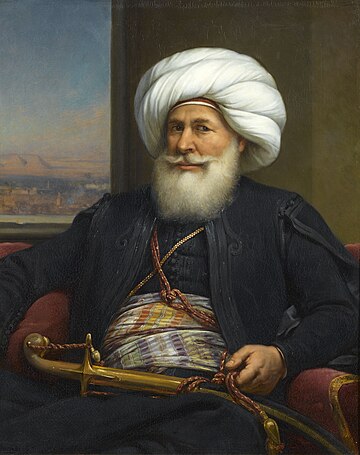
In the power vacuum of their hasty departure, emerged the original Muhammad Ali, a Turk from humble origins whose chief tools were cunning, sadism, and a force of cutthroat Albanian bodyguards. Unlike the Mamelukes, he desired to modernize Egypt as well as to utilize Western technology to mine whatever materials were available, particularly gold. The third section of The Blue Nile deals with his brutal reign and the various explorers, adventurers, and tourists now coming down to visit the ruins.

Muhammad Ali

What Ali wanted for his court was slaves and gold and sent a military expedition towards the Sudan to claim it. In 1820 when the invasion commenced, the Sudan was as backwater as any place on earth: “nothing was built, every activity was delayed, and the villages turned listlessly in upon themselves…” This was pagan Africa, a frontier between the Islamic desert of Egypt and Christian highlands of Ethiopia. If there was a power in the region it was the Shaiqiya, a Muslim cavalry caste of adroit warriors similar to the Mamelukes in both horsemanship and passé fighting tactics. The battle, though hopeless, deserves to be described for all its raucous pomp:

“A young girl mounted on a gorgeously caparisoned camel, gave the Shaiqiya the signal to attack—that warbling cry, lilli-lilli-loo— and a horde of unarmed peasants came running down on the Turks in a cloud of dust. They had been assured by a religious fanatic that bullets could not kill true believers…behind came the Shaiqiya cavalry, accompanied by a roll of drums and uttering their sardonic war-cry Salaam Aleikoum as they charged… the Turks took to their guns and pistols.”

After the battle, ears were collected from the living and the dead, as Ali had offered a small bounty for them.

As horrible as the campaign would prove to be it made the Nile safer and some Europeans decided to include the Nile experience in the Grand Tour. Those who visited published, and those who read were entertained to tales of temples, animals, savages, concubines, and treasure buried in the sand. That a “sophisticated past was overwhelmed by the primitive present” illuminated the adventure in a profound context. But great care had to be spent on the undertaking as this fascinating inventory of the big game hunter-turned-explorer Samuel Baker testifies: “a large umbrella with a double lining, a quart syringe for injecting brine into meat, sticks of Indian ink that can be ‘rubbed up in a few moments to write up the notebook during the march’, tinted writing paper, burning glasses and flint and steel, quicksilver and lead for making bullets.”

The final section of The Blue Nile deals with the mad Emperor Theodore of Ethiopia who puts several British envoys and missionaries in chains upon deciding that the Empire is conspiring against him. By now it is 1867 and John Speke has confirmed that Lake Victoria is the source of the Nile and in Egypt construction of the Suez Canal is underway. Rescuing several dozen Europeans was not a priority with England when it was very much involved in so many global affairs, but in order to save face, they sent a major expedition to rescue the hostages. The situation was indeed delicate as Theodore had a habit of having prisoners thrust off a precipice.

The arrival of the British in Africa was indeed the culmination of the taming of the Blue Nile. It marked the arrival of major technology in the region as the British employed a remarkable exercise in logistics (the commander, General Napier, had begun his career as an engineer). Napier had to move 32,000 men (only 13,000 of whom were soldiers, 9000 of them Hindus, Muslims, and Sikhs conscripted from India, Persia and Egypt) as well as 55,000 animals from the coast at Zuba to Magdala in the mountains, where the prisoners were being kept. To make it happen, a port with pier and tramway was constructed. A railway with locomotive came next and inevitably a native bazaar. In the march itself, engineers composed the vanguard, ensuring that the crossing would be safe for the forty-four trained elephants sent from India to carry the heavy guns. Even the banks in Vienna were solicited, as the only European currency accepted in the region was that of the Maria Theresa dollar, the one minted in 1780 showing a “profusion of bust.” Because the expedition was so religiously diverse, great sensitivity was taken in culinary matters so that 50,000 tons each of salt and pork were inventoried (as well as 30,000 gallons of rum). Discipline was strict regarding propriety: “No swarthy damsel was subjected to any rude gallantry on the part of the redcoats.” Such the 19th century globalization column appeared:

“The cavalry came first, the troopers dressed in crimson caps and green uniforms, and the officers with silver helmets on their heads. Among the infantry that followed on, many of the white men in the Irish regiment wore beards, their cheeks burned a deep brown by the Indian sun, and the native soldiers, the Beloochees, marched along in green tunics with red facings and with large green turbans wound round their fezzes.”


The British in Ethiopia

This is a story in logistics rather than in war and the battle was somewhat anticlimactic, if a little tragic as will happen when technology is so mismatched. Suffice it to say, the Battle at Magdala ended Ethiopia’s isolation forever and would be now engaged in contemporary politics and its characteristic swindling. The history of Africa is a brief one as far as written records go and reads like an awakening. It is rude, but it is also at times comic and poetic. That might be Moorehead's strength as a historian: he tells a good story, one so vivid and anecdotal, it inspires readers into engaging flights of fantasy that make Africa, in spite of all the detailed hardships, worth the while so that the reader not only commiserates with the British wayfarer wandering under an assumed name such as Sheikh Ibrahim ibn Abdullah (as the explorer, Burckhardt, does), he wants to be him too, warts and all, sailing up the Nile, notebook hidden within one's jellaba.

In spite of the inevitability of history detailed in this book, when technology competes with superstition, more often than not it fails. This is generally true in Africa at least. The efficiency of machines just cannot compete with the wonders of the mystical. Beyond Aswan and the cataracts that make journeying by boat difficult, life on the Nile has yet to be revolutionized by the digital byte or even a Big Mac bite. Part of it is politics and violence, part of it is the brutality of the climate and part of it is that some people hold fast in their ways. Thus traveling in some regions in the Sudan and Ethiopia remain nearly as exotic today as they were two hundred years ago. And anyone going there today is considered as much an adventurer as they were in Victorian times. The risk lingers. As does the sense of drama.

Sunday, February 7, 2010

The Spirit of '76

The most humanistic pronouncement in the history of political tracts, that which asserts "life, liberty, and the pursuit of happiness" are among man's "certain inalienable rights," is the utopian secular American signature written into our Declaration of Independence. That was the spirit of '76 and a quality of political imagination that has been difficult to live up to ever since. Certainly, Thomas Jefferson's ebullient claims taken at face value are abstract but in the proper contexts they can be defined with certain qualifications. For example, the right to "life" would be the right to proper, affordable health care. "Liberty" would entail a transparent government, the closure of illegal detention centers, proper civilian trials and habeas corpus. The pursuit of happiness is the fuzziest of the three, yet so-called modern day patriots would probably equate it with mass consumption. But if the revolutionaries of 1776 knew their strenuous efforts were undergone so that their descendants could laze around sofas tweeting, facebooking, shopping, and eating "freedom fries," would they have risked their fortunes fighting the formidable British empire? Or might they have stayed home to tend their farms, lamenting that the American Dream in a philosophical sense would always be just that, a dream?

David McCullough's history of George Washington's Continental army in the very grim fighting year of 1776 isn't asking those questions. As an establishment historian, a winner of two Pulitzers, McCullough is strictly concerned with the facts, drawing so generously from a prodigious survey of primary sources it's easy to forget that he's even there. 1776 is a focused work meaning that 1775's Battle of Bunker Hill is mentioned in passing and the battles of Lexington and Concord not at all. Nor are Valley Forge, the Maquis de Lafayette, and Yorktown discussed. As any sixth grader who passed his civics test will tell you, 1776 is the year the Continental Congress signed the Declaration of Independence in Philadelphia, but even that monumental convergence of great philosophical minds merits just one paragraph. This book is about one man, George Washington, and his ragtag army.

As a fighting force it was a pretty pathetic sight, the Continental Army. Consider, in his own words, Washington's dire assessment of his underpaid, underfed, undertrained motley ranks:

"Men just dragged from the tender scenes of domestic life-- unaccustomed to the din of arms- totally unacquainted with every kind of military skill, which being followed by a want of confidence in themselves when opposed to troops regularly trained, disciplined, and appointed, superior in knowledge and superior in arms, makes them timid and ready to fly from their own shadows."

Your Average Soldier in Washington's Continental Army

1776 is divided into three parts: the siege of Boston, the battles of New York, and Washington's retreat through New Jersey, into eastern Pennsylvania. McCullough portrays the strategies of the British as well as the American forces in order to create a thorough narrative of the events in the early stage of the war (though to British high command, the word, 'war,' was never used as that would legitimize the conflict as one between sovereign states; 'rebellion' being the preferred epithet.) The British did not want to fight and would have been happy with a capitulation returning things more or less to the prior status quo. In fact, throughout the contest, the British eagerly proffered the olive branch, going so far as to publish a Proclamation granting amnesty to all revolutionaries conditional on their signing of a loyalty oath. That was refused by the rebels, even when it appeared the destruction of the Continental Army and therefore the American military seemed all but certain.

As many Americans would be today, many civilians at the time were perturbed by the revolution, more concerned with commerce than politics. Those so-called "Loyalists" were not necessarily monarchists, but just ordinary people at odds with a sweeping movement, more concerned with property and the safety of their family. Hoping to expedite the end of the war, many of them gave intelligence to the British, jeopardizing secret missions and troop deployments. Had Vegas odds been around in '76 only fools would have wagered on the rebels. Although in Massachusetts the Americans defeated the British in the challenge to command Dorchester Heights (instigating a humiliating Redcoat retreat), the situation went sour in New York, a city that was viewed by both sides as the key to the Hudson River and thus should it be taken by the British they would be able to split the rebels geographically, isolating New England, disrupting communication and supply lines. The Americans spent the spring of that year fortifying south Manhattan and Brooklyn against a formidable British siege: at one point one hundred frigates docked around Staten Island forming the largest Armada ever seen on the continent. But after the Americans lost The Battle of Brooklyn (it's interesting to place the fighting in a modern city context), Washington and his soldiers had to abandon Manhattan, the fortifications, and of course control of the Hudson River. It didn't do well for troop morale. Soldiers deserted in droves often taking their muskets home with them as souvenirs. Many of them, shoeless and hungry, deserted to the enemy.

Leading them in their flight was George Washington, a by-his-bootstraps surveyor-turned-wealthy planter with virtually no military experience prior to the war. What comes across from McCullough's exhaustive research is a plainspoken man of common sense, who was a small town fellow in over his head and knew it:

"Could I have foreseen the difficulties which have come upon us, could I have known that such a backwardness would have been discovered in the old soldiers to the service, all the generals upon earth should not have convinced me of the propriety of delaying an attack upon Boston till this time."

If Washington could have "justified the measure to posterity, and my own conscience," he would have, "retired to the back country, and lived in a wigwam." But that's why he's celebrated today as one of the Great American Heroes, because he believed in the Cause so fervently, that he was willing to risk his livelihood, and being a self-made man also had much to lose. Today he is revered as a national godhead but in the early stages of war, he lacked decisiveness and good judgment. Had the British known just how dire his situation was and had pursued the Americans beyond New Jersey and into Pennsylvania, it is likely the revolution would have failed and Washington would have disappeared into history books as a footnote. Perhaps, our journey to autonomy would have progressed like Canada's, evolving into dominion status, a bloodless passage towards sovereignty.

Crossing the Delaware

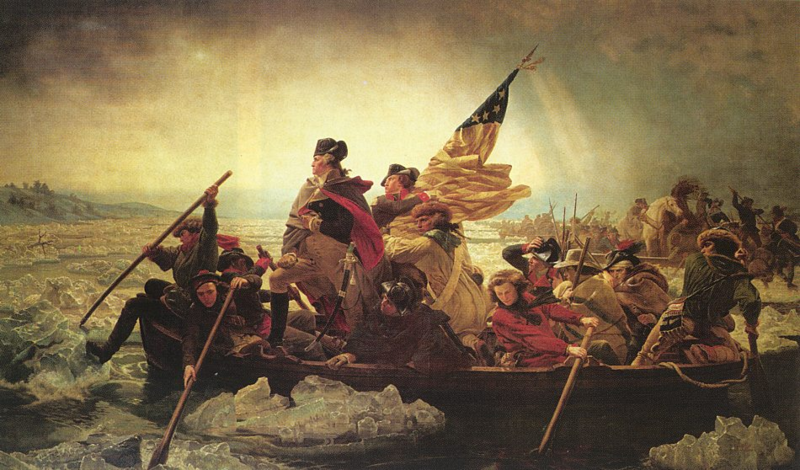
But Washington put on a good fight, which of course being primarily a military history, composes the climax of 1776. Famously on Christmas night, General Washington and his forces crossed the icy floes of the Delaware River in order to ambush the mercenary Hessian soldiers quartered in Trenton, New Jersey. The Hessians, perhaps drunk with holiday spirits, were properly surprised and routed. As far as battles go, it was hardly decisive in what would become an eight-year struggle. But McCullough treats it as a turning point in the war, a desperately needed morale injection as well as confirmation of Washington's leadership skills.

What makes 1776 a good read is the harrowing portrayal of how just how close Americans were to being vanquished. Then, just as now, to speak out and especially act against an unpopular government required tremendous courage. Had the rebels been forced to surrender under British terms they might have been executed or at the least had their livelihood ruined. They risked their lives because they seemed to really believe in what was at the time a newfangled concept of civil liberty, those certain unalienable rights. Without faith in these ambitions-- life, liberty, and the pursuit of happiness-- the revolution would have likely failed.

Brave Men Putting Their Names to Independence

Today should we be asking the same questions as our Founding Fathers regarding the legitimacy of government? Does Congress and the President really intend to guarantee the rights of all citizens and if it does not, what is to be done? If you want to go back to that same prized parchment penned by Mr. Jefferson, he suggests something overlooked and ignored by the establishment hypocrites and power brokers today, that is:

"That to secure these rights, governments are instituted among men, deriving their just powers from the consent of the governed. That whenever any form of government becomes destructive of the these ends, it is the right of the people to alter or abolish it, and to institute new government, laying its foundation on such principles and organizing its powers in such form as to them shall seem most likely to effect their safety and happiness."

It's something we should all think about come every 4th of July after the hot dogs and beer and pleasure seeking. Freedom is more than picking through the supermarket, the television, or the information superhighway, and its intrinsic value is revealed to us when we witness demonstrations in other countries, as seen most recently in Burma and Iran. What happened in 1776 was a movement, a collection of passionate philosophers who contemplated a better reality. This process, without proper liberal reform and better guarantees for the burgeoning poor and jobless, is likely to repeat itself once a crisis brings us to a breaking point.

The revolutionaries shocked the world. It happens from time to time. Let's just hope that when it happens again, it doesn't take eight years of war to recognize that a new humanitarian approach is the better way.